Get Fabric or SQL Certified for Free.
Get certified for free when you join Fabric Data Days 2026 and dive into Fabric, Power BI, SQL, AI, and other essential data skills.
Join now- Power BI forums
- Get Help with Power BI
- Desktop
- Service
- Report Server
- Power Query
- Mobile Apps
- Developer
- DAX Commands and Tips
- Custom Visuals Development Discussion
- Health and Life Sciences
- Power BI Spanish forums
- Translated Spanish Desktop
- Training and Consulting
- Instructor Led Training
- Dashboard in a Day for Women, by Women
- Galleries
- Data Stories Gallery
- Themes Gallery
- Contests Gallery
- QuickViz Gallery
- Quick Measures Gallery
- Visual Calculations Gallery
- Fabric Apps Gallery
- Notebook Gallery
- Translytical Task Flow Gallery
- TMDL Gallery
- R Script Showcase
- Webinars and Video Gallery
- Ideas
- Custom Visuals Ideas (read-only)
- Issues
- Issues
- Events
- Upcoming Events
July 28 - August 9 | Final Round of the Power BI Dataviz World Championships. This is your chance. Learn more
- Power BI forums
- Forums
- Get Help with Power BI
- Desktop
- Re: Creating a Counter Column
- Subscribe to RSS Feed
- Mark Topic as New
- Mark Topic as Read
- Float this Topic for Current User
- Bookmark
- Subscribe
- Printer Friendly Page


- Mark as New
- Bookmark
- Subscribe
- Mute
- Subscribe to RSS Feed
- Permalink
- Report Inappropriate Content
Creating a Counter Column
Hello,
I want to create new column that acts as a Counter for col1, col2, col3. It will count the number of "Yes" values in each row, starting from col1 to col3 values.
Sample Table:
Name | col1 | col2 | col3
James | Yes | | Yes
Alex | No | No | Yes
John | Yes | Yes | Yes
George | No | Yes |
Desired Column:
Name | col1 | col2 | col3 | Counter
James | Yes | | Yes | 2
Alex | No | No | Yes | 1
John | Yes | Yes | Yes | 3
George | No | Yes | | 1
Thank you and most appreciated.
Solved! Go to Solution.


- Mark as New
- Bookmark
- Subscribe
- Mute
- Subscribe to RSS Feed
- Permalink
- Report Inappropriate Content
@aa_KF -
More of an exercise in trying new things (for me):
I took your sample and unpivoted your [col1],[col2], and [col3] in the Query Editor.
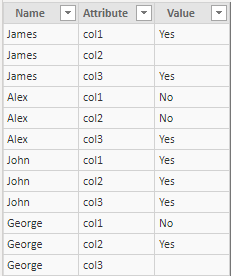
Create a [CountYes] measure as:
CountYes =
CALCULATE(
    COUNTROWS(Table1),
    Table1[Value] = "Yes"
)
Then I used https://www.sqlbi.com/articles/using-concatenatex-in-measures/ as an example/template to create a [Counter Measure] as:
Counter Measure =
VAR TotalYes = [CountYes]
VAR NameYes =
    ADDCOLUMNS (
        VALUES ( Table1[Name] ),
        "Yes's", [CountYes]
    )
RETURN
    IF (
        ISFILTERED ( Table1[Name] ),
        IF (
            TotalYes > 0,
            CONCATENATEX (
                SELECTCOLUMNS (
                    TOPN (
                        1,
                        NameYes,
                        [Name]
                    ),
                    "Result", [Yes's]
                ),
                [Result]
            )
        ),
        FORMAT([CountYes],"0")
    )
Producting a Matrix visual as:
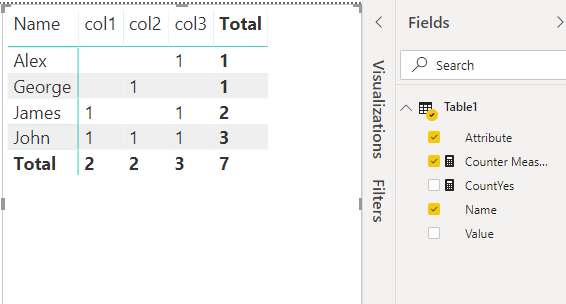
Thank you for the inspiration to try new things!
Did I answer your question? Mark my post as a solution!
Did my answers help arrive at a solution? Give it a kudos by clicking the Thumbs Up!
Proud to be a Super User!


- Mark as New
- Bookmark
- Subscribe
- Mute
- Subscribe to RSS Feed
- Permalink
- Report Inappropriate Content
Hi @aa_KF ,
Please check the following steps as below.
1, Unpivot the table in power query as below.
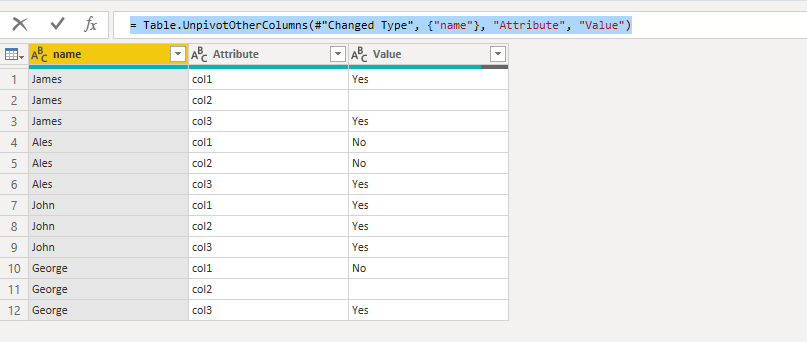
let
    Source = Table.FromRows(Json.Document(Binary.Decompress(Binary.FromText("i45W8krMTS1W0lGKBJNQRqxOtJJjDljELx9GwCS88jPy4BoQJEjKPTW/KD0VpgEmEQsA", BinaryEncoding.Base64), Compression.Deflate)), let _t = ((type text) meta [Serialized.Text = true]) in type table [name = _t, col1 = _t, col2 = _t, col3 = _t]),
    #"Changed Type" = Table.TransformColumnTypes(Source,{{"name", type text}, {"col1", type text}, {"col2", type text}, {"col3", type text}}),
    #"Unpivoted Other Columns" = Table.UnpivotOtherColumns(#"Changed Type", {"name"}, "Attribute", "Value")
in
    #"Unpivoted Other Columns"
2. Create a measure based on the new table.
Measure =
IF (
    ISFILTERED ( 'Table'[Attribute] ),
    MAX ( 'Table'[Value] ),
    CALCULATE ( COUNTROWS ( 'Table' ), FILTER ( 'Table', 'Table'[Value] = "Yes" ) )
)
3. Then we can get the result by creating a matrix.
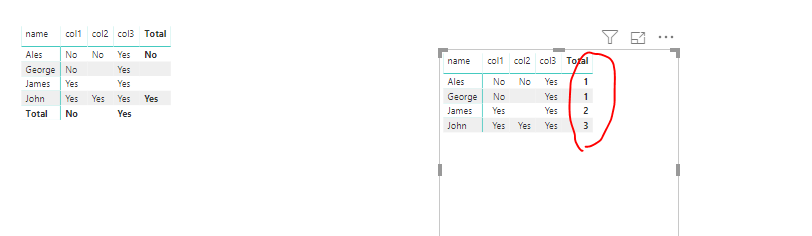
If this post helps, then please consider Accept it as the solution to help the others find it more quickly.
- Mark as New
- Bookmark
- Subscribe
- Mute
- Subscribe to RSS Feed
- Permalink
- Report Inappropriate Content
@jdbuchanan71 @mussaenda @ChrisMendoza @v-frfei-msft Thank you a lot all!! I really appreicate it.
I'm going to try them all.
Thank you again!
- Mark as New
- Bookmark
- Subscribe
- Mute
- Subscribe to RSS Feed
- Permalink
- Report Inappropriate Content
Hi @aa_KF ,
Please check the following steps as below.
1, Unpivot the table in power query as below.
let
    Source = Table.FromRows(Json.Document(Binary.Decompress(Binary.FromText("i45W8krMTS1W0lGKBJNQRqxOtJJjDljELx9GwCS88jPy4BoQJEjKPTW/KD0VpgEmEQsA", BinaryEncoding.Base64), Compression.Deflate)), let _t = ((type text) meta [Serialized.Text = true]) in type table [name = _t, col1 = _t, col2 = _t, col3 = _t]),
    #"Changed Type" = Table.TransformColumnTypes(Source,{{"name", type text}, {"col1", type text}, {"col2", type text}, {"col3", type text}}),
    #"Unpivoted Other Columns" = Table.UnpivotOtherColumns(#"Changed Type", {"name"}, "Attribute", "Value")
in
    #"Unpivoted Other Columns"
2. Create a measure based on the new table.
Measure =
IF (
    ISFILTERED ( 'Table'[Attribute] ),
    MAX ( 'Table'[Value] ),
    CALCULATE ( COUNTROWS ( 'Table' ), FILTER ( 'Table', 'Table'[Value] = "Yes" ) )
)
3. Then we can get the result by creating a matrix.
If this post helps, then please consider Accept it as the solution to help the others find it more quickly.
- Mark as New
- Bookmark
- Subscribe
- Mute
- Subscribe to RSS Feed
- Permalink
- Report Inappropriate Content
@aa_KF -
More of an exercise in trying new things (for me):
I took your sample and unpivoted your [col1],[col2], and [col3] in the Query Editor.
Create a [CountYes] measure as:
CountYes =
CALCULATE(
    COUNTROWS(Table1),
    Table1[Value] = "Yes"
)
Then I used https://www.sqlbi.com/articles/using-concatenatex-in-measures/ as an example/template to create a [Counter Measure] as:
Counter Measure =
VAR TotalYes = [CountYes]
VAR NameYes =
    ADDCOLUMNS (
        VALUES ( Table1[Name] ),
        "Yes's", [CountYes]
    )
RETURN
    IF (
        ISFILTERED ( Table1[Name] ),
        IF (
            TotalYes > 0,
            CONCATENATEX (
                SELECTCOLUMNS (
                    TOPN (
                        1,
                        NameYes,
                        [Name]
                    ),
                    "Result", [Yes's]
                ),
                [Result]
            )
        ),
        FORMAT([CountYes],"0")
    )
Producting a Matrix visual as:
Thank you for the inspiration to try new things!
Did I answer your question? Mark my post as a solution!
Did my answers help arrive at a solution? Give it a kudos by clicking the Thumbs Up!
Proud to be a Super User!


- Mark as New
- Bookmark
- Subscribe
- Mute
- Subscribe to RSS Feed
- Permalink
- Report Inappropriate Content
Counter = (CONTAINSSTRINGEXACT(Table1[col1],"Yes")) + (CONTAINSSTRINGEXACT(Table1[col2],"Yes")) + (CONTAINSSTRINGEXACT(Table1[col3],"Yes"))
I don't know if this is right but it works


- Mark as New
- Bookmark
- Subscribe
- Mute
- Subscribe to RSS Feed
- Permalink
- Report Inappropriate Content
Try this
Counter = IF (Table1[Col1] = "yes",1,0) + IF (Table1[Col2] = "yes",1,0) + IF (Table1[Col3] = "yes",1,0)

Helpful resources

Fabric Community Sticker Challenge - Barcelona 2026
If you love stickers, then you will definitely want to check out our community sticker challenge, Barcelona edition!

Power BI Monthly Update - July 2026
Check out the July 2026 Power BI update to learn about new features.

Power BI DataViz World Championships - June 2026
A new Power BI DataViz World Championship is coming this June! Don't miss out on submitting your entry.

| User | Count |
|---|---|
| 28 | |
| 28 | |
| 19 | |
| 19 | |
| 19 |


| User | Count |
|---|---|
| 37 | |
| 29 | |
| 18 | |
| 17 | |
| 15 |


