Get certified for free when you join Fabric Data Days 2026 and dive into Fabric, Power BI, SQL, AI, and other essential data skills.
Join nowJuly 7 - July 17 | Round 2 of the Power BI Dataviz World Championships. Don't miss your chance! Learn more
I'm trying to create a matrix table to work with in my report e.a. in my charts.
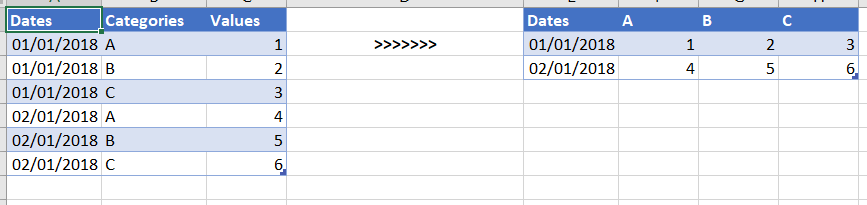
See below's example. On the left my current table and on the right the result I want. I've tried a few things in the query editor and using DAX. However, I did not get the result I want. I know I can create such a table easely in my report but then I cannot use is in other visuals.
The categories are dynamic so I cannot hard code these columns names.
Can someone help me out?
Solved! Go to Solution.
Hi @SanderBI ,
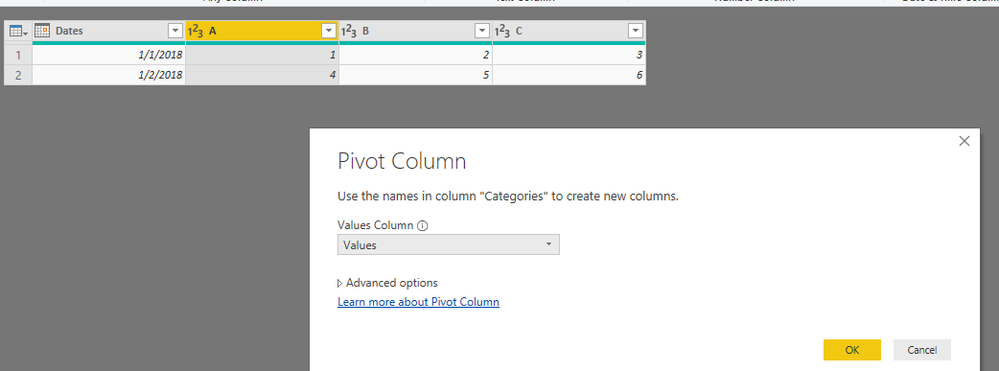
As @Anonymous , we can pivot your table in power query. Here I create one sample for your reference. M code as below.
let
Source = Table.FromRows(Json.Document(Binary.Decompress(Binary.FromText("i45WMtQ31DcyMLRQ0lFyBGJDpVgdFEEnIDZCF3QGYmOooBGydhN0QZB2U3RBkHYzpdhYAA==", BinaryEncoding.Base64), Compression.Deflate)), let _t = ((type text) meta [Serialized.Text = true]) in type table [Dates = _t, Categories = _t, Values = _t]),
#"Changed Type" = Table.TransformColumnTypes(Source,{{"Dates", type date}, {"Categories", type text}, {"Values", Int64.Type}}),
#"Pivoted Column" = Table.Pivot(#"Changed Type", List.Distinct(#"Changed Type"[Categories]), "Categories", "Values", List.Sum)
in
#"Pivoted Column"
Pbix as attached.
Regards,
Frank
Hi @SanderBI ,
As @Anonymous , we can pivot your table in power query. Here I create one sample for your reference. M code as below.
let
Source = Table.FromRows(Json.Document(Binary.Decompress(Binary.FromText("i45WMtQ31DcyMLRQ0lFyBGJDpVgdFEEnIDZCF3QGYmOooBGydhN0QZB2U3RBkHYzpdhYAA==", BinaryEncoding.Base64), Compression.Deflate)), let _t = ((type text) meta [Serialized.Text = true]) in type table [Dates = _t, Categories = _t, Values = _t]),
#"Changed Type" = Table.TransformColumnTypes(Source,{{"Dates", type date}, {"Categories", type text}, {"Values", Int64.Type}}),
#"Pivoted Column" = Table.Pivot(#"Changed Type", List.Distinct(#"Changed Type"[Categories]), "Categories", "Values", List.Sum)
in
#"Pivoted Column"
Pbix as attached.
Regards,
Frank
Join us in Barcelona for FabCon and SQLCon, the Fabric, Power BI, SQL, and AI community event. Save €200 with code FABCMTY200.
Join Fabric Data Days 2026: 60 days of free live/on-demand sessions, challenges, study groups, and certification opportunities.
| User | Count |
|---|---|
| 22 | |
| 22 | |
| 18 | |
| 16 | |
| 13 |
| User | Count |
|---|---|
| 63 | |
| 42 | |
| 40 | |
| 40 | |
| 40 |