This is best Fabric, Power BI, SQL and AI community event. How do we know? The last event sold out! Save €200 with code FABCMTY200.
Register nowA new Data Days event is coming soon! This time we’re going bigger than ever. Fabric, Power BI, SQL, AI and more. Don't miss out.
I have a date table that has calculated column counting all requests submitted on a given day.
There are two KPIs that need to be tracked. The first KPI is that each weekday has a capacity for 10 new requests.
This I can track quite easily.
The other KPI is that wekends have a capacity of 5 new requests in total over the weekend.
How can I create a column that sums the number of requests made on a Saturday and Sunday of each week?
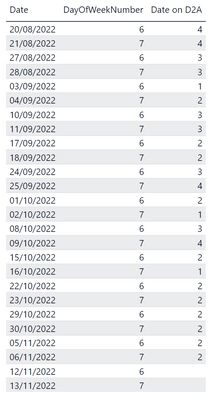
My table currently looks like this:
I want a column that sums 20/08 & 21/08 and places the value in 21/08 so that I can display it as a time series visual
e.g.
Date Weekend Requests
21/08/22 8
28/08/22 6
Solved! Go to Solution.
I think I have the answer. I used a variable to get teh value of the previous row...
Thanks for the reply. This goes part way. The total is placed in Day 7 but the final sum places the total for the whole column in the cell and not just the total of the 2 days of that week's day 6&7.
Hi @Anonymous,
You can use:
Weekend Requests = IF(DayOfWeekNumber=7, IF(DayOfWeekNumber=6 || DayOfWeekNumber=7, SUM('Table'[Requests])))
Works for you? Mark this post as a solution if it does!
Check out this blog of mine: How to Export Telemetry Data from Azure IoT Central into Power BI
Check out the May 2026 Power BI update to learn about new features.
Sign up to receive a private message when registration opens and key events begin.
If you have recently started exploring Fabric, we'd love to hear how it's going. Your feedback can help with product improvements.
| User | Count |
|---|---|
| 29 | |
| 27 | |
| 25 | |
| 19 | |
| 14 |
| User | Count |
|---|---|
| 56 | |
| 48 | |
| 37 | |
| 21 | |
| 20 |