cancel
Showing results for 
Search instead for 
Did you mean: 

Join the FabCon + SQLCon recap series. Up next: Power BI, Real-Time Intelligence, IQ and AI, and Data Factory take center stage. All sessions are available on-demand after the live show. Register now

Reply
brett_walton
Helper II
Helper II

Converting SAP or Unix time stamp

SAP posted data with a time stamp that is seconds since 1/1/1990   example  8,461,585,290,000


What the best way to convert this to a date and time field 

1 ACCEPTED SOLUTION
Anonymous
Not applicable

Hi @brett_walton

Firstly, according to my knowledge, the Unix time stamp is a whole number value, which is number of seconds from 1/1/1970 rather than from 1/1/1990.

Secondly, you can use one of the following two methods to covert Unix time stamp to date time.

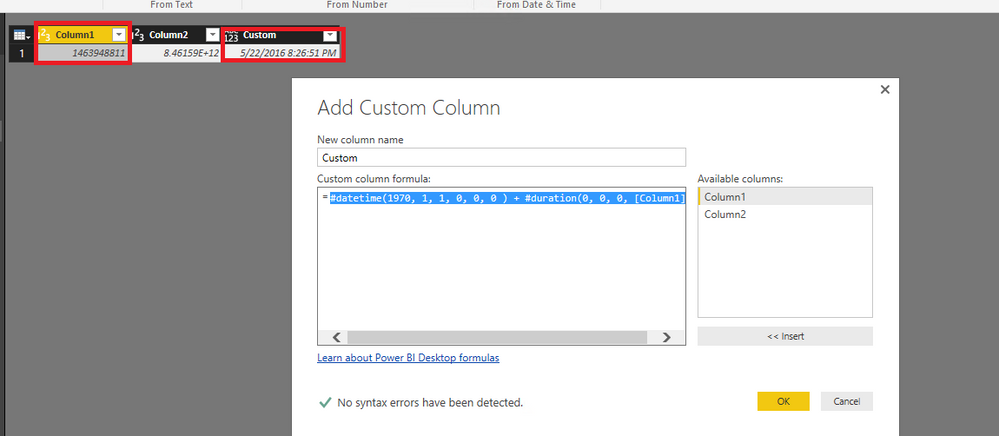
1. In Query Editor of Power BI Desktop, add a custom column and specify that using the following formula. There is an example in the following screenshot for your reference.

#datetime(1970, 1, 1, 0, 0, 0 ) + #duration(0, 0, 0, [Timestampcolumn])

1.PNG


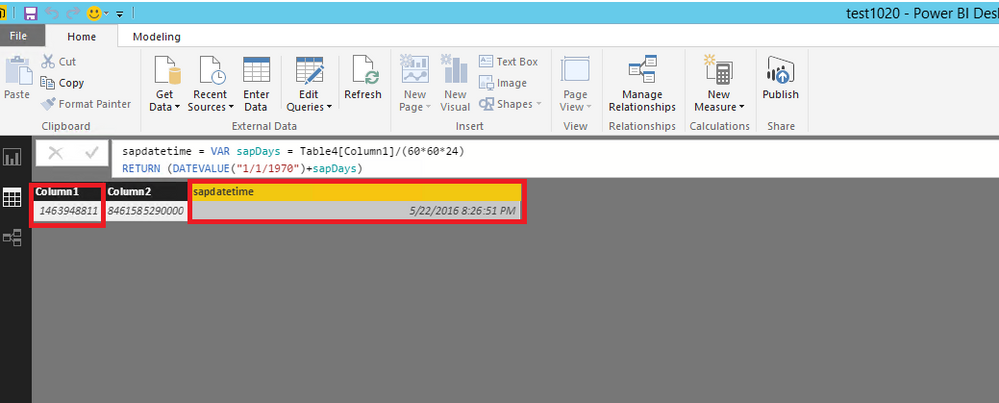
2. Create a calculated column in Data view of Power BI Desktop using the following formula.

sapdatetime = VAR sapDays = Table[Timestampcolumn]/(60*60*24)
RETURN (DATEVALUE("1/1/1970")+sapDays)

2.PNG


Thirdly, do you post the correct timestamp value? When I convert the example number 8,461,585,290,000 to date time, I get the following error message.

3.PNG

Besides, if you are sure that the timestamp is calculated from 1/1/1990, please replace 1/1/1970 with 1/1/1990 in the above formulas.

Thanks,
Lydia Zhang

View solution in original post

2 REPLIES 2
Anonymous
Not applicable

Hi @brett_walton

Firstly, according to my knowledge, the Unix time stamp is a whole number value, which is number of seconds from 1/1/1970 rather than from 1/1/1990.

Secondly, you can use one of the following two methods to covert Unix time stamp to date time.

1. In Query Editor of Power BI Desktop, add a custom column and specify that using the following formula. There is an example in the following screenshot for your reference.

#datetime(1970, 1, 1, 0, 0, 0 ) + #duration(0, 0, 0, [Timestampcolumn])

1.PNG


2. Create a calculated column in Data view of Power BI Desktop using the following formula.

sapdatetime = VAR sapDays = Table[Timestampcolumn]/(60*60*24)
RETURN (DATEVALUE("1/1/1970")+sapDays)

2.PNG


Thirdly, do you post the correct timestamp value? When I convert the example number 8,461,585,290,000 to date time, I get the following error message.

3.PNG

Besides, if you are sure that the timestamp is calculated from 1/1/1990, please replace 1/1/1970 with 1/1/1990 in the above formulas.

Thanks,
Lydia Zhang

Thank you this worked , I realize UNIX is 1970 was just using it as a reference. You are correct about the time stamp digging into it SAP multiples the number by 10,000 so I had to divide and it all worked out.


Thank you

Helpful resources

Announcements
April Power BI Update Carousel

Power BI Monthly Update - April 2026

Check out the April 2026 Power BI update to learn about new features.

New to Fabric survey Carousel

New to Fabric Survey

If you have recently started exploring Fabric, we'd love to hear how it's going. Your feedback can help with product improvements.

Power BI DataViz World Championships carousel

Power BI DataViz World Championships - June 2026

A new Power BI DataViz World Championship is coming this June! Don't miss out on submitting your entry.

FabCon and SQLCon Highlights Carousel

FabCon &SQLCon Highlights

Experience the highlights from FabCon & SQLCon, available live and on-demand starting April 14th.