Don't miss your chance to take the Fabric Data Engineer (DP-600) exam for FREE! Find out how by watching the DP-600 session on-demand now through April 28th.
Learn moreJoin the FabCon + SQLCon recap series. Up next: Power BI, Real-Time Intelligence, IQ and AI, and Data Factory take center stage. All sessions are available on-demand after the live show. Register now
Solved! Go to Solution.
Hi @Josearce
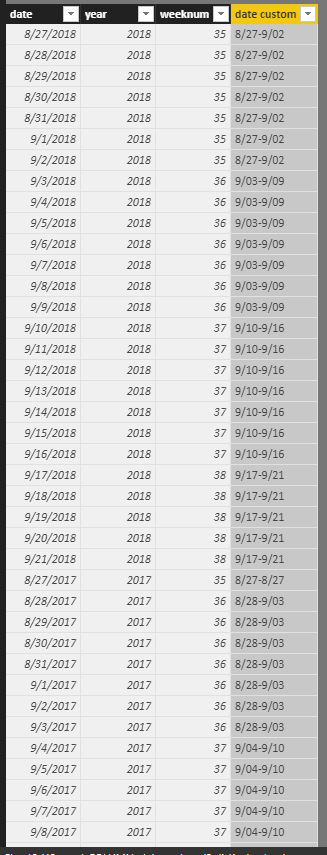
Create three calculated columns as below
year = YEAR([date])
weeknum = WEEKNUM([date],2)
date custom =
CONCATENATE (
CONCATENATE (
FORMAT (
CALCULATE (
MIN ( [date] ),
ALLEXCEPT ( Sheet8, Sheet8[year], Sheet8[weeknum] )
),
"m/dd"
),
"-"
),
FORMAT (
CALCULATE (
MAX ( [date] ),
ALLEXCEPT ( Sheet8, Sheet8[year], Sheet8[weeknum] )
),
"m/dd"
)
)
Best Reagrds
Maggie
Hi @Josearce
Create three calculated columns as below
year = YEAR([date])
weeknum = WEEKNUM([date],2)
date custom =
CONCATENATE (
CONCATENATE (
FORMAT (
CALCULATE (
MIN ( [date] ),
ALLEXCEPT ( Sheet8, Sheet8[year], Sheet8[weeknum] )
),
"m/dd"
),
"-"
),
FORMAT (
CALCULATE (
MAX ( [date] ),
ALLEXCEPT ( Sheet8, Sheet8[year], Sheet8[weeknum] )
),
"m/dd"
)
)
Best Reagrds
Maggie
Thanks Maggie...I did something with the formula to present it more organized:
Weekfromto =
VAR Desde = format(Calculate(min('Calendar Table'[Date]),ALLEXCEPT('Calendar Table','Calendar Table'[Year],'Calendar Table'[Week#])),"mmm-dd-yy")
VAR Hasta = format(Calculate(max('Calendar Table'[Date]),ALLEXCEPT('Calendar Table','Calendar Table'[Year],'Calendar Table'[Week#])),"mmm-dd-yy")
RETURN
Desde &" - "& Hasta
Desde means From and Hasta means Through
Check out the April 2026 Power BI update to learn about new features.
If you have recently started exploring Fabric, we'd love to hear how it's going. Your feedback can help with product improvements.
A new Power BI DataViz World Championship is coming this June! Don't miss out on submitting your entry.
| User | Count |
|---|---|
| 45 | |
| 38 | |
| 34 | |
| 21 | |
| 17 |
| User | Count |
|---|---|
| 66 | |
| 65 | |
| 31 | |
| 26 | |
| 26 |