Get Fabric or SQL Certified for Free.
Get certified for free when you join Fabric Data Days 2026 and dive into Fabric, Power BI, SQL, AI, and other essential data skills.
Join now- Power BI forums
- Get Help with Power BI
- Desktop
- Service
- Report Server
- Power Query
- Mobile Apps
- Developer
- DAX Commands and Tips
- Custom Visuals Development Discussion
- Health and Life Sciences
- Power BI Spanish forums
- Translated Spanish Desktop
- Training and Consulting
- Instructor Led Training
- Dashboard in a Day for Women, by Women
- Galleries
- Data Stories Gallery
- Themes Gallery
- Contests Gallery
- QuickViz Gallery
- Quick Measures Gallery
- Visual Calculations Gallery
- Fabric Apps Gallery
- Notebook Gallery
- Translytical Task Flow Gallery
- TMDL Gallery
- R Script Showcase
- Webinars and Video Gallery
- Ideas
- Custom Visuals Ideas (read-only)
- Issues
- Issues
- Events
- Upcoming Events
July 28 - August 9 | Final Round of the Power BI Dataviz World Championships. This is your chance. Learn more
- Power BI forums
- Forums
- Get Help with Power BI
- Desktop
- Re: Calculation with Time Intelligence
- Subscribe to RSS Feed
- Mark Topic as New
- Mark Topic as Read
- Float this Topic for Current User
- Bookmark
- Subscribe
- Printer Friendly Page


- Mark as New
- Bookmark
- Subscribe
- Mute
- Subscribe to RSS Feed
- Permalink
- Report Inappropriate Content
Calculation with Time Intelligence
Hello, I need help with the following measure.
I have a measure that calculates "Allowed $" based on hours worked. We updated the "Allowed $" for the new year. I need to edit the measure to calculate the old Allowed $ for dates prior to 12/31/2022 and calculate the new allowed amount for dates on/after 1/1/2023.
Please see my current measure. Thank you.
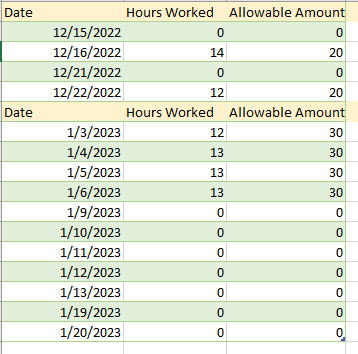
Solved! Go to Solution.


- Mark as New
- Bookmark
- Subscribe
- Mute
- Subscribe to RSS Feed
- Permalink
- Report Inappropriate Content
Please try this combined measure.
NewMeasures =
VAR afterdate =
    DATE ( 2023, 1, 1 )
VAR after =
    CALCULATE (
        SUMX (
            ADDCOLUMNS (
                SUMMARIZE (
                    Timesheet,
                    Timesheet[Employee ID],
                    Timesheet[Date],
                    Timesheet[Holiday],
                    Timesheet[Day of Week]
                ),
                "DailyHrs", CALCULATE ( SUM ( Timesheet[Number (unit)] ) )
            ),
            SWITCH (
                TRUE,
                [DailyHrs] >= 4
                    && [DailyHrs] < 8
                    && Timesheet[Holiday] = "Yes", 18,
                [DailyHrs] >= 8
                    && Timesheet[Holiday] = "Yes", 45,
                [DailyHrs] >= 10
                    && 'Timesheet'[Day of Week] <= 4, 45,
                [DailyHrs] >= 4
                    && [DailyHrs] < 8
                    && 'Timesheet'[Day of Week] >= 5, 18,
                [DailyHrs] >= 8
                    && 'Timesheet'[Day of Week] >= 5, 45,
                0
            )
        ),
        Timesheet[Date] >= afterdate
    )
VAR before =
    CALCULATE (
        SUMX (
            ADDCOLUMNS (
                SUMMARIZE (
                    Timesheet,
                    Timesheet[Employee ID],
                    Timesheet[Date],
                    Timesheet[Holiday],
                    Timesheet[Day of Week]
                ),
                "DailyHrs", CALCULATE ( SUM ( Timesheet[Number (unit)] ) )
            ),
            SWITCH (
                TRUE,
                [DailyHrs] >= 4
                    && [DailyHrs] < 8
                    && Timesheet[Holiday] = "Yes", 12,
                [DailyHrs] >= 8
                    && Timesheet[Holiday] = "Yes", 32,
                [DailyHrs] >= 10
                    && 'Timesheet'[Day of Week] <= 4, 20,
                [DailyHrs] >= 4
                    && [DailyHrs] < 8
                    && 'Timesheet'[Day of Week] >= 5, 12,
                [DailyHrs] >= 8
                    && 'Timesheet'[Day of Week] >= 5, 32,
                0
            )
        ),
        Timesheet[Date] < afterdate
    )
RETURN
    after + before
Pat
- Mark as New
- Bookmark
- Subscribe
- Mute
- Subscribe to RSS Feed
- Permalink
- Report Inappropriate Content
Please try this combined measure.
NewMeasures =
VAR afterdate =
    DATE ( 2023, 1, 1 )
VAR after =
    CALCULATE (
        SUMX (
            ADDCOLUMNS (
                SUMMARIZE (
                    Timesheet,
                    Timesheet[Employee ID],
                    Timesheet[Date],
                    Timesheet[Holiday],
                    Timesheet[Day of Week]
                ),
                "DailyHrs", CALCULATE ( SUM ( Timesheet[Number (unit)] ) )
            ),
            SWITCH (
                TRUE,
                [DailyHrs] >= 4
                    && [DailyHrs] < 8
                    && Timesheet[Holiday] = "Yes", 18,
                [DailyHrs] >= 8
                    && Timesheet[Holiday] = "Yes", 45,
                [DailyHrs] >= 10
                    && 'Timesheet'[Day of Week] <= 4, 45,
                [DailyHrs] >= 4
                    && [DailyHrs] < 8
                    && 'Timesheet'[Day of Week] >= 5, 18,
                [DailyHrs] >= 8
                    && 'Timesheet'[Day of Week] >= 5, 45,
                0
            )
        ),
        Timesheet[Date] >= afterdate
    )
VAR before =
    CALCULATE (
        SUMX (
            ADDCOLUMNS (
                SUMMARIZE (
                    Timesheet,
                    Timesheet[Employee ID],
                    Timesheet[Date],
                    Timesheet[Holiday],
                    Timesheet[Day of Week]
                ),
                "DailyHrs", CALCULATE ( SUM ( Timesheet[Number (unit)] ) )
            ),
            SWITCH (
                TRUE,
                [DailyHrs] >= 4
                    && [DailyHrs] < 8
                    && Timesheet[Holiday] = "Yes", 12,
                [DailyHrs] >= 8
                    && Timesheet[Holiday] = "Yes", 32,
                [DailyHrs] >= 10
                    && 'Timesheet'[Day of Week] <= 4, 20,
                [DailyHrs] >= 4
                    && [DailyHrs] < 8
                    && 'Timesheet'[Day of Week] >= 5, 12,
                [DailyHrs] >= 8
                    && 'Timesheet'[Day of Week] >= 5, 32,
                0
            )
        ),
        Timesheet[Date] < afterdate
    )
RETURN
    after + before
Pat

- Mark as New
- Bookmark
- Subscribe
- Mute
- Subscribe to RSS Feed
- Permalink
- Report Inappropriate Content
Hi @Coryanthony ,
According to your requirements description, you want to achieve the purpose of merging into one measure according to the logic of [date BEFORE/After 1/1/2023] according to the two measures provided in the reply above, right?
If this is the case, you might consider trying this measure to logically combine two measures using the If() function.
Allowed OT $ =
If(Max(Timesheet[Date])<Date(2023,1,1),
SumX(SUMMARIZE(
        Timesheet,
        Timesheet[Employee ID],Timesheet[Date],Timesheet[Holiday],Timesheet[Day of Week],
        "DailyHrs",sum(Timesheet[Number (unit)])),
    SWITCH(TRUE,
        [DailyHrs]>=4 && [DailyHrs]<8 && Timesheet[Holiday] = "Yes" ,12,
        [DailyHrs]>=8 && Timesheet[Holiday] = "Yes" ,32,
        [DailyHrs]>=10 &&'Timesheet'[Day of Week]<=4,20,
        [DailyHrs]>=4 && [DailyHrs]<8 && 'Timesheet'[Day of Week]>=5,12,
        [DailyHrs]>=8 && 'Timesheet'[Day of Week]>=5,32,
        0
        ))
,
SumX(SUMMARIZE(
        Timesheet,
        Timesheet[Employee ID],Timesheet[Date],Timesheet[Holiday],Timesheet[Day of Week],
        "DailyHrs",sum(Timesheet[Number (unit)])),
    SWITCH(TRUE,
        [DailyHrs]>=4 && [DailyHrs]<8 && Timesheet[Holiday] = "Yes" ,18,
        [DailyHrs]>=8 && Timesheet[Holiday] = "Yes" ,45,
        [DailyHrs]>=10 &&'Timesheet'[Day of Week]<=4,45,
        [DailyHrs]>=4 && [DailyHrs]<8 && 'Timesheet'[Day of Week]>=5,18,
        [DailyHrs]>=8 && 'Timesheet'[Day of Week]>=5,45,
        0
        ))
)
Best Regards,
Neeko Tang
If this post helps, then please consider Accept it as the solution to help the other members find it more quickly.


- Mark as New
- Bookmark
- Subscribe
- Mute
- Subscribe to RSS Feed
- Permalink
- Report Inappropriate Content
Hi,
Share some data (in a format that can be pasted in an MS Excel file), explain the question and show the expected result.
Regards,
Ashish Mathur
http://www.ashishmathur.com
https://www.linkedin.com/in/excelenthusiasts/
- Mark as New
- Bookmark
- Subscribe
- Mute
- Subscribe to RSS Feed
- Permalink
- Report Inappropriate Content
Switching to the ADDCOLUMNS(SUMMARIZE pattern should help, but the SWITCH evaluation on every row may still keep things slow.
Allowed OT $ =
SUMX (
    ADDCOLUMNS (
        SUMMARIZE (
            Timesheet,
            Timesheet[Employee ID],
            Timesheet[Date],
            Timesheet[Holiday],
            Timesheet[Day of Week]
        ),
        "DailyHrs", CALCULATE ( SUM ( Timesheet[Number (unit)] ) )
    ),
    SWITCH (
        TRUE,
        [DailyHrs] >= 4
            && [DailyHrs] < 8
            && Timesheet[Holiday] = "Yes", 12,
        [DailyHrs] >= 8
            && Timesheet[Holiday] = "Yes", 32,
        [DailyHrs] >= 10
            && 'Timesheet'[Day of Week] <= 4, 20,
        [DailyHrs] >= 4
            && [DailyHrs] < 8
            && 'Timesheet'[Day of Week] >= 5, 12,
        [DailyHrs] >= 8
            && 'Timesheet'[Day of Week] >= 5, 32,
        0
    )
)
Pat
- Mark as New
- Bookmark
- Subscribe
- Mute
- Subscribe to RSS Feed
- Permalink
- Report Inappropriate Content
Hi @Ashish_Mathur and @ppm1
To simplify: I need below measure to reflect on date BEFORE 1/1/2023.
Helpful resources

Fabric Community Sticker Challenge - Barcelona 2026
If you love stickers, then you will definitely want to check out our community sticker challenge, Barcelona edition!

Power BI Monthly Update - July 2026
Check out the July 2026 Power BI update to learn about new features.

Power BI DataViz World Championships - June 2026
A new Power BI DataViz World Championship is coming this June! Don't miss out on submitting your entry.

| User | Count |
|---|---|
| 29 | |
| 28 | |
| 20 | |
| 20 | |
| 19 |


| User | Count |
|---|---|
| 35 | |
| 26 | |
| 20 | |
| 18 | |
| 17 |


