Join us at FabCon Atlanta from March 16 - 20, 2026, for the ultimate Fabric, Power BI, AI and SQL community-led event. Save $200 with code FABCOMM.
Register now!Vote for your favorite vizzies from the Power BI Dataviz World Championship submissions. Vote now!
I have a table like this :
| Date | Num return |
| 22/1/2022 | 14 |
| 21/1/2022 | 20 |
| 21/1/2022 | 15 |
| 20/1/2022 | 20 |
How do I create a measure that shows the number of return for the most recent date.
The measure should have a value of 35 on 21/2022 and 14 on 22/1/2022
Solved! Go to Solution.
@gancw1 , Most recent or two most recent, based on selection or over all
You can try like
measure =
var _max = maxx(allselected(Table), Table[Date])
return
calculate(sum(Table[Num return]), filter(Table, Table[Date] =_max))
Hi @gancw1 ,
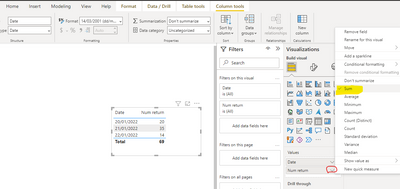
You could simply use the "Sum" type of summarization for [Num Return]
Or use :
Measure = CALCULATE(SUM('Table'[Num return]),ALLEXCEPT('Table','Table'[Date]))
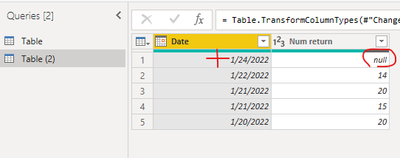
Based on the keyword ——" the most recent date", I used another table by adding 1/24/2022
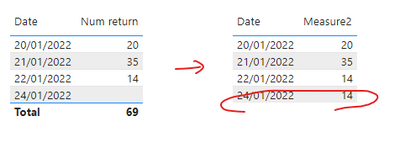
Since 1/24/2022 has no value ,it should get sum from the most recent date=2022/1/22 =14
Measure2 =
var _max= MAXX(FILTER(ALL('Table (2)'),[Date]<=MAX('Table (2)'[Date]) && [Num return]<>BLANK() ),[Date])
return CALCULATE(SUM('Table (2)'[Num return]),FILTER(ALL('Table (2)'),[Date]=_max))
Output:
Best Regards,
Eyelyn Qin
If this post helps, then please consider Accept it as the solution to help the other members find it more quickly.
Hi @gancw1 ,
You could simply use the "Sum" type of summarization for [Num Return]
Or use :
Measure = CALCULATE(SUM('Table'[Num return]),ALLEXCEPT('Table','Table'[Date]))
Based on the keyword ——" the most recent date", I used another table by adding 1/24/2022
Since 1/24/2022 has no value ,it should get sum from the most recent date=2022/1/22 =14
Measure2 =
var _max= MAXX(FILTER(ALL('Table (2)'),[Date]<=MAX('Table (2)'[Date]) && [Num return]<>BLANK() ),[Date])
return CALCULATE(SUM('Table (2)'[Num return]),FILTER(ALL('Table (2)'),[Date]=_max))
Output:
Best Regards,
Eyelyn Qin
If this post helps, then please consider Accept it as the solution to help the other members find it more quickly.
@gancw1 , Most recent or two most recent, based on selection or over all
You can try like
measure =
var _max = maxx(allselected(Table), Table[Date])
return
calculate(sum(Table[Num return]), filter(Table, Table[Date] =_max))
Vote for your favorite vizzies from the Power BI World Championship submissions!
If you love stickers, then you will definitely want to check out our Community Sticker Challenge!
Check out the January 2026 Power BI update to learn about new features.
| User | Count |
|---|---|
| 63 | |
| 52 | |
| 41 | |
| 23 | |
| 18 |
| User | Count |
|---|---|
| 124 | |
| 108 | |
| 47 | |
| 28 | |
| 27 |