Join us at FabCon Atlanta from March 16 - 20, 2026, for the ultimate Fabric, Power BI, AI and SQL community-led event. Save $200 with code FABCOMM.
Register now!The Power BI Data Visualization World Championships is back! It's time to submit your entry. Live now!
Hi All,
I am facing strange behaviour of ALL function
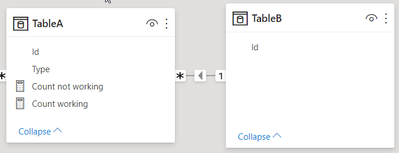
Let me explain, model is simple in this case and i am having fact table (tableA) and dimension table (TableB). You can also download PBIX here it is probably easier to understand it
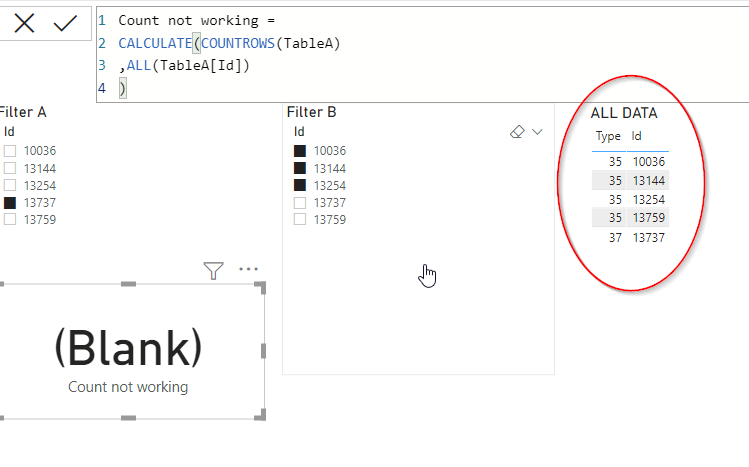
There are only few records in TableA and the logic is following: i would like to get rowcount of tableA but only considering filter from tableB, this is the reason why ALL(tableA[ID]) is used to clear any filter ID column of Table A. FIlterB is constant like shown in the picture
Problem is following, this logic is working for FilterA Id = 13759 but it is not working for 13737 (one shown on the picture), i am not quite sure why is this happening, only difference is type of those two IDs, but i dont see how that could influence this result.
IT could be solved by adding anohter tableC and using it as a slicer, I already checked this solution on the second tab, but for this approach i would need to change my reports heavily so i would prefer if i get it working with measure fix.
Solved! Go to Solution.
Hey @Anonymous ,
the reason is that you are using a slicer for the same table as you do a COUNTROWS.
In that case the Auto-Exist feature kicks in, what is a technique to optimize unnecessary calculations in DAX. You can easily solve that by using a star schema, filtering only on dimensional tables and using the IDs from the fact table only to create the relationships.
There is also an article about the details of Auto-Exist:
Understanding DAX Auto-Exist - SQLBI
Hey @Anonymous ,
the reason is that you are using a slicer for the same table as you do a COUNTROWS.
In that case the Auto-Exist feature kicks in, what is a technique to optimize unnecessary calculations in DAX. You can easily solve that by using a star schema, filtering only on dimensional tables and using the IDs from the fact table only to create the relationships.
There is also an article about the details of Auto-Exist:
Understanding DAX Auto-Exist - SQLBI
The Power BI Data Visualization World Championships is back! It's time to submit your entry.
Check out the January 2026 Power BI update to learn about new features.
| User | Count |
|---|---|
| 61 | |
| 49 | |
| 30 | |
| 25 | |
| 23 |
| User | Count |
|---|---|
| 128 | |
| 102 | |
| 57 | |
| 39 | |
| 31 |