Get certified for free when you join Fabric Data Days 2026 and dive into Fabric, Power BI, SQL, AI, and other essential data skills.
Join nowJuly 7 - July 17 | Round 2 of the Power BI Dataviz World Championships. Don't miss your chance! Learn more
Hi
I'm trying to work out how to achieve the following in DAX (or Power Query) that I currently do using VBA in excel.
I have a table with data similar to the below:
| Distance From | Distance To | Type |
| 0 | 1 | Red |
| 1 | 2 | Red |
| 2 | 4 | Green |
| 4 | 10 | Green |
| 10 | 13 | Green |
| 13 | 14 | Red |
| 14 | 33 | Red |
| 33 | 40 | Blue |
| 40 | 45 | Green |
| 45 | 46 | Green |
| 46 | 50 | Red |
And need to rationalise it to the below.
Distance From | Distance To | Type |
| 0 | 2 | Red |
| 2 | 13 | Green |
| 13 | 33 | Red |
| 33 | 40 | Blue |
| 40 | 46 | Green |
| 46 | 50 | Red |
So currently I do this in VBA by looping through the rows and keeping track of the Min [Distance From] from and Max [Distance To] until the [Type] changes. The data is alway sorted on [Distance From] ascending and the [Distance To] always matches the next rows [Distance From]
Solved! Go to Solution.
let
Source = Table.FromRows(Json.Document(Binary.Decompress(Binary.FromText("i45WMlDSUTIE4qDUFKVYnWgw2wiJD2KbALF7UWpqHlgExDM0QBECcw2NUcVAXEMTZKNBHGNjJBEwxwSk2SmnNBViOohnYopqI4hrYoYqBuKaGsAMiwUA", BinaryEncoding.Base64), Compression.Deflate)), let _t = ((type nullable text) meta [Serialized.Text = true]) in type table [#"Distance From" = _t, #"Distance To" = _t, Type = _t]),
#"Changed Type" = Table.TransformColumnTypes(Source,{{"Distance From", Int64.Type}, {"Distance To", Int64.Type}}),
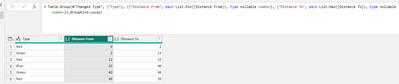
#"Grouped Rows" = Table.Group(#"Changed Type", {"Type"}, {{"Distance From", each List.Min([Distance From]), type nullable number}, {"Distance To", each List.Max([Distance To]), type nullable number}},GroupKind.Local)
in
#"Grouped Rows"
obligatory credit: @ImkeF
let
Source = Table.FromRows(Json.Document(Binary.Decompress(Binary.FromText("i45WMlDSUTIE4qDUFKVYnWgw2wiJD2KbALF7UWpqHlgExDM0QBECcw2NUcVAXEMTZKNBHGNjJBEwxwSk2SmnNBViOohnYopqI4hrYoYqBuKaGsAMiwUA", BinaryEncoding.Base64), Compression.Deflate)), let _t = ((type nullable text) meta [Serialized.Text = true]) in type table [#"Distance From" = _t, #"Distance To" = _t, Type = _t]),
#"Changed Type" = Table.TransformColumnTypes(Source,{{"Distance From", Int64.Type}, {"Distance To", Int64.Type}}),
#"Grouped Rows" = Table.Group(#"Changed Type", {"Type"}, {{"Distance From", each List.Min([Distance From]), type nullable number}, {"Distance To", each List.Max([Distance To]), type nullable number}},GroupKind.Local)
in
#"Grouped Rows"
obligatory credit: @ImkeF
I always discounted using group. I guess I missed reading up on the GroupKind parameter.
Thanks that worked a treat.
Join us in Barcelona for FabCon and SQLCon, the Fabric, Power BI, SQL, and AI community event. Save €200 with code FABCMTY200.
Join Data Days 2026: 60 days of free live/on-demand sessions, challenges, study groups, and certification opportunities.