Join us at FabCon Atlanta from March 16 - 20, 2026, for the ultimate Fabric, Power BI, AI and SQL community-led event. Save $200 with code FABCOMM.
Register now!The Power BI Data Visualization World Championships is back! Get ahead of the game and start preparing now! Learn more
Hi,
I have a simple data set:
category brand value
x a 10
x b 15
y c 20
y d 25
I need to create ONE measure that will give me ranking for category and brand but shown in two separate tables:
cat value rank
x 35 2
y 45 1
brand value rank
a 10 4
b 15 3
... for the rest brands
Is it possible via one RankX measure?
thanks
Mcg
Solved! Go to Solution.
Sorry, hadn't read properly.
Rank measure V2 =
SWITCH (
TRUE (),
ISFILTERED ( Table1[category] ), RANKX ( ALL ( Table1[category] ), CALCULATE ( SUM ( Table1[value] ) ) ),
ISFILTERED ( Table1[brand] ), RANKX ( ALL ( Table1[brand] ), CALCULATE ( SUM ( Table1[value] ) ) )
)
Please mark the question solved when done and consider giving a thumbs up if posts are helpful.
Contact me privately for support with any larger-scale BI needs, tutoring, etc.
Cheers
Sorry, hadn't read properly.
Rank measure V2 =
SWITCH (
TRUE (),
ISFILTERED ( Table1[category] ), RANKX ( ALL ( Table1[category] ), CALCULATE ( SUM ( Table1[value] ) ) ),
ISFILTERED ( Table1[brand] ), RANKX ( ALL ( Table1[brand] ), CALCULATE ( SUM ( Table1[value] ) ) )
)
Please mark the question solved when done and consider giving a thumbs up if posts are helpful.
Contact me privately for support with any larger-scale BI needs, tutoring, etc.
Cheers
exactly what i was looking for:)
perfect!
greta thanks
mcg
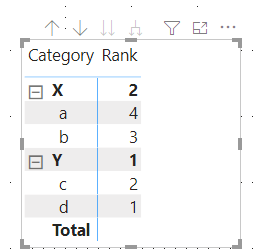
Hi, @MCG , you might want to try to further integrate rankings this way,
Rank =
SWITCH (
TRUE (),
ISINSCOPE ( Table1[brand] ),
RANKX (
ALL ( Table1[brand] ),
CALCULATE ( SUM ( Table1[value] ), ALL ( Table1[Category] ) )
),
ISINSCOPE ( Table1[category] ), RANKX ( ALL ( Table1[category] ), CALCULATE ( SUM ( Table1[value] ) ) )
)| Thanks to the great efforts by MS engineers to simplify syntax of DAX! Most beginners are SUCCESSFULLY MISLED to think that they could easily master DAX; but it turns out that the intricacy of the most frequently used RANKX() is still way beyond their comprehension! |
DAX is simple, but NOT EASY! |
That is also nice solution:)
I will keep it in mind
thx
Mcg
Hi @MCG
For your first visual:
Rank measure =
RANKX(ALL(Table1[category]), CALCULATE(SUM(Table1[value])))
For the second:
Rank measure 2 =
RANKX(ALL(Table1[brand]), CALCULATE(SUM(Table1[value])))
Please mark the question solved when done and consider giving a thumbs up if posts are helpful.
Contact me privately for support with any larger-scale BI needs, tutoring, etc.
Cheers
Thanks:)
That is what I also calculated...
What i wanted to achieve is to get same result in one measure...
br
Mcg
The Power BI Data Visualization World Championships is back! Get ahead of the game and start preparing now!
Check out the November 2025 Power BI update to learn about new features.
| User | Count |
|---|---|
| 19 | |
| 11 | |
| 9 | |
| 4 | |
| 4 |
| User | Count |
|---|---|
| 35 | |
| 32 | |
| 20 | |
| 12 | |
| 10 |