
Join us at FabCon Atlanta from March 16 - 20, 2026, for the ultimate Fabric, Power BI, AI and SQL community-led event. Save $200 with code FABCOMM.
Register now!Vote for your favorite vizzies from the Power BI Dataviz World Championship submissions. Vote now!
Hi there,
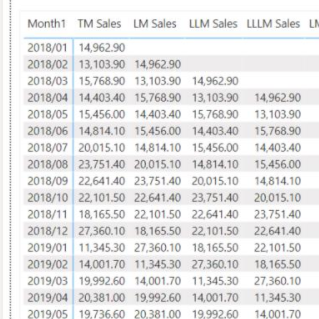
Below is the sum of Sales with
LLM last last month, LM Last Month, TM This Month
Hope my result like:
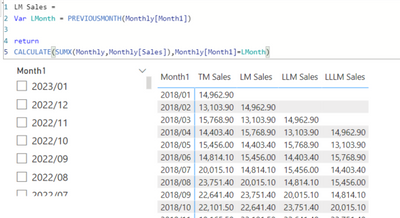
1st approach:
Right now i can retrieve the result by selecting Billing Month.
Without selecting Billing Month Error Message: A table of multiple values was supplied where a single value was expected
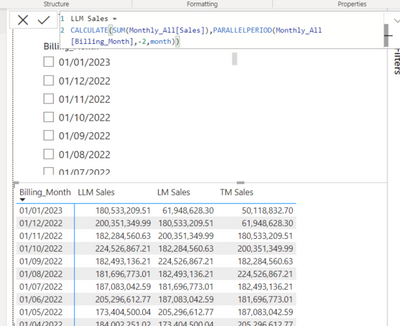
2nd approach:
Its not working since i have to use month as one of my parameter.
How can I modify the code so that I can have a full picture without selecting Month.
Thank you for your help.
Sammy Chu
Solved! Go to Solution.
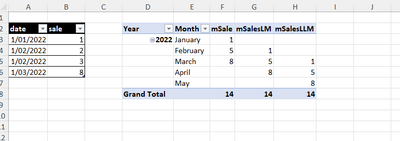
mSale:=SUM(Sales[sale])
mSalesLM:=CALCULATE([mSale],PARALLELPERIOD('Calendar'[Date],-1,MONTH))
mSalesLLM:=CALCULATE([mSale],PARALLELPERIOD('Calendar'[Date],-2,MONTH))
mSale:=SUM(Sales[sale])
mSalesLM:=CALCULATE([mSale],PARALLELPERIOD('Calendar'[Date],-1,MONTH))
mSalesLLM:=CALCULATE([mSale],PARALLELPERIOD('Calendar'[Date],-2,MONTH))
Hi @RichardOfSydney ,
Thank you for your help.
But the LLM get the same result with This month.
Cheers,
Sammy Chu
Dont use the var, they are 3 distinct measures.
Vote for your favorite vizzies from the Power BI World Championship submissions!
If you love stickers, then you will definitely want to check out our Community Sticker Challenge!
Check out the January 2026 Power BI update to learn about new features.
| User | Count |
|---|---|
| 7 | |
| 5 | |
| 4 | |
| 3 | |
| 3 |
| User | Count |
|---|---|
| 19 | |
| 10 | |
| 6 | |
| 6 | |
| 5 |