Join us in Barcelona for FabCon and SQLCon, September 28 - October 1, 2026.
This is best Fabric, Power BI, SQL and AI community event. How do we know? The last event sold out! Save €200 with code FABCMTY200.
Register now- Power BI forums
- Get Help with Power BI
- Desktop
- Service
- Report Server
- Power Query
- Mobile Apps
- Developer
- DAX Commands and Tips
- Custom Visuals Development Discussion
- Health and Life Sciences
- Power BI Spanish forums
- Translated Spanish Desktop
- Training and Consulting
- Instructor Led Training
- Dashboard in a Day for Women, by Women
- Galleries
- Data Stories Gallery
- Themes Gallery
- Contests Gallery
- QuickViz Gallery
- Quick Measures Gallery
- Visual Calculations Gallery
- Fabric Apps Gallery
- Notebook Gallery
- Translytical Task Flow Gallery
- TMDL Gallery
- R Script Showcase
- Webinars and Video Gallery
- Ideas
- Custom Visuals Ideas (read-only)
- Issues
- Issues
- Events
- Upcoming Events
The Fabric community is upgrading! Read all of the details including the timeline and what you can expect. Learn more
- Power BI forums
- Forums
- Get Help with Power BI
- Power Query
- Exponential Moving Average in Power Query M ?
- Subscribe to RSS Feed
- Mark Topic as New
- Mark Topic as Read
- Float this Topic for Current User
- Bookmark
- Subscribe
- Printer Friendly Page

- Mark as New
- Bookmark
- Subscribe
- Mute
- Subscribe to RSS Feed
- Permalink
- Report Inappropriate Content
Exponential Moving Average in Power Query M ?
Hello! How can an exponential moving average be created in Power Query M? I already know how to do this in Excel, and DAX can be a pain in the tail. Here's a table of example data. Thank you!
Date Value
1/1/2021 0.888073856
1/2/2021 0.087243733
1/3/2021 0.597531606
1/4/2021 0.25492501
1/5/2021 0.836644673
1/6/2021 0.253785258
1/7/2021 0.757333787
1/8/2021 0.958886707
1/9/2021 0.598108137
1/10/2021 0.180565909
1/11/2021 0.788755716
1/12/2021 0.888126908
1/13/2021 0.231740519
1/14/2021 0.107410191
1/15/2021 0.648458581
1/16/2021 0.582213204
1/17/2021 0.191300599
1/18/2021 0.864502562
1/19/2021 0.583108477
Solved! Go to Solution.


- Mark as New
- Bookmark
- Subscribe
- Mute
- Subscribe to RSS Feed
- Permalink
- Report Inappropriate Content
@jsflint
Can you share the expected value based on the sample data that you have given?
You can save the Excel file with the results in One Drive or Google Drive and share the link
⭕ Subscribe and learn Power BI from these videos
⚪ Website ⚪ LinkedIn ⚪ PBI User Group
- Mark as New
- Bookmark
- Subscribe
- Mute
- Subscribe to RSS Feed
- Permalink
- Report Inappropriate Content
- Mark as New
- Bookmark
- Subscribe
- Mute
- Subscribe to RSS Feed
- Permalink
- Report Inappropriate Content
@jsflint
Please find attached the PBIX file below my signature with the desired results. Basically, the solution involves a recursive operation to calculate the EMA ( Exponential Moving Average in Power Query ).
There are two columns, Average and EMA.
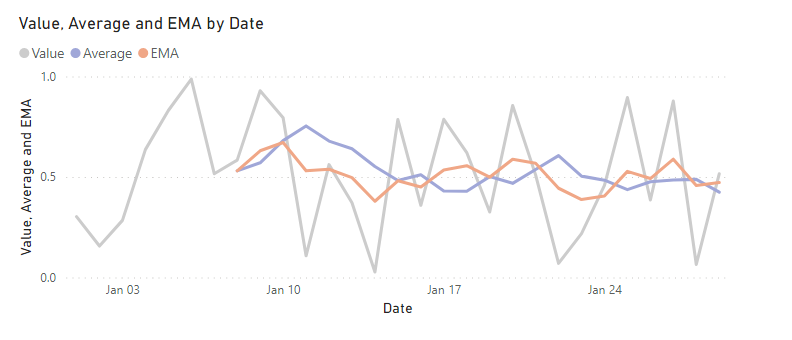
Complete M Code:
let
  Source = Table.FromRows(
    Json.Document(
      Binary.Decompress(
        Binary.FromText(
          "VZLbbQRBCARz2e+TD5p3LNbln4Y5adnB3yVmmqJ/fy9+8xsEvl4X/Qghwwp2fV5fhIPY3BERuJEchFRIROmN9CAXB2Ua38gOSmEmS5Ib+UGVIdIobxQHGbsEdFLkIqlM7E/2Wu+hxDV5AjIdFmUIE58YvHQwJZX1d8OWD3PWkqL5jpeQTsim5jVsGSEEzEzGCC8lkZbO5bMdLydiZar8+OfYc17gHhy2tDi+xjrMsOVF4CQVz3WwvGSHJCedOfA+Qh8uO+qw5YWCoBJDdk24L+TBswGWFe3FJeMxhl2UXlz6eHMhbCtpndGmKFhSssvaZdYnypJC3YYyz4fVv4aBvOt8fT5/",
          BinaryEncoding.Base64
        ),
        Compression.Deflate
      )
    ),
    let
      _t = ((type nullable text) meta [Serialized.Text = true])
    in
      type table [Date = _t, Value = _t]
  ),
  #"Changed Type" = Table.TransformColumnTypes(
    Source,
    {{"Date", type date}, {"Value", type number}}
  ),
  Step1 = Table.AddIndexColumn(#"Changed Type", "Index", 0, 1, Int64.Type),
  Step2 = Table.AddColumn(
    Step1,
    "Average",
    each if [Index] > 6 then List.Average(List.Range(Step1[Value], _[Index] - 7, 7)) else null
  , type number),
  Step3 = Table.AddColumn(
    Step2,
    "EMA",
    each
      if [Index] > 6 then
        let
          start = List.First(List.RemoveNulls(Step2[Average])),
          vlist = List.Range(Step2[Value], 8, _[Index] - 7),
          acc = List.Accumulate(
            vlist,
            start,
            (state, current) => (current - state) * (2 / (1 + 7)) + state
          )
        in
          if [Index] = 7 then start else acc
      else
        null,
  type number )
in
    Step3
⭕ Subscribe and learn Power BI from these videos
⚪ Website ⚪ LinkedIn ⚪ PBI User Group
- Mark as New
- Bookmark
- Subscribe
- Mute
- Subscribe to RSS Feed
- Permalink
- Report Inappropriate Content
@jsflint
Can you share the expected value based on the sample data that you have given?
You can save the Excel file with the results in One Drive or Google Drive and share the link
⭕ Subscribe and learn Power BI from these videos
⚪ Website ⚪ LinkedIn ⚪ PBI User Group
- Mark as New
- Bookmark
- Subscribe
- Mute
- Subscribe to RSS Feed
- Permalink
- Report Inappropriate Content
- Mark as New
- Bookmark
- Subscribe
- Mute
- Subscribe to RSS Feed
- Permalink
- Report Inappropriate Content
@jsflint
Please find attached the PBIX file below my signature with the desired results. Basically, the solution involves a recursive operation to calculate the EMA ( Exponential Moving Average in Power Query ).
There are two columns, Average and EMA.
Complete M Code:
let
  Source = Table.FromRows(
    Json.Document(
      Binary.Decompress(
        Binary.FromText(
          "VZLbbQRBCARz2e+TD5p3LNbln4Y5adnB3yVmmqJ/fy9+8xsEvl4X/Qghwwp2fV5fhIPY3BERuJEchFRIROmN9CAXB2Ua38gOSmEmS5Ib+UGVIdIobxQHGbsEdFLkIqlM7E/2Wu+hxDV5AjIdFmUIE58YvHQwJZX1d8OWD3PWkqL5jpeQTsim5jVsGSEEzEzGCC8lkZbO5bMdLydiZar8+OfYc17gHhy2tDi+xjrMsOVF4CQVz3WwvGSHJCedOfA+Qh8uO+qw5YWCoBJDdk24L+TBswGWFe3FJeMxhl2UXlz6eHMhbCtpndGmKFhSssvaZdYnypJC3YYyz4fVv4aBvOt8fT5/",
          BinaryEncoding.Base64
        ),
        Compression.Deflate
      )
    ),
    let
      _t = ((type nullable text) meta [Serialized.Text = true])
    in
      type table [Date = _t, Value = _t]
  ),
  #"Changed Type" = Table.TransformColumnTypes(
    Source,
    {{"Date", type date}, {"Value", type number}}
  ),
  Step1 = Table.AddIndexColumn(#"Changed Type", "Index", 0, 1, Int64.Type),
  Step2 = Table.AddColumn(
    Step1,
    "Average",
    each if [Index] > 6 then List.Average(List.Range(Step1[Value], _[Index] - 7, 7)) else null
  , type number),
  Step3 = Table.AddColumn(
    Step2,
    "EMA",
    each
      if [Index] > 6 then
        let
          start = List.First(List.RemoveNulls(Step2[Average])),
          vlist = List.Range(Step2[Value], 8, _[Index] - 7),
          acc = List.Accumulate(
            vlist,
            start,
            (state, current) => (current - state) * (2 / (1 + 7)) + state
          )
        in
          if [Index] = 7 then start else acc
      else
        null,
  type number )
in
    Step3
⭕ Subscribe and learn Power BI from these videos
⚪ Website ⚪ LinkedIn ⚪ PBI User Group
- Mark as New
- Bookmark
- Subscribe
- Mute
- Subscribe to RSS Feed
- Permalink
- Report Inappropriate Content
Hey @Fowmy , first of all the code you sent works awesome! However, I've been ultimately trying to create a Triple Exponential Moving Average, and I figure I could just reuse a good part of the code to create a second and third EMA then calculate a final column to create a TEMA. It's not working out for me right now, and I'd greatly appreciate your assistance again. I've attached another sample Excel file that includes date, value, average, ema1, ema2, ema3, and Tema columns. The formulas are present, and hopefully makes sense. Thanks again!!!

Helpful resources

FabCon & SQLCon – Barcelona 2026
Join us in Barcelona for FabCon and SQLCon, the Fabric, Power BI, SQL, and AI community event. Save €200 with code FABCMTY200.

Power BI DataViz World Championships - June 2026
A new Power BI DataViz World Championship is coming this June! Don't miss out on submitting your entry.


