cancel
Showing results for 
Search instead for 
Did you mean: 

The Power BI Data Visualization World Championships is back! Get ahead of the game and start preparing now! Learn more

Reply
ana-pierola
Frequent Visitor

Custom visual with aggregated values

Hello!


I'm trying to create a custom Histogram visual. I need the custom visual to take a data measure and a category, calculate aggregated sums of the measure by the category, and draw a histogram of the aggregated sum values. All this needs to be compatible with an interactive date filter. My data table looks like this:


Date                    Category          Measure

2022-01-01        1

2022-01-01        2

...

2022-01-02        1

2022-01-02        2

...


I've tried adapting these two examples, but I have not achieved any good results:

https://github.com/microsoft/PowerBI-visuals-sampleBarChart

https://github.com/microsoft/powerbi-visuals-histogram


Can anybody give me a hint of how to do this?

Thanks!


2 REPLIES 2
ana-pierola
Frequent Visitor

Hi @dm-p 


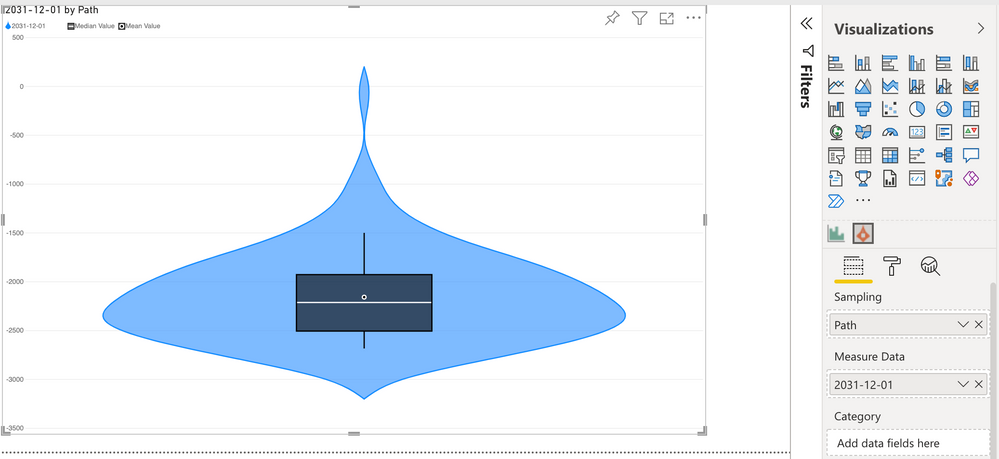
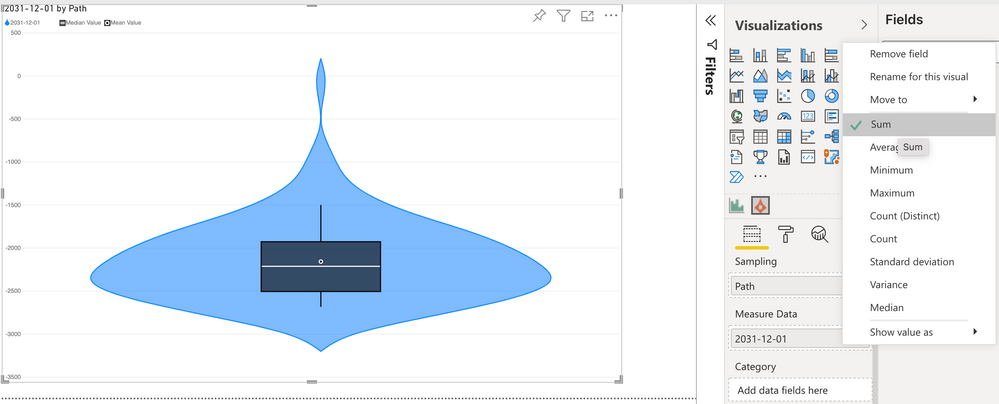
Thanks a lot for your answer. That was really helpful! Actually, I can get the aggregation that I need with your Violin Plot visual.


Screenshot 2022-04-22 at 09.44.48.png

Screenshot 2022-04-22 at 09.45.02.png


Also, since it shows the distribution, it may be a good alternative to the Histogram that I need to develop.


However, if I still needed to create a Histogram, how should I define the data roles and data view mappings in order to have this aggregation? And how do I get the visual to use these calculated values instead of the input fields?


Thanks!

dm-p
Super User
Super User

Hi @ana-pierola,

For any visuals that need to calculate statistics over values and aggregate them, all underlying values need to be provided to the visual dataset so that they can be computed internally. Visuals are not able to know more about the model than what is supplied to the visual data roles and data view mapping (dataset).

In the case of a histogram, you will need to also supply a grouping column/field to your dataset that ensures each row is unique, such as an identify column, otherwise you will not be able to derive the correct values. Note that if you supply lots of data you may need to ensure that you can work with the row limits.

The Violin Plot visual uses this approach also, and I've written a post to explain thy this is necessary here, which may help you to understand how visuals need their data to be able to aggregate it themselves.

Regards,

Daniel


Did I answer your question? Mark my post as a solution!

Proud to be a Super User!


On how to ask a technical question, if you really want an answer (courtesy of SQLBI)


Helpful resources

Announcements
Power BI DataViz World Championships

Power BI Dataviz World Championships

The Power BI Data Visualization World Championships is back! Get ahead of the game and start preparing now!

December 2025 Power BI Update Carousel

Power BI Monthly Update - December 2025

Check out the December 2025 Power BI Holiday Recap!

FabCon Atlanta 2026 carousel

FabCon Atlanta 2026

Join us at FabCon Atlanta, March 16-20, for the ultimate Fabric, Power BI, AI and SQL community-led event. Save $200 with code FABCOMM.