Join us at FabCon Atlanta from March 16 - 20, 2026, for the ultimate Fabric, Power BI, AI and SQL community-led event. Save $200 with code FABCOMM.
Register now!The Power BI Data Visualization World Championships is back! Get ahead of the game and start preparing now! Learn more
Hello,
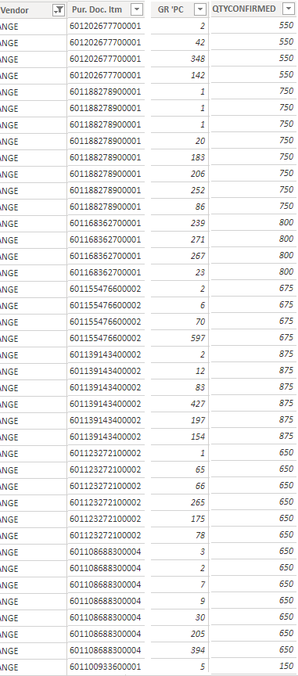
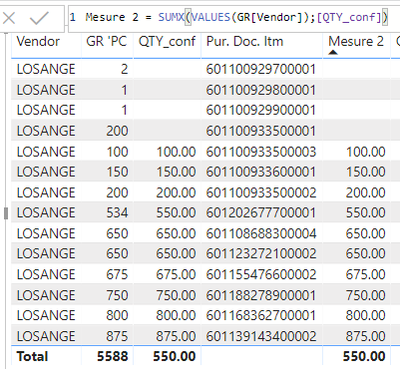
I have a wrong total for my column QTY_conf comparing to the table :
Do you know why I have only 550 in total ?
Thank you,
Best regards,
Ludivine
Solved! Go to Solution.
Hi, @LudivineLOU
The formula is correct for the calculation results of the data in each row of the table.
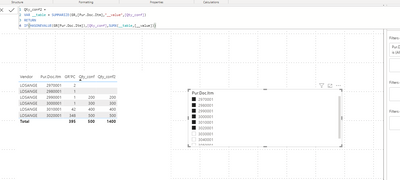
But when calculating the total row, it will first find the largest max [Pur. Doc. Itm] (60120267700700001), so you will get the QTY (550) where [Pur. Doc. Itm] = max [Pur. Doc. Itm] (60120267700700001).
As a workaround , you can try to create another measure to modify the total:
Qty_conf = CALCULATE(SUM(ZE[SUMQTY]),FILTER(ZE,ZE[Pur.Doc.Itm]=MAX(GR[Pur.Doc.Itm])))Qty_conf2 =
VAR __table = SUMMARIZE(GR,[Pur.Doc.Itm],"__value",[Qty_conf])
RETURN
IF(HASONEVALUE(GR[Pur.Doc.Itm]),[Qty_conf],SUMX(__table,[__value]))
Please refer to the sample pbix file attached for more details.
Best Regards,
Community Support Team _ Eason
If this post helps, then please consider Accept it as the solution to help the other members find it more quickly.
@LudivineLOU , is qty_conf is a measure. Then try like
qty_conf new = sumx(values(Table[vendor]),[qty_conf ])
Unfortunetaly, I got the same result 😞
MESURE 2 =
It is a formula in interaction with an other table called ZE.
Qty_conf = CALCULATE(SUM(ZE[SUMQTY]);FILTER(ZE;ZE[Pur. Doc. Itm]=MAX(GR[Pur. Doc. Itm])))
Thanks
Hi, @LudivineLOU
The formula is correct for the calculation results of the data in each row of the table.
But when calculating the total row, it will first find the largest max [Pur. Doc. Itm] (60120267700700001), so you will get the QTY (550) where [Pur. Doc. Itm] = max [Pur. Doc. Itm] (60120267700700001).
As a workaround , you can try to create another measure to modify the total:
Qty_conf = CALCULATE(SUM(ZE[SUMQTY]),FILTER(ZE,ZE[Pur.Doc.Itm]=MAX(GR[Pur.Doc.Itm])))Qty_conf2 =
VAR __table = SUMMARIZE(GR,[Pur.Doc.Itm],"__value",[Qty_conf])
RETURN
IF(HASONEVALUE(GR[Pur.Doc.Itm]),[Qty_conf],SUMX(__table,[__value]))
Please refer to the sample pbix file attached for more details.
Best Regards,
Community Support Team _ Eason
If this post helps, then please consider Accept it as the solution to help the other members find it more quickly.
The Power BI Data Visualization World Championships is back! Get ahead of the game and start preparing now!
| User | Count |
|---|---|
| 40 | |
| 35 | |
| 34 | |
| 31 | |
| 28 |
| User | Count |
|---|---|
| 137 | |
| 102 | |
| 71 | |
| 67 | |
| 65 |