FabCon is coming to Atlanta
Join us at FabCon Atlanta from March 16 - 20, 2026, for the ultimate Fabric, Power BI, AI and SQL community-led event. Save $200 with code FABCOMM.
Register now!- Power BI forums
- Get Help with Power BI
- Desktop
- Service
- Report Server
- Power Query
- Mobile Apps
- Developer
- DAX Commands and Tips
- Custom Visuals Development Discussion
- Health and Life Sciences
- Power BI Spanish forums
- Translated Spanish Desktop
- Training and Consulting
- Instructor Led Training
- Dashboard in a Day for Women, by Women
- Galleries
- Data Stories Gallery
- Themes Gallery
- Contests Gallery
- QuickViz Gallery
- Quick Measures Gallery
- Visual Calculations Gallery
- Notebook Gallery
- Translytical Task Flow Gallery
- TMDL Gallery
- R Script Showcase
- Webinars and Video Gallery
- Ideas
- Custom Visuals Ideas (read-only)
- Issues
- Issues
- Events
- Upcoming Events
The Power BI Data Visualization World Championships is back! Get ahead of the game and start preparing now! Learn more
- Power BI forums
- Forums
- Get Help with Power BI
- Desktop
- Re: how to use countif accross each columns
- Subscribe to RSS Feed
- Mark Topic as New
- Mark Topic as Read
- Float this Topic for Current User
- Bookmark
- Subscribe
- Printer Friendly Page


- Mark as New
- Bookmark
- Subscribe
- Mute
- Subscribe to RSS Feed
- Permalink
- Report Inappropriate Content
how to use countif accross each columns
if there is number not 0 in clolumn it should count 1 from a to c as example below. If all columns values >0 then it should count 1.
I want that result at the end. In excel I used =3- Countif(a1:c1, "0")
A B C RESULT
2.1 8.9 6 3
3.0 0 0 1
0 2.5 8 2
0 0 0 0
Solved! Go to Solution.


- Mark as New
- Bookmark
- Subscribe
- Mute
- Subscribe to RSS Feed
- Permalink
- Report Inappropriate Content
Measure = COUNTX ( FILTER ( TableName, TableName[A] > 0 ), TableName[A] )
        + COUNTX ( FILTER ( TableName, TableName[B] > 0 ), TableName[B] )
        + COUNTX ( FILTER ( TableName, TableName[C] > 0 ), TableName[C] ) + 0
Did I answer your question? Mark my post as a solution!
Did my answers help arrive at a solution? Give it a kudos by clicking the Thumbs Up!
Proud to be a Super User!


- Mark as New
- Bookmark
- Subscribe
- Mute
- Subscribe to RSS Feed
- Permalink
- Report Inappropriate Content
A more elegant solution in Power Query, especially there are more columns,
let
    Source = Table.FromRows(Json.Document(Binary.Decompress(Binary.FromText("i45WMtIzVNJRstCzBJJmQGwA5hkqxepEKxlD+SBsCsSWYFEQz0gPxLcAs4zAKmAyyBhoSiwA", BinaryEncoding.Base64), Compression.Deflate)), let _t = ((type nullable text) meta [Serialized.Text = true]) in type table [A = _t, B = _t, C = _t, D = _t, E = _t]),
    #"Added Custom" = Table.AddColumn(Source, "Result", each List.Accumulate(Record.ToList(_),0,(s,c)=>if c<>"0" then s+1 else s))
in
    #"Added Custom"
BTW, here's a concise Excel formula,
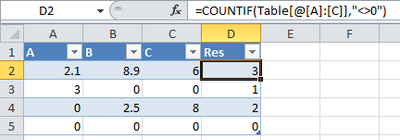
| Thanks to the great efforts by MS engineers to simplify syntax of DAX! Most beginners are SUCCESSFULLY MISLED to think that they could easily master DAX; but it turns out that the intricacy of the most frequently used RANKX() is still way beyond their comprehension! |
DAX is simple, but NOT EASY! |
- Mark as New
- Bookmark
- Subscribe
- Mute
- Subscribe to RSS Feed
- Permalink
- Report Inappropriate Content
Thanks everyone for helping me out, really appreciated. 😊
- Mark as New
- Bookmark
- Subscribe
- Mute
- Subscribe to RSS Feed
- Permalink
- Report Inappropriate Content
A more elegant solution in Power Query, especially there are more columns,
let
    Source = Table.FromRows(Json.Document(Binary.Decompress(Binary.FromText("i45WMtIzVNJRstCzBJJmQGwA5hkqxepEKxlD+SBsCsSWYFEQz0gPxLcAs4zAKmAyyBhoSiwA", BinaryEncoding.Base64), Compression.Deflate)), let _t = ((type nullable text) meta [Serialized.Text = true]) in type table [A = _t, B = _t, C = _t, D = _t, E = _t]),
    #"Added Custom" = Table.AddColumn(Source, "Result", each List.Accumulate(Record.ToList(_),0,(s,c)=>if c<>"0" then s+1 else s))
in
    #"Added Custom"
BTW, here's a concise Excel formula,
| Thanks to the great efforts by MS engineers to simplify syntax of DAX! Most beginners are SUCCESSFULLY MISLED to think that they could easily master DAX; but it turns out that the intricacy of the most frequently used RANKX() is still way beyond their comprehension! |
DAX is simple, but NOT EASY! |
- Mark as New
- Bookmark
- Subscribe
- Mute
- Subscribe to RSS Feed
- Permalink
- Report Inappropriate Content
@CNENFRNL
where should I put this code in blank query? Can we make measure or add column in edit query ?


- Mark as New
- Bookmark
- Subscribe
- Mute
- Subscribe to RSS Feed
- Permalink
- Report Inappropriate Content
Hi @adnankabina !
You can place this in Power Query, new blank query. The DAX code which i provided can be using in New Column.
Regards,
Hasham
- Mark as New
- Bookmark
- Subscribe
- Mute
- Subscribe to RSS Feed
- Permalink
- Report Inappropriate Content
Measure = COUNTX ( FILTER ( TableName, TableName[A] > 0 ), TableName[A] )
        + COUNTX ( FILTER ( TableName, TableName[B] > 0 ), TableName[B] )
        + COUNTX ( FILTER ( TableName, TableName[C] > 0 ), TableName[C] ) + 0
Did I answer your question? Mark my post as a solution!
Did my answers help arrive at a solution? Give it a kudos by clicking the Thumbs Up!
Proud to be a Super User!
- Mark as New
- Bookmark
- Subscribe
- Mute
- Subscribe to RSS Feed
- Permalink
- Report Inappropriate Content
Hi @adnankabina !
You can using following DAX to create new column;
AllColumn =
    VAR _Col1 = IF(Table[A] > 0, 1, 0)
    VAR _Col2 = IF(Table[B] > 0, 1, 0)
    VAR _Col3 = IF(Table[C] > 0, 1, 0)
RETURN
    _Col1 + _Col2 + _Col3
Hope this wil solve your issue.
Regards,
Hasham

Helpful resources

Power BI Dataviz World Championships
The Power BI Data Visualization World Championships is back! Get ahead of the game and start preparing now!

Power BI Monthly Update - November 2025
Check out the November 2025 Power BI update to learn about new features.

FabCon Atlanta 2026
Join us at FabCon Atlanta, March 16-20, for the ultimate Fabric, Power BI, AI and SQL community-led event. Save $200 with code FABCOMM.

| User | Count |
|---|---|
| 65 | |
| 46 | |
| 43 | |
| 26 | |
| 19 |


| User | Count |
|---|---|
| 198 | |
| 126 | |
| 102 | |
| 68 | |
| 51 |


