Get Fabric or SQL Certified for Free.
Get certified for free when you join Fabric Data Days 2026 and dive into Fabric, Power BI, SQL, AI, and other essential data skills.
Join now- Power BI forums
- Get Help with Power BI
- Desktop
- Service
- Report Server
- Power Query
- Mobile Apps
- Developer
- DAX Commands and Tips
- Custom Visuals Development Discussion
- Health and Life Sciences
- Power BI Spanish forums
- Translated Spanish Desktop
- Training and Consulting
- Instructor Led Training
- Dashboard in a Day for Women, by Women
- Galleries
- Data Stories Gallery
- Themes Gallery
- Contests Gallery
- QuickViz Gallery
- Quick Measures Gallery
- Visual Calculations Gallery
- Fabric Apps Gallery
- Notebook Gallery
- Translytical Task Flow Gallery
- TMDL Gallery
- R Script Showcase
- Webinars and Video Gallery
- Ideas
- Custom Visuals Ideas (read-only)
- Issues
- Issues
- Events
- Upcoming Events
July 28 - August 9 | Final Round of the Power BI Dataviz World Championships. This is your chance. Learn more
- Power BI forums
- Forums
- Get Help with Power BI
- Desktop
- Re: dynamic rolling date (last 7 days)
- Subscribe to RSS Feed
- Mark Topic as New
- Mark Topic as Read
- Float this Topic for Current User
- Bookmark
- Subscribe
- Printer Friendly Page

- Mark as New
- Bookmark
- Subscribe
- Mute
- Subscribe to RSS Feed
- Permalink
- Report Inappropriate Content
dynamic date
Hi,
I need a date table that has only the last dates of every month. Like the one below. (I wanted to create a parameter for period end date but that function doesn't seem to be available in power BI). Can you please help!
Thanks
| 31-Jan-18 |
| 28-Feb-18 |
| 31-Mar-18 |
| 30-Apr-18 |
| 31-May-18 |
| 30-Jun-18 |
| 31-Jul-18 |
| 31-Aug-18 |
| 30-Sep-18 |
| 31-Oct-18 |
| 30-Nov-18 |
| 31-Dec-18 |
| 31-Jan-19 |
| 28-Feb-19 |
| 31-Mar-19 |
Solved! Go to Solution.


- Mark as New
- Bookmark
- Subscribe
- Mute
- Subscribe to RSS Feed
- Permalink
- Report Inappropriate Content
You can do this in Edit query mode. Here below are the screen shots.
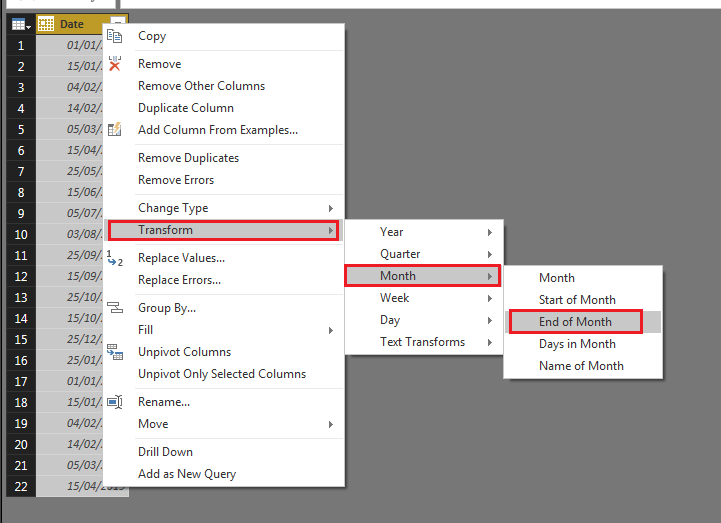
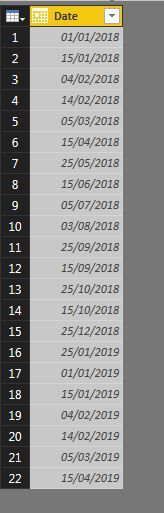
and then right click on the Date header --> Remove duplicate , this will give you one row for each month as last day of the month.
Hope this helps,
SS


- Mark as New
- Bookmark
- Subscribe
- Mute
- Subscribe to RSS Feed
- Permalink
- Report Inappropriate Content
@Anonymous Another way of doing this is.. Using "New Table" option with DAX below
_DimDateEOM = FILTER(CALENDAR("01-01-2018","31-12-2018"),[Date]=EOMONTH([Date],0))
Did I answer your question? Mark my post as a solution!
Proud to be a PBI Community Champion
- Mark as New
- Bookmark
- Subscribe
- Mute
- Subscribe to RSS Feed
- Permalink
- Report Inappropriate Content
You can do this in Edit query mode. Here below are the screen shots.
and then right click on the Date header --> Remove duplicate , this will give you one row for each month as last day of the month.
Hope this helps,
SS
- Mark as New
- Bookmark
- Subscribe
- Mute
- Subscribe to RSS Feed
- Permalink
- Report Inappropriate Content
Hi Dynamic date,
That helped with the current database that I have. But in case where I dont have a date column and I need to create one, this solution wouldnt be helpful. If you have anything around creating a fresh date column lemme know.
Thanks
- Mark as New
- Bookmark
- Subscribe
- Mute
- Subscribe to RSS Feed
- Permalink
- Report Inappropriate Content
Hi Dynamic date,
That helped with the current database that I have. But in case where I dont have a date column and I need to create one, this solution wouldnt be helpful. If you have anything around creating a fresh date column lemme know.
Thanks
- Mark as New
- Bookmark
- Subscribe
- Mute
- Subscribe to RSS Feed
- Permalink
- Report Inappropriate Content
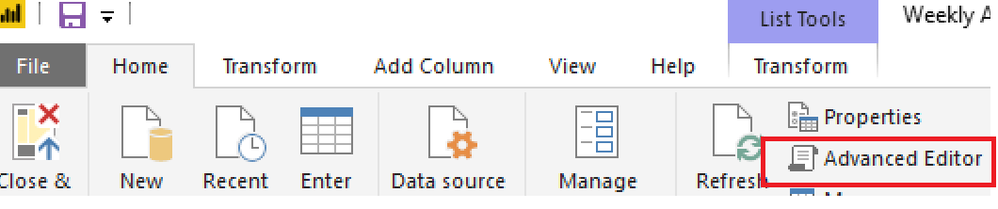
Create a blank query in the query editor and put this in the advanced editor, this will give you end of month dates up to todays date if you want to change the end date, update the DateTime.LocalNow() to the date you want.
let
    Source = #date(2013,1,1),
    Custom1 = List.Dates(Source, Number.From(DateTime.LocalNow())- Number.From(Source) ,#duration(1,0,0,0)),
    #"Converted to Table" = Table.FromList(Custom1, Splitter.SplitByNothing(), null, null, ExtraValues.Error),
    #"Inserted End of Month" = Table.AddColumn(#"Converted to Table", "End of Month", each Date.EndOfMonth([Column1]), type any),
    #"Removed Other Columns" = Table.SelectColumns(#"Inserted End of Month",{"End of Month"}),
    #"Removed Duplicates" = Table.Distinct(#"Removed Other Columns")
in
    #"Removed Duplicates"
- Mark as New
- Bookmark
- Subscribe
- Mute
- Subscribe to RSS Feed
- Permalink
- Report Inappropriate Content
I tried what you mentioned. It has created a table with one row with data as this formula. I dont see any dates.
- Mark as New
- Bookmark
- Subscribe
- Mute
- Subscribe to RSS Feed
- Permalink
- Report Inappropriate Content
@Anonymous Another way of doing this is.. Using "New Table" option with DAX below
_DimDateEOM = FILTER(CALENDAR("01-01-2018","31-12-2018"),[Date]=EOMONTH([Date],0))Did I answer your question? Mark my post as a solution!
Proud to be a PBI Community Champion
- Mark as New
- Bookmark
- Subscribe
- Mute
- Subscribe to RSS Feed
- Permalink
- Report Inappropriate Content
Hi Pattemmanohar,
This was helpful.
Thanks!
- Mark as New
- Bookmark
- Subscribe
- Mute
- Subscribe to RSS Feed
- Permalink
- Report Inappropriate Content
Did you put it in the advanced editor?
- Mark as New
- Bookmark
- Subscribe
- Mute
- Subscribe to RSS Feed
- Permalink
- Report Inappropriate Content
Yep Tried that. Didn't work.
Helpful resources

FabCon & SQLCon – Barcelona 2026
Join us in Barcelona for FabCon and SQLCon, the Fabric, Power BI, SQL, and AI community event. Save €200 with code FABCMTY200.

Fabric Community Sticker Challenge - Barcelona 2026
If you love stickers, then you will definitely want to check out our community sticker challenge, Barcelona edition!

Power BI Monthly Update - July 2026
Check out the July 2026 Power BI update to learn about new features.

Power BI DataViz World Championships - June 2026
A new Power BI DataViz World Championship is coming this June! Don't miss out on submitting your entry.

| User | Count |
|---|---|
| 30 | |
| 28 | |
| 22 | |
| 21 | |
| 19 |


| User | Count |
|---|---|
| 44 | |
| 32 | |
| 18 | |
| 17 | |
| 17 |


