Don't miss your chance to take the Fabric Data Engineer (DP-600) exam for FREE! Find out how by watching the DP-600 session on-demand now through April 28th.
Learn moreJoin the FabCon + SQLCon recap series. Up next: Power BI, Real-Time Intelligence, IQ and AI, and Data Factory take center stage. All sessions are available on-demand after the live show. Register now
Hi,
I'm trying to find a smarter way to create 1 table, to combine 2 types of calculation, i.e. a sum of a category & a result from a measured column.
For example:
sum of Category A = 1000 (which is a sum from the raw data)
sum of Category B = 900 (which is a sum from the raw data)
Gap = 100 (which is returned from a measured column (Gap = SUM([Category A]) + SUM([Category B])
The table result is suppose to look like this:
| Total | Average | |
| Category A | 1000 | 110 |
| Category B | 900 | 95 |
| Gap | 100 | 15 |
Now, have 2 separate tables for Category A & Category B total & average, and another table for the Gap measured total & average.
Solved! Go to Solution.
We used calculated columns to get the desired table, so using slicer here is not work as expected, unless we use calculated measure.
But using calculate measures, we will not be able to get the desired table format, the only way is to use two table visuals.
Best Regards,
Herbert
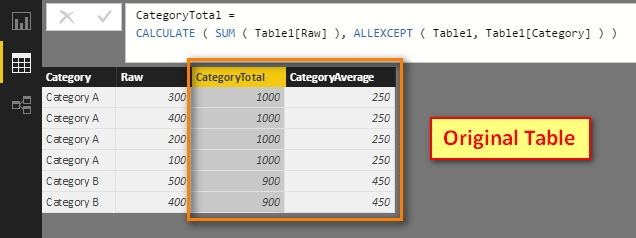
In such scenario, we may need to create another table and some calculated columns as a trick.
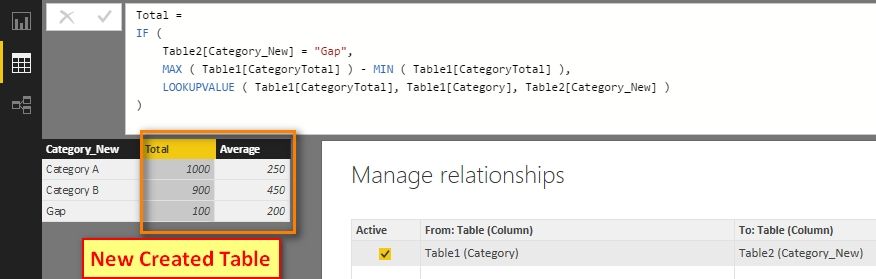
The new created table needs to have a column which includes Category A, B, and Gap like following screenshot. Then we can use IF function to do the desired calculations.
For details, please refer to attached PBIX file.
Best Regards,
Herbert
Hi @v-haibl-msft,
This is awesome. I got the concept & managed to create the format.
However, I faced another challenge.
I have 2 slicers from the raw data table, i.e. Table 1 in this example, i.e. entity & month.
Need a further advise, how can I link the slicers to the new table?
We used calculated columns to get the desired table, so using slicer here is not work as expected, unless we use calculated measure.
But using calculate measures, we will not be able to get the desired table format, the only way is to use two table visuals.
Best Regards,
Herbert
Hi @v-haibl-msft,
Thanks for the explanation.
It's not what I expected, since it took an amount of time to do the setting (for example format, interactions, etc)
But, I can live with separated tables for now ![]()
Thanks again.
Check out the April 2026 Power BI update to learn about new features.
If you have recently started exploring Fabric, we'd love to hear how it's going. Your feedback can help with product improvements.
A new Power BI DataViz World Championship is coming this June! Don't miss out on submitting your entry.
| User | Count |
|---|---|
| 43 | |
| 35 | |
| 33 | |
| 21 | |
| 15 |
| User | Count |
|---|---|
| 64 | |
| 59 | |
| 31 | |
| 27 | |
| 25 |