A new Data Days event is coming soon!
This time we’re going bigger than ever. Fabric, Power BI, SQL, AI and more. We're covering it all. You won't want to miss it.
Learn more- Power BI forums
- Get Help with Power BI
- Desktop
- Service
- Report Server
- Power Query
- Mobile Apps
- Developer
- DAX Commands and Tips
- Custom Visuals Development Discussion
- Health and Life Sciences
- Power BI Spanish forums
- Translated Spanish Desktop
- Training and Consulting
- Instructor Led Training
- Dashboard in a Day for Women, by Women
- Galleries
- Data Stories Gallery
- Themes Gallery
- Contests Gallery
- QuickViz Gallery
- Quick Measures Gallery
- Visual Calculations Gallery
- Notebook Gallery
- Translytical Task Flow Gallery
- TMDL Gallery
- R Script Showcase
- Webinars and Video Gallery
- Ideas
- Custom Visuals Ideas (read-only)
- Issues
- Issues
- Events
- Upcoming Events
Did you hear? There's a new SQL AI Developer certification (DP-800). Start preparing now and be one of the first to get certified. Register now
- Power BI forums
- Forums
- Get Help with Power BI
- Desktop
- Re: YTD calculation
- Subscribe to RSS Feed
- Mark Topic as New
- Mark Topic as Read
- Float this Topic for Current User
- Bookmark
- Subscribe
- Printer Friendly Page

- Mark as New
- Bookmark
- Subscribe
- Mute
- Subscribe to RSS Feed
- Permalink
- Report Inappropriate Content
YTD calculation
Hi everyone,
I need to calculate:
1.- YTD both columns 2016 and 2017
2.- % variation 2017 vs 2016 should be -17% 2016=209.300, but it's wrong.
This is the actual formula, the 2017 is correct data but 2016 should be YTD 5/11/2017 too.
2016=CALCULATE(SUM('table'[transactions];'table'[year] IN { 2016})
2017=CALCULATE(SUM('table'[transactions];'table'[year] IN { 2017})
¿What is the correct calculation YTD?
This is a date table example.
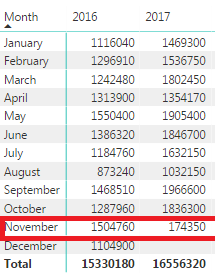
Thank you very much. 
Solved! Go to Solution.
- Mark as New
- Bookmark
- Subscribe
- Mute
- Subscribe to RSS Feed
- Permalink
- Report Inappropriate Content


- Mark as New
- Bookmark
- Subscribe
- Mute
- Subscribe to RSS Feed
- Permalink
- Report Inappropriate Content
Hi,
In your image, the YTD transactions have declined in March 2016 and April 2017. How is that possible? Share your sample dataset and also show the expected result.
Regards,
Ashish Mathur
http://www.ashishmathur.com
https://www.linkedin.com/in/excelenthusiasts/

- Mark as New
- Bookmark
- Subscribe
- Mute
- Subscribe to RSS Feed
- Permalink
- Report Inappropriate Content
@MontsePuig,
Could you please share the raw sample data of your table? We need to verify if the Month field comes from your fact table or date table.
Besides, I am not very clear about the logic you use to calculate % variation 2017 vs 2016 , how do you get -17% and 209300 based on the data in the above Matrix visual?
Regards,
Lydia
- Mark as New
- Bookmark
- Subscribe
- Mute
- Subscribe to RSS Feed
- Permalink
- Report Inappropriate Content
Hi Lydia, Thank you very much for your help.
Here you are the raw data link, I have used Matrix Visualization.
% variation 2017 vs 2016 MTD should be -17% , calculation (174.350 /209.300)-1
% variation 2017 vs 2016 YTD should be 28%, calculation (16.556320/12.929.820)-1
Montse
- Mark as New
- Bookmark
- Subscribe
- Mute
- Subscribe to RSS Feed
- Permalink
- Report Inappropriate Content
Create the following columns in your table.
max = MAX(Hoja1[Date])
Column = DATE(YEAR(Hoja1[max])-1,MONTH(Hoja1[max]),DAY(Hoja1[max]))
Then create the following measures in your table.
YTD For 2016 = CALCULATE(SUM(Hoja1[Transactions]),FILTER(Hoja1,Hoja1[Date]<=MAX(Hoja1[Column])))
YTD For 2017 = CALCULATE(SUM(Hoja1[Transactions]),FILTER(Hoja1,YEAR(Hoja1[Date])= YEAR(TODAY())))
% Variation 2017 vs 2016 YTD = ([YTD For 2017]/[YTD For 2016])-1
2016Nov = CALCULATE(SUM(Hoja1[Transactions]),FILTER(Hoja1,Hoja1[Date]<=MAX(Hoja1[Column]) && MONTH(Hoja1[Date])=MONTH(TODAY())))
2017Nov = CALCULATE(SUM(Hoja1[Transactions]),FILTER(Hoja1,YEAR(Hoja1[Date])= YEAR(TODAY())&&MONTH(Hoja1[Date])=MONTH(TODAY())))
% Variation 2017 vs 2016 for Nov = ([2017Nov]/[2016Nov])-1
Regards,
Lydia
- Mark as New
- Bookmark
- Subscribe
- Mute
- Subscribe to RSS Feed
- Permalink
- Report Inappropriate Content
Hi Lydia, thank you very much for your help.
I understand your idea, I have reproduced your instructions but I think something is wrong. The result of YTD For 2016 and YTD For 2017 are very high numbers.
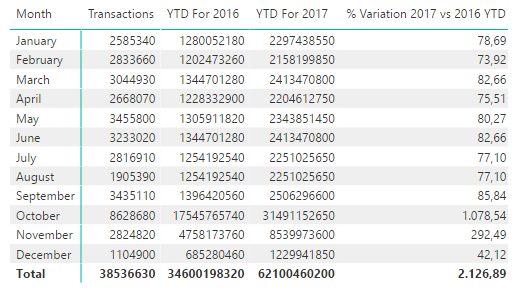
In my example, the numbers are correct but I don't know how to calculate variation % YTD in a current Month (November)
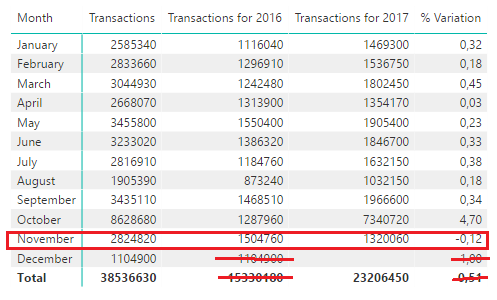
Thank you very much,
- Mark as New
- Bookmark
- Subscribe
- Mute
- Subscribe to RSS Feed
- Permalink
- Report Inappropriate Content
- Mark as New
- Bookmark
- Subscribe
- Mute
- Subscribe to RSS Feed
- Permalink
- Report Inappropriate Content
Hi Lydia,
Now everything is correct. I'm very happy
Thank you very much!
Montse


- Mark as New
- Bookmark
- Subscribe
- Mute
- Subscribe to RSS Feed
- Permalink
- Report Inappropriate Content
Measure = CALCULATE ( Value , DATESYTD ( 'Date' [Date]))
Assume you have a date dimension table named "Date". This should work for you...


- Mark as New
- Bookmark
- Subscribe
- Mute
- Subscribe to RSS Feed
- Permalink
- Report Inappropriate Content
Helpful resources

Power BI Monthly Update - April 2026
Check out the April 2026 Power BI update to learn about new features.

Data Days 2026 coming soon!
Sign up to receive a private message when registration opens and key events begin.

New to Fabric Survey
If you have recently started exploring Fabric, we'd love to hear how it's going. Your feedback can help with product improvements.

Power BI DataViz World Championships - June 2026
A new Power BI DataViz World Championship is coming this June! Don't miss out on submitting your entry.

| User | Count |
|---|---|
| 36 | |
| 33 | |
| 31 | |
| 21 | |
| 16 |


| User | Count |
|---|---|
| 66 | |
| 55 | |
| 31 | |
| 24 | |
| 23 |


