This time we’re going bigger than ever. Fabric, Power BI, SQL, AI and more. We're covering it all. You won't want to miss it.
Learn moreLevel up your Power BI skills this month - build one visual each week and tell better stories with data! Get started
Hi,
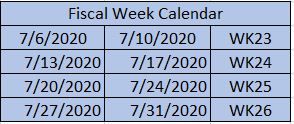
I am trying to calculate weekly workload for the team.
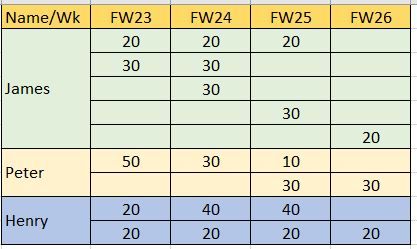
Eg: When a developer plans to complete a Task in 3 weeks (07/06/2020 to 07/24/2020) then his work load should be distributed to 3 weeks (i.e. 60/3 = 20 hours/Week), so he has 20 hours of work for next three weeks.
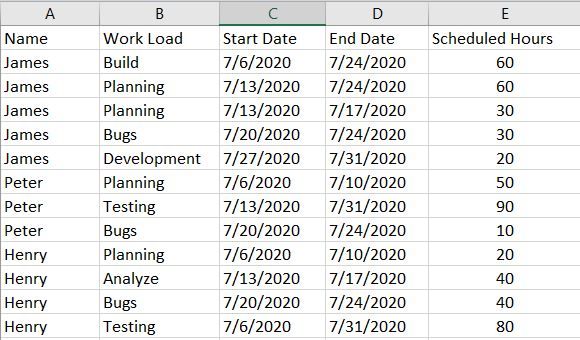
Raw Data
| Name | Work Load | Start Date | End Date | Scheduled Hours |
| James | Build | 7/6/2020 | 7/24/2020 | 60 |
| James | Planning | 7/13/2020 | 7/24/2020 | 60 |
| James | Planning | 7/13/2020 | 7/17/2020 | 30 |
| James | Bugs | 7/20/2020 | 7/24/2020 | 30 |
| James | Development | 7/27/2020 | 7/31/2020 | 20 |
| Peter | Planning | 7/6/2020 | 7/10/2020 | 50 |
| Peter | Testing | 7/13/2020 | 7/31/2020 | 90 |
| Peter | Bugs | 7/20/2020 | 7/24/2020 | 10 |
| Henry | Planning | 7/6/2020 | 7/10/2020 | 20 |
| Henry | Analyze | 7/13/2020 | 7/17/2020 | 40 |
| Henry | Bugs | 7/20/2020 | 7/24/2020 | 40 |
| Henry | Testing | 7/6/2020 | 7/31/2020 | 80 |
Additional Info:
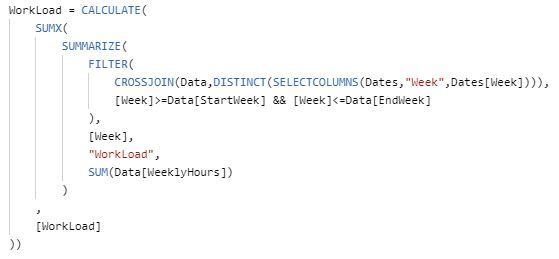
You Can find an example of a solution in this github, which essentially uses the following Measure:
******************************************
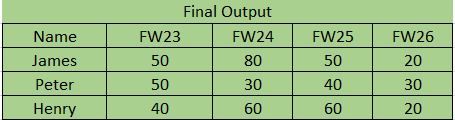
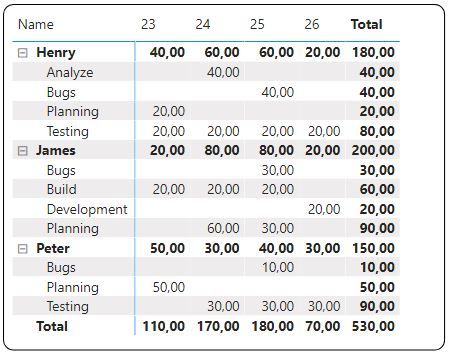
Deliveriung the expected result (Your example Final Output had a mistake with james, who only had 20h workload in Week 23):
Hope this helps.
Check out the April 2026 Power BI update to learn about new features.
Sign up to receive a private message when registration opens and key events begin.
If you have recently started exploring Fabric, we'd love to hear how it's going. Your feedback can help with product improvements.
| User | Count |
|---|---|
| 30 | |
| 24 | |
| 23 | |
| 17 | |
| 15 |
| User | Count |
|---|---|
| 63 | |
| 36 | |
| 30 | |
| 23 | |
| 22 |