This is best Fabric, Power BI, SQL and AI community event. How do we know? The last event sold out! Save €200 with code FABCMTY200.
Register nowThe Fabric community is now in read-only for platform upgrade. Learn more
Hello Experts,
Could you please help me with this issue?
I have a table with monthly sales by Year/Month, like this
| product code | description | year | Jan | feb | Mar | Apr | May | jun | Jul | Aug | Sep | Oct | Nov | Dec |
| M01 | Product A | 2019 | 10 | 12 | 22 | 32 | 12 | 10 | 56 | 23 | 60 | 65 | 90 | 98 |
| M01 | Product A | 2020 | 8 | 15 | 16 | 18 | 25 | 54 | 24 | 65 | 89 | 120 | 100 | 125 |
| M02 | Product B | 2019 | 3 | 13 | 25 | 21 | 17 | 87 | 98 | 34 | 54 | 26 | 43 | 55 |
| M02 | Product B | 2020 | 15 | 32 | 54 | 56 | 76 | 54 | 56 | 43 | 22 | 90 | 18 | 130 |
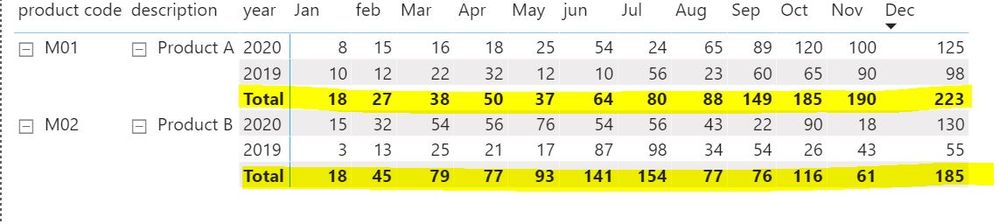
Then, I need generate a new row below each product with the Variation 2020 minus 2019 for each month.
Something like this:
I tried using a matrix, but it only make a sum of the values for each month, Is possible change it to generate a row with variation 2020 minus 2019?..
Solved! Go to Solution.
@gomezc73 - Put together a more concrete example for you with your data. The quick measure basically discusses the concept of how to do it, how to use HASONEVALUE, ISINSCOPE, etc. to find out where you are in the hierarchy/matrix and then you can decide how to do your calculation accordingly. See attached PBIX beneath sig. Page 6, Table (6), Measure 6.
Measure 6 =
VAR __productcode = MAX([product code])
VAR __description = MAX([description])
VAR __year = MAX([year])
VAR __Month = MAX([Attribute])
VAR __2019 = SUMX(FILTER(ALL('Table (6)'),[product code]=__productcode && [description]=__description && [Attribute]=__Month && [year]=2019),[Value])
VAR __2020 = SUMX(FILTER(ALL('Table (6)'),[product code]=__productcode && [description]=__description && [Attribute]=__Month && [year]=2020),[Value])
RETURN
IF(ISINSCOPE([year]),SUM([Value]),__2020 - __2019)
@gomezc73 - You want MM3TR&R - https://community.powerbi.com/t5/Quick-Measures-Gallery/Matrix-Measure-Total-Triple-Threat-Rock-amp-...
Thanks fot your help, It can help is very similar. but i am not an expert user.. Sorry!!. Is very complicated to modified the formula to generated the difference insted MIN/Max or AVE?
@gomezc73 - Put together a more concrete example for you with your data. The quick measure basically discusses the concept of how to do it, how to use HASONEVALUE, ISINSCOPE, etc. to find out where you are in the hierarchy/matrix and then you can decide how to do your calculation accordingly. See attached PBIX beneath sig. Page 6, Table (6), Measure 6.
Measure 6 =
VAR __productcode = MAX([product code])
VAR __description = MAX([description])
VAR __year = MAX([year])
VAR __Month = MAX([Attribute])
VAR __2019 = SUMX(FILTER(ALL('Table (6)'),[product code]=__productcode && [description]=__description && [Attribute]=__Month && [year]=2019),[Value])
VAR __2020 = SUMX(FILTER(ALL('Table (6)'),[product code]=__productcode && [description]=__description && [Attribute]=__Month && [year]=2020),[Value])
RETURN
IF(ISINSCOPE([year]),SUM([Value]),__2020 - __2019)
Join us in Barcelona for FabCon and SQLCon, the Fabric, Power BI, SQL, and AI community event. Save €200 with code FABCMTY200.
| User | Count |
|---|---|
| 21 | |
| 21 | |
| 14 | |
| 14 | |
| 13 |
| User | Count |
|---|---|
| 47 | |
| 35 | |
| 24 | |
| 20 | |
| 19 |