FabCon is coming to Atlanta
Join us at FabCon Atlanta from March 16 - 20, 2026, for the ultimate Fabric, Power BI, AI and SQL community-led event. Save $200 with code FABCOMM.
Register now!- Power BI forums
- Get Help with Power BI
- Desktop
- Service
- Report Server
- Power Query
- Mobile Apps
- Developer
- DAX Commands and Tips
- Custom Visuals Development Discussion
- Health and Life Sciences
- Power BI Spanish forums
- Translated Spanish Desktop
- Training and Consulting
- Instructor Led Training
- Dashboard in a Day for Women, by Women
- Galleries
- Data Stories Gallery
- Themes Gallery
- Contests Gallery
- QuickViz Gallery
- Quick Measures Gallery
- Visual Calculations Gallery
- Notebook Gallery
- Translytical Task Flow Gallery
- TMDL Gallery
- R Script Showcase
- Webinars and Video Gallery
- Ideas
- Custom Visuals Ideas (read-only)
- Issues
- Issues
- Events
- Upcoming Events
The Power BI Data Visualization World Championships is back! Get ahead of the game and start preparing now! Learn more
- Power BI forums
- Forums
- Get Help with Power BI
- Desktop
- Re: Unique number of customers
- Subscribe to RSS Feed
- Mark Topic as New
- Mark Topic as Read
- Float this Topic for Current User
- Bookmark
- Subscribe
- Printer Friendly Page

- Mark as New
- Bookmark
- Subscribe
- Mute
- Subscribe to RSS Feed
- Permalink
- Report Inappropriate Content
Unique number of customers
Hi
I've trying to achieve the following requirement.
I've a table of Part numbers and customers who bought those part numbers. I wish to create a table that contains unique part numbers and next to it, number of unique customers per part number.
Below is example of the data:
| Part # | Customer |
| A-123 | Customer A |
| A-123 | Customer B |
| A-123 | Customer C |
| A-123 | Customer D |
| B-456 | Customer B |
| B-456 | Customer B |
| B-456 | Customer A |
| B-456 | Customer A |
| C-789 | Customer B |
| C-789 | Customer C |
| C-789 | Customer C |
| C-789 | Customer A |
Below is example of the result I wish to get.
| Part # | # of Unique Customers |
| A-123 | 4 |
| B-456 | 2 |
| C-789 | 3 |
Solved! Go to Solution.


- Mark as New
- Bookmark
- Subscribe
- Mute
- Subscribe to RSS Feed
- Permalink
- Report Inappropriate Content
@Anonymous , You can create a measure
distinctcount(Table[Customer])
And use that in visual with item #
Or create a new tbale
summarize(table, Table[Item #], "Cust", distinctcount(Table[Customer]) )

- Mark as New
- Bookmark
- Subscribe
- Mute
- Subscribe to RSS Feed
- Permalink
- Report Inappropriate Content
Hi @Anonymous
You can use Measure = DISTINCTCOUNT ( Table[Customer] ) to achieve this. Just create a table with Part # on left and the new measure on the right.
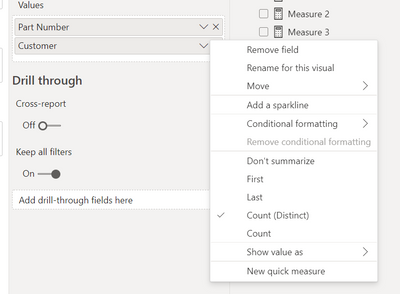
In addition to the above, you can simply have the Table visual with the Part Number on the left, then drag the Customer field on the visual as well. Click the down arrow on Customer, then click on Count (Distinct). This will achieve the same outcome without any code.
Theo 🙂
If I have posted a response that resolves your question, please accept it as a solution to formally close the post.
Also, if you are as passionate about Power BI, DAX and data as I am, please feel free to reach out if you have any questions, queries, or if you simply want to connect and talk to another data geek!
Want to connect?www.linkedin.com/in/theoconias
- Mark as New
- Bookmark
- Subscribe
- Mute
- Subscribe to RSS Feed
- Permalink
- Report Inappropriate Content
@Anonymous , You can create a measure
distinctcount(Table[Customer])
And use that in visual with item #
Or create a new tbale
summarize(table, Table[Item #], "Cust", distinctcount(Table[Customer]) )
- Mark as New
- Bookmark
- Subscribe
- Mute
- Subscribe to RSS Feed
- Permalink
- Report Inappropriate Content
Interesting! @amitchandak
I had similar approach where I tried to use
Helpful resources

Power BI Dataviz World Championships
The Power BI Data Visualization World Championships is back! Get ahead of the game and start preparing now!

Power BI Monthly Update - December 2025
Check out the December 2025 Power BI Holiday Recap!

FabCon Atlanta 2026
Join us at FabCon Atlanta, March 16-20, for the ultimate Fabric, Power BI, AI and SQL community-led event. Save $200 with code FABCOMM.

| User | Count |
|---|---|
| 41 | |
| 38 | |
| 36 | |
| 30 | |
| 28 |


| User | Count |
|---|---|
| 128 | |
| 88 | |
| 79 | |
| 67 | |
| 62 |


