cancel
Showing results for 
Search instead for 
Did you mean: 

Learn from the best! Meet the four finalists headed to the FINALS of the Power BI Dataviz World Championships! Register now

Reply
Anonymous
Not applicable

Time Functions

Hi,

@amitchandak @Ashish_Mathur 

I have data Amount and Date in a table and wanted to calculate some time functions. I dont want to use any calendar table here. I derived Year and Month from the date field and using it for filters.


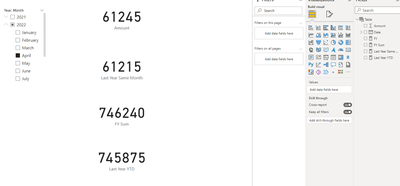
I do have filters like Year and Month. When I select Year 2022 and Month APRIL


1) Selected Month and Year: I just used SUM(Amount) -- I am getting correct results.


2) Same selected Month and Year but Last Year:

CALCULATE(SUM(Amount),SAMEPERIODLASTYEAR(Date))  --- not sure why this is not giving correct results. I suppose to get 2021 APRIL data but it is showing BLANK.
 
3) YTD: My financial year starts from APRIL to MARCH when I selected 2022 and APRIL. I suppose to see 2022 APRIL to 2023 March.  not sure how to get this done.
 
Last Year YTD: When I select 2022 APRIL then I supposed to see 2021 APRIL to 22 MARCH. not sure how to get this done.
 
Appreciated your support.
 
Thanks,
1 ACCEPTED SOLUTION
Anonymous
Not applicable

Hi @Anonymous ,


Please try:

Last Year Same Month = 
CALCULATE(SUM('Table'[Amount]),FILTER(ALL('Table'),YEAR([Date])=SELECTEDVALUE('Table'[Date].[Year])-1 && MONTH([Date])=MAX('Table'[Date].[MonthNo])))
FY = IF(MONTH(MAX('Table'[Date]))<4, YEAR(MAX('Table'[Date]))-1 , YEAR(MAX('Table'[Date])) )
FY Sum = CALCULATE(SUM('Table'[Amount]),FILTER(ALL('Table'),[FY]=MAXX('Table',[FY]))) 
Last Year YTD = CALCULATE(SUM('Table'[Amount]),FILTER(ALL('Table'),[FY]=MAXX('Table',[FY])-1))

Eyelyn9_0-1655797072633.png


Best Regards,
Eyelyn Qin
If this post helps, then please consider Accept it as the solution to help the other members find it more quickly.

View solution in original post

3 REPLIES 3
Anonymous
Not applicable

Hi @Anonymous ,


Please try:

Last Year Same Month = 
CALCULATE(SUM('Table'[Amount]),FILTER(ALL('Table'),YEAR([Date])=SELECTEDVALUE('Table'[Date].[Year])-1 && MONTH([Date])=MAX('Table'[Date].[MonthNo])))
FY = IF(MONTH(MAX('Table'[Date]))<4, YEAR(MAX('Table'[Date]))-1 , YEAR(MAX('Table'[Date])) )
FY Sum = CALCULATE(SUM('Table'[Amount]),FILTER(ALL('Table'),[FY]=MAXX('Table',[FY]))) 
Last Year YTD = CALCULATE(SUM('Table'[Amount]),FILTER(ALL('Table'),[FY]=MAXX('Table',[FY])-1))

Eyelyn9_0-1655797072633.png


Best Regards,
Eyelyn Qin
If this post helps, then please consider Accept it as the solution to help the other members find it more quickly.

Anonymous
Not applicable

Yes it worked, much appreciated your support.

Ashish_Mathur
Super User
Super User

Hi,

Why do you not want to create a Calendar Table?


Regards,
Ashish Mathur
http://www.ashishmathur.com
https://www.linkedin.com/in/excelenthusiasts/

Helpful resources

Announcements
Power BI DataViz World Championships carousel

Power BI DataViz World Championships - June 2026

A new Power BI DataViz World Championship is coming this June! Don't miss out on submitting your entry.

Join our Fabric User Panel

Join our Fabric User Panel

Share feedback directly with Fabric product managers, participate in targeted research studies and influence the Fabric roadmap.

March Power BI Update Carousel

Power BI Community Update - March 2026

Check out the March 2026 Power BI update to learn about new features.