cancel
Showing results for 
Search instead for 
Did you mean: 

Learn from the best! Meet the four finalists headed to the FINALS of the Power BI Dataviz World Championships! Register now

Reply
rivastoday
Frequent Visitor

Support with Calculation evaluating several lines

Hello team I need support with the next:


I need to calculate the distint count of claims, the logic is sum AC1 + AC5 + AC14 with compensation, the formula is the next:


Reparability = CALCULATE([Net_Claims],LAM_Data[GSP Labor Price]>0,LAM_Data[Action Code]=1||LAM_Data[Action Code]=5||LAM_Data[Action Code]=14||LAM_Data[Action Code]=36)


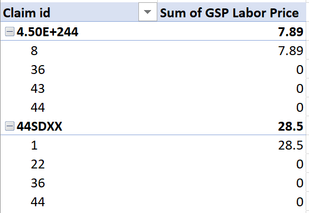
The trouble is the AC36 sometimes is in combination with the AC1 for the same claim, and the compensation is in the AC1, so if I just make the sum of AC36 I would be duplicating claims in my formula. Every claim can have several action codes which means several lines, so what I need is the count of AC36 where the AC1 is not compensated (evaluating several lines for the same claim number)


Capture.PNG


Capture1.PNG


Thanks a Lot for the Support

1 ACCEPTED SOLUTION

Hi @rivastoday,

>>For my formula I need to calculate the distint count of the Claim Number,


You can use the formula below to calculate the distint count of the Claim Number

count=DISTINCTCOUNT(LAM_Data[Claim Number])


>>I need to know how many real claims I have, and then how many compensated with AC1, AC5 and AC14. Additional to my formula I need to add how many AC36 I have, except if the claim with AC36 is in combination with AC1 in the same claim and the AC1 is compensated to avoid duplicity.


Please calculate using the formula below.

Reparability =
CALCULATE (
    DISTINCTCOUNT ( LAM_Data[Claim Number] ),
    FILTER ( LAM_Data, LAM_Data[Compensation ] > 0 || LAM_Data[Action Code] = 1 )
)
    + CALCULATE (
        DISTINCTCOUNT ( LAM_Data[Claim Number] ),
        FILTER ( LAM_Data, LAM_Data[Compensation ] > 0 || LAM_Data[Action Code] = 5 )
    )
    + CALCULATE (
        DISTINCTCOUNT ( LAM_Data[Claim Number] ),
        FILTER ( LAM_Data, LAM_Data[Compensation ] > 0 || LAM_Data[Action Code] = 14 )
    )
    + CALCULATE (
        DISTINCTCOUNT ( LAM_Data[Claim Number] ),
        FILTER (
            LAM_Data,
            LAM_Data[Action Code] = 36
                || LAM_Data[Compensation ] = BLANK
        )
    )


Best Regards,
Angelia


View solution in original post

4 REPLIES 4
v-huizhn-msft
Microsoft Employee
Microsoft Employee

Hi @rivastoday,

After research and preview, I am still confusing about your requirement. Please share your sample data and list expected result. Do hide sensitve information before uploading your data. Or you can create fake data with similar structure. So that we can post detailed solution.


Thanks,
Angelia

Hello Angelia,


Thanks a lot for reply, let me share a better example:


  • I have a column with claim number which can be in many rows depending the action codes contained in the claim (Column Action Code) but only 1 is compensated (Column Compensation)
  • For my formula I need to calculate the distint count of the Claim Number, I need to know how many real claims I have, and then how many compensated with AC1, AC5 and AC14.
  • Additional to my formula I need to add how many AC36 I have, except if the claim with AC36 is in combination with AC1 in the same claim and the AC1 is compensated to avoid duplicity.
  • The logic is the action code with the highest labor is the one compensated but only one by claim. To measure reparability I need to consider AC1, AC5, AC14 and AC36, but if the AC36 is in combination with AC1 this has priority


Claim NumberAction Code Compensation 
448H6Q36 $                         -  
448H6Q1 $                    8.36
448H6Q1 $                         -  
457LVW36 $                    8.36
457LXP1 $                    8.36
457LXP1 $                         -  
457LXP36 $                         -  
457LXP1 $                         -  
45906V1 $                         -  
45906V36 $                         -  
45906V37 $                  10.00
45906V5 $                         -  
4590715 $                  12.00
4590716 $                         -  
4590717 $                         -  
45907914 $                    8.00
45906336 $                    8.36


Thanks Again !!!

Hi @rivastoday,

>>For my formula I need to calculate the distint count of the Claim Number,


You can use the formula below to calculate the distint count of the Claim Number

count=DISTINCTCOUNT(LAM_Data[Claim Number])


>>I need to know how many real claims I have, and then how many compensated with AC1, AC5 and AC14. Additional to my formula I need to add how many AC36 I have, except if the claim with AC36 is in combination with AC1 in the same claim and the AC1 is compensated to avoid duplicity.


Please calculate using the formula below.

Reparability =
CALCULATE (
    DISTINCTCOUNT ( LAM_Data[Claim Number] ),
    FILTER ( LAM_Data, LAM_Data[Compensation ] > 0 || LAM_Data[Action Code] = 1 )
)
    + CALCULATE (
        DISTINCTCOUNT ( LAM_Data[Claim Number] ),
        FILTER ( LAM_Data, LAM_Data[Compensation ] > 0 || LAM_Data[Action Code] = 5 )
    )
    + CALCULATE (
        DISTINCTCOUNT ( LAM_Data[Claim Number] ),
        FILTER ( LAM_Data, LAM_Data[Compensation ] > 0 || LAM_Data[Action Code] = 14 )
    )
    + CALCULATE (
        DISTINCTCOUNT ( LAM_Data[Claim Number] ),
        FILTER (
            LAM_Data,
            LAM_Data[Action Code] = 36
                || LAM_Data[Compensation ] = BLANK
        )
    )


Best Regards,
Angelia


Hello,


I tried the formula and still getting duplicated claims, in the next example the formula considered the AC36 with compensation blank or "0" and also the AC1 compensated, so its counting both. why I need is a formula to evaluate the claim number in different rows and identify if the AC1 is compensated to exclude this combination of AC1+ AC36 from the calculation


Claim NumberAction Code Compensation 
448H6Q36 $                         -  
448H6Q1 $                    8.36
448H6Q1 $                         -  
448H6Q1 $                         - 


Thanks,

Helpful resources

Announcements
Join our Fabric User Panel

Join our Fabric User Panel

Share feedback directly with Fabric product managers, participate in targeted research studies and influence the Fabric roadmap.

February Power BI Update Carousel

Power BI Monthly Update - February 2026

Check out the February 2026 Power BI update to learn about new features.

FabCon Atlanta 2026 carousel

FabCon Atlanta 2026

Join us at FabCon Atlanta, March 16-20, for the ultimate Fabric, Power BI, AI and SQL community-led event. Save $200 with code FABCOMM.