Get Fabric certified for FREE!
Don't miss your chance to take the Fabric Data Engineer (DP-700) exam on us!
Learn more- Power BI forums
- Get Help with Power BI
- Desktop
- Service
- Report Server
- Power Query
- Mobile Apps
- Developer
- DAX Commands and Tips
- Custom Visuals Development Discussion
- Health and Life Sciences
- Power BI Spanish forums
- Translated Spanish Desktop
- Training and Consulting
- Instructor Led Training
- Dashboard in a Day for Women, by Women
- Galleries
- Data Stories Gallery
- Themes Gallery
- Contests Gallery
- QuickViz Gallery
- Quick Measures Gallery
- Visual Calculations Gallery
- Notebook Gallery
- Translytical Task Flow Gallery
- TMDL Gallery
- R Script Showcase
- Webinars and Video Gallery
- Ideas
- Custom Visuals Ideas (read-only)
- Issues
- Issues
- Events
- Upcoming Events
The FabCon + SQLCon recap series starts April 14th at 8am Pacific. If you’re tracking where AI is going inside Fabric, this first session is a can't miss. Register now
- Power BI forums
- Forums
- Get Help with Power BI
- Desktop
- Re: Summarize dates without blanks
- Subscribe to RSS Feed
- Mark Topic as New
- Mark Topic as Read
- Float this Topic for Current User
- Bookmark
- Subscribe
- Printer Friendly Page

- Mark as New
- Bookmark
- Subscribe
- Mute
- Subscribe to RSS Feed
- Permalink
- Report Inappropriate Content
Summarize dates without blanks
Hi all,
I need help with the following dax. I am creating a table that summerizes the latest dates by id. This works well however I have blank dates. How can I get the latest dates where the id has no blank dates against it?
Solved! Go to Solution.


- Mark as New
- Bookmark
- Subscribe
- Mute
- Subscribe to RSS Feed
- Permalink
- Report Inappropriate Content
@Anonymous hi
I have written simple dax similar to your dax except i have applied filter which remove blank dates rows.
It have worked for me.
table2 = SUMMARIZE(FILTER(Table1,Table1[DATE] <> BLANK()),Table1[ID],"MAX DATE",MAX(Table1[DATE]))
Regards,
Novil
If I answer you question, please mark my post as solution.
- Mark as New
- Bookmark
- Subscribe
- Mute
- Subscribe to RSS Feed
- Permalink
- Report Inappropriate Content


- Mark as New
- Bookmark
- Subscribe
- Mute
- Subscribe to RSS Feed
- Permalink
- Report Inappropriate Content
Is it possible for you to share some sample table and the desired output?
Rgds,
Vivek
- Mark as New
- Bookmark
- Subscribe
- Mute
- Subscribe to RSS Feed
- Permalink
- Report Inappropriate Content
| Id | LastEntryDate |
| 11 | 23/05/2019 0:00 |
| 12 | 23/05/2019 0:00 |
| 13 | 23/05/2019 0:00 |
| 24 | 24/05/2019 0:00 |
| 25 | 24/05/2019 0:00 |
| 26 | |
| 49 | |
| 50 | |
| 51 | 31/05/2019 0:00 |
| 52 | 8/06/2019 0:00 |
| 55 | 11/06/2019 0:00 |
- Mark as New
- Bookmark
- Subscribe
- Mute
- Subscribe to RSS Feed
- Permalink
- Report Inappropriate Content
@Anonymous hi
I have written simple dax similar to your dax except i have applied filter which remove blank dates rows.
It have worked for me.
table2 = SUMMARIZE(FILTER(Table1,Table1[DATE] <> BLANK()),Table1[ID],"MAX DATE",MAX(Table1[DATE]))
Regards,
Novil
If I answer you question, please mark my post as solution.


- Mark as New
- Bookmark
- Subscribe
- Mute
- Subscribe to RSS Feed
- Permalink
- Report Inappropriate Content
Hi
If the other column other than the summerized need also to be Non-Blank for example in our case (Table1[ID]) how can we do that?
- Mark as New
- Bookmark
- Subscribe
- Mute
- Subscribe to RSS Feed
- Permalink
- Report Inappropriate Content
Try this-
table2 = SUMMARIZE(FILTER(Table1,Table1[DATE] <> BLANK() && Table1[ID]<>BLANK()),Table1[ID],"MAX DATE",MAX(Table1[DATE]))
Regards,
Novil
If I answer your question, please mark my post as a solution.


- Mark as New
- Bookmark
- Subscribe
- Mute
- Subscribe to RSS Feed
- Permalink
- Report Inappropriate Content
Hey,
I use this kind of DAX statement:
Table =
FILTER(
    ADDCOLUMNS(
        SUMMARIZE(
            VALUES(Table1[Id])
            , Table1[Id]
        )
        , "the latest date" , CALCULATE(LASTNONBLANK('Table1'[LastEntryDate] , MAX('Table1'[LastEntryDate]) ))
    )
    , [the latest date] <> BLANK()
)
This creates a table like this:
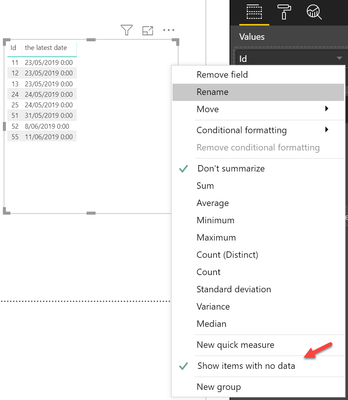
As you can see from the screenshot from above, there really are no blank rows 🙂
You have to be aware that you have to use TREATAS(...) if you want to use the summarized table as a table filter, as the calculation of the last date breaks the lineage to the column [LastEntryDate] like so:
a measure =
var thesummarizedtable = ...
return
CALCULATE(
...
, TREATAS(<thesummarizedtable> , '<the table name>'[Id] , '<the table name>'[LastEntryDate])
)
Hopefully this is what you are looking for.
Regards,
Tom
Did I answer your question? Mark my post as a solution, this will help others!
Proud to be a Super User!
I accept Kudos 😉
Hamburg, Germany
Helpful resources

New to Fabric Survey
If you have recently started exploring Fabric, we'd love to hear how it's going. Your feedback can help with product improvements.

Power BI DataViz World Championships - June 2026
A new Power BI DataViz World Championship is coming this June! Don't miss out on submitting your entry.

Join our Fabric User Panel
Share feedback directly with Fabric product managers, participate in targeted research studies and influence the Fabric roadmap.

Power BI Community Update - March 2026
Check out the March 2026 Power BI update to learn about new features.

| User | Count |
|---|---|
| 53 | |
| 40 | |
| 37 | |
| 19 | |
| 18 |


| User | Count |
|---|---|
| 69 | |
| 67 | |
| 34 | |
| 33 | |
| 30 |


