dear PowerBI masters,
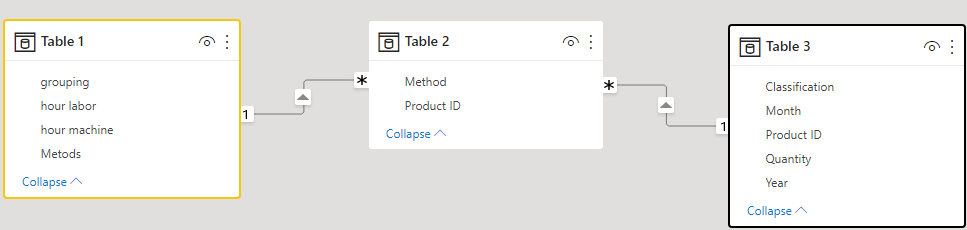
I have a problem with a database, based on multiple tables. The data structure is as follows:
table 1 contains the list of "methods" and the respective "time labor", "time machine" and "grouping"
| Metods | hour labor | hour machine | grouping |
| ABC | 12 | 5 | 2 |
| DEF | 24 | 6 | 6 |
| GHI | 11 | 9 | 8 |
table 2 associates the methods to each product ID. One product ID is linked to one or more methods.
| Product ID | Method |
| 111 | ABC |
| 111 | DEF |
| 222 | DEF |
| 222 | GHI |
| 333 | ABC |
| 333 | DEF |
| 333 | GHI |
| 444 | DEF |
table 3 contains instead the quantities, by Product ID, month, year and classification. Little complexity, the same ID can have multiple rows with same classification, year and month.
| Product ID | Classification | Year | Month | Quantity |
| 111 | … | … | … | … |
I would need a resulting table that, for each "Method" in table 1 is able to sum the "Quantity" in table 3 - maintaining the classification, year and month - for all items that are linked to that "Method" in table 2, i.e.
| Metods | hour labor | hour machine | grouping | Product ID | Classification | Year | Month | Quantity |
| ABC | 12 | 5 | 2 | 111 | … | … | … | … |
| ABC | 12 | 5 | 2 | 333 | | | | |
| DEF | 24 | 6 | 6 | 111 | | | | |
| DEF | 24 | 6 | 6 | 222 | | | | |
| DEF | 24 | 6 | 6 | 444 | | | | |
| GHI | 11 | 9 | 8 | 222 | | | | |
| GHI | 11 | 9 | 8 | 333 | | | | |
not sure what is the best way to do it. Can you please suggest? Should I create a new table combining the existing tables?