This time we’re going bigger than ever. Fabric, Power BI, SQL, AI and more. We're covering it all. You won't want to miss it.
Learn moreLevel up your Power BI skills this month - build one visual each week and tell better stories with data! Get started
Hi Community,
New to Power BI and need your help.
I have got a requirement to separate the project start and end dates from a project dates column.
Project Name Status Dates
| Project1 | Completed | Jan 15-21, 2019 |
| Project2 | Completed | Feb 1-9, 2020 |
Project Name Status Start Date End Date
| Project1 | Completed | Jan 15, 2019 | Jan 21, 2019 |
| Project2 | Completed | Feb 1, 2020 | Feb 9, 2020 |
I tried creating a custom column using REPLACE and CONTAINS functions but no luck.
Cheers
Solved! Go to Solution.
Hi @vabiuser1
How is your Dates field look like if start and end dates in differents monthes?
If you have preiods mandatory from the same month you can try a calculated columns like
Start Date =
var _y = RIGHT([Dates],4)
var _m = LEFT([Dates],3)
var _delimiterPos = SEARCH("-",[Dates])
var _d = MID([Dates],4,_delimiterPos-4)
RETURN
DATEVALUE(CONCATENATE(_d,CONCATENATE(" ",CONCATENATE(_m,CONCATENATE(" ",_y)))))
and
End Date =
var _y = RIGHT([Dates],4)
var _m = LEFT([Dates],3)
var _delimiterPos = SEARCH("-",[Dates])
var _d = MID([Dates],_delimiterPos+1,LEN([Dates])-6-_delimiterPos)
RETURN
DATEVALUE(CONCATENATE(_d,CONCATENATE(" ",CONCATENATE(_m,CONCATENATE(" ",_y)))))
Hi @vabiuser1 ,
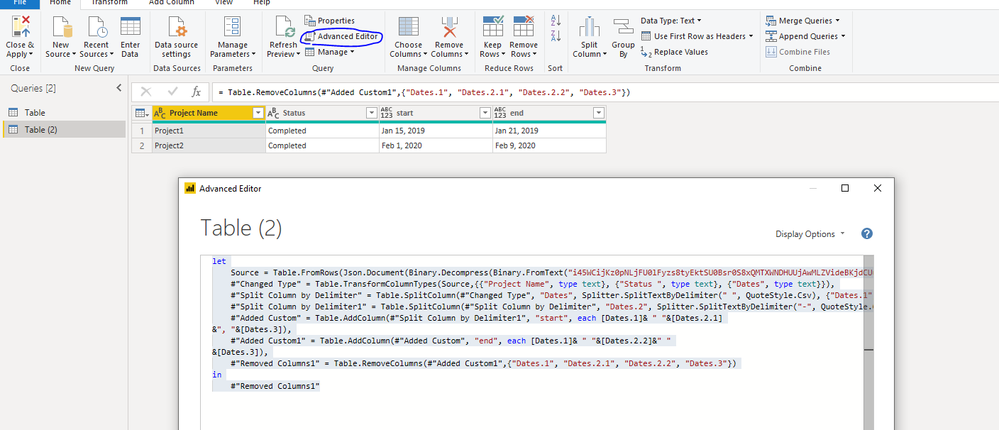
You also could use M code(Edit Queries) to achieve this goal
let
Source = Table.FromRows(Json.Document(Binary.Decompress(Binary.FromText("i45WCijKz0pNLjFU0lFyzs8tyEktSU0Bsr0S8xQMTXWNDHUUjAwMLZVideBKjdCUuqUmKRjqWoIUGhkoxcYCAA==", BinaryEncoding.Base64), Compression.Deflate)), let _t = ((type text) meta [Serialized.Text = true]) in type table [#"Project Name" = _t, #"Status " = _t, Dates = _t]),
#"Changed Type" = Table.TransformColumnTypes(Source,{{"Project Name", type text}, {"Status ", type text}, {"Dates", type text}}),
#"Split Column by Delimiter" = Table.SplitColumn(#"Changed Type", "Dates", Splitter.SplitTextByDelimiter(" ", QuoteStyle.Csv), {"Dates.1", "Dates.2", "Dates.3"}),
#"Split Column by Delimiter1" = Table.SplitColumn(#"Split Column by Delimiter", "Dates.2", Splitter.SplitTextByDelimiter("-", QuoteStyle.Csv), {"Dates.2.1", "Dates.2.2"}),
#"Added Custom" = Table.AddColumn(#"Split Column by Delimiter1", "start", each [Dates.1]& " "&[Dates.2.1]
&", "&[Dates.3]),
#"Added Custom1" = Table.AddColumn(#"Added Custom", "end", each [Dates.1]& " "&[Dates.2.2]&" "
&[Dates.3]),
#"Removed Columns1" = Table.RemoveColumns(#"Added Custom1",{"Dates.1", "Dates.2.1", "Dates.2.2", "Dates.3"})
in
#"Removed Columns1"
Best Regards,
Zoe Zhi
If this post helps, then please consider Accept it as the solution to help the other members find it more quickly.
Hi @vabiuser1 ,
You also could use M code(Edit Queries) to achieve this goal
let
Source = Table.FromRows(Json.Document(Binary.Decompress(Binary.FromText("i45WCijKz0pNLjFU0lFyzs8tyEktSU0Bsr0S8xQMTXWNDHUUjAwMLZVideBKjdCUuqUmKRjqWoIUGhkoxcYCAA==", BinaryEncoding.Base64), Compression.Deflate)), let _t = ((type text) meta [Serialized.Text = true]) in type table [#"Project Name" = _t, #"Status " = _t, Dates = _t]),
#"Changed Type" = Table.TransformColumnTypes(Source,{{"Project Name", type text}, {"Status ", type text}, {"Dates", type text}}),
#"Split Column by Delimiter" = Table.SplitColumn(#"Changed Type", "Dates", Splitter.SplitTextByDelimiter(" ", QuoteStyle.Csv), {"Dates.1", "Dates.2", "Dates.3"}),
#"Split Column by Delimiter1" = Table.SplitColumn(#"Split Column by Delimiter", "Dates.2", Splitter.SplitTextByDelimiter("-", QuoteStyle.Csv), {"Dates.2.1", "Dates.2.2"}),
#"Added Custom" = Table.AddColumn(#"Split Column by Delimiter1", "start", each [Dates.1]& " "&[Dates.2.1]
&", "&[Dates.3]),
#"Added Custom1" = Table.AddColumn(#"Added Custom", "end", each [Dates.1]& " "&[Dates.2.2]&" "
&[Dates.3]),
#"Removed Columns1" = Table.RemoveColumns(#"Added Custom1",{"Dates.1", "Dates.2.1", "Dates.2.2", "Dates.3"})
in
#"Removed Columns1"
Best Regards,
Zoe Zhi
If this post helps, then please consider Accept it as the solution to help the other members find it more quickly.
Hi @vabiuser1
How is your Dates field look like if start and end dates in differents monthes?
If you have preiods mandatory from the same month you can try a calculated columns like
Start Date =
var _y = RIGHT([Dates],4)
var _m = LEFT([Dates],3)
var _delimiterPos = SEARCH("-",[Dates])
var _d = MID([Dates],4,_delimiterPos-4)
RETURN
DATEVALUE(CONCATENATE(_d,CONCATENATE(" ",CONCATENATE(_m,CONCATENATE(" ",_y)))))
and
End Date =
var _y = RIGHT([Dates],4)
var _m = LEFT([Dates],3)
var _delimiterPos = SEARCH("-",[Dates])
var _d = MID([Dates],_delimiterPos+1,LEN([Dates])-6-_delimiterPos)
RETURN
DATEVALUE(CONCATENATE(_d,CONCATENATE(" ",CONCATENATE(_m,CONCATENATE(" ",_y)))))
Check out the April 2026 Power BI update to learn about new features.
Sign up to receive a private message when registration opens and key events begin.
If you have recently started exploring Fabric, we'd love to hear how it's going. Your feedback can help with product improvements.
| User | Count |
|---|---|
| 36 | |
| 33 | |
| 26 | |
| 24 | |
| 17 |
| User | Count |
|---|---|
| 67 | |
| 49 | |
| 32 | |
| 27 | |
| 22 |