cancel
Showing results for 
Search instead for 
Did you mean: 

The Power BI Data Visualization World Championships is back! Get ahead of the game and start preparing now! Learn more

Reply
kevhav
Continued Contributor

Specify one path, when USERELATIONSHIP creates ambiguous paths?

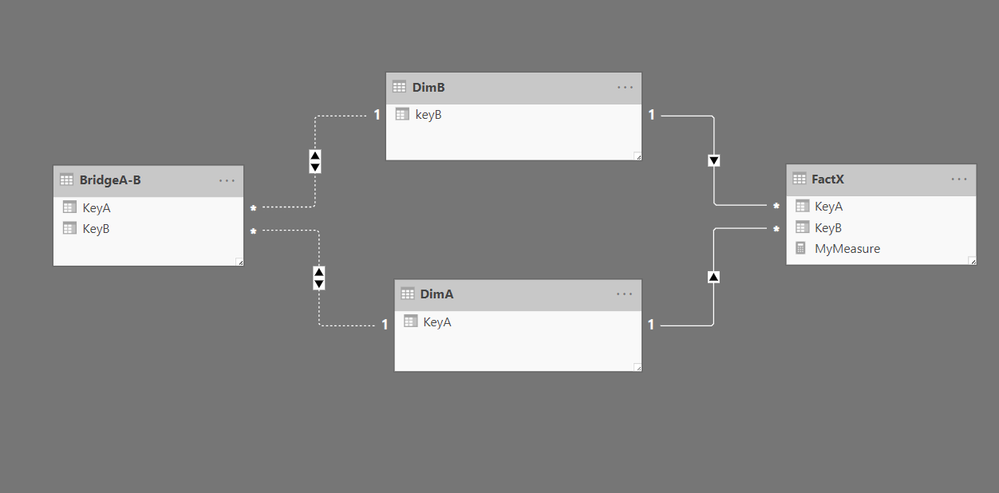
Consider this model...Capture.PNG
 

I want to write a measure such that setting a filter on DimA will filter FactX by using the DimA -> BridgeA-B -> DimB -> FactX path, instead of the direct DimA -> FactX path.


I read about USERELATIONSHIP that "Even if the relationship is inactive, it will be used and overrides any other active relationships that might be present in the model but not mentioned in the function arguments." So I tried "activating" the inactive relationships, hoping this would "override" the direct relationship DimA -> FactX, like this...


MyMeasure = 
    CALCULATE(
        COUNTROWS('FactX')
        ,USERELATIONSHIP('DimA'[KeyA], 'BridgeA-B'[KeyA])
        ,USERELATIONSHIP('BridgeA-B'[KeyB], 'DimB'[KeyB])
    )


...However, I got an error like: There are ambiguous paths between 'FactX' and 'BridgeA-B'


Then, I even tried this...

MyMeasure = 
    CALCULATE(
        COUNTROWS('FactX')
        ,USERELATIONSHIP('DimA'[KeyA], 'BridgeA-B'[KeyA])
        ,USERELATIONSHIP('BridgeA-B'[KeyB], 'DimB'[KeyB])
 ,USERELATIONSHIP('DimB'[KeyB], 'FactX'[KeyB]) )

...Just hoping that if I specified the path between FactX and BridgeA-B that the measure should use, then maybe Power BI would "get it." Because even though there are multiple paths, I am telling it exactly which path to use! So, there should be no ambiguity! But no luck; I still got the same ambiguous paths error.


Then, I found articles like this and this and this. Which seem to indicate there is no solution. 


But, is there any solution? It feels like there should be. Anything I am missing?

2 ACCEPTED SOLUTIONS
v-yuta-msft
Community Support
Community Support

@kevhav ,


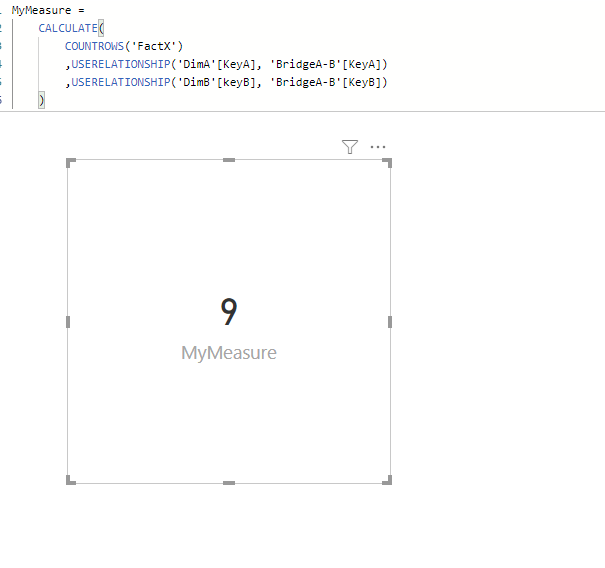
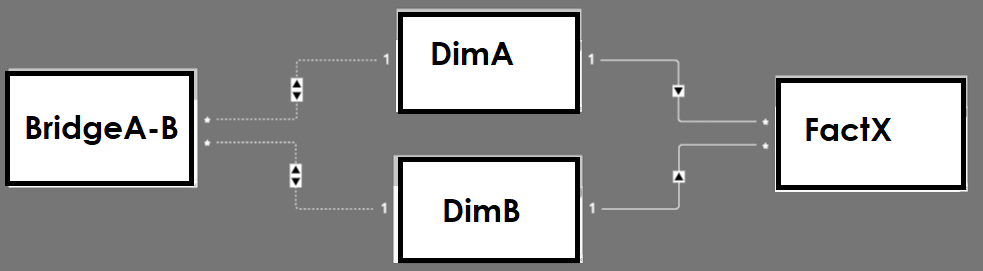
I have make a test but couldn't reproduce your issue, the USERELATIONSHIP() function works well on my side. This issue should be related with your original data. So if possible, could you please share some sample data? The relationship in my demo is as below:

1.PNG 2.PNG 


Community Support Team _ Jimmy Tao

If this post helps, then please consider Accept it as the solution to help the other members find it more quickly.

View solution in original post

kevhav
Continued Contributor

Interesting! Thanks for this reply, @v-yuta-msft ... I cannot share my data as it is now, but I will do some more testing, and see if I can come up with a sample dataset that I can share. 

View solution in original post

2 REPLIES 2
v-yuta-msft
Community Support
Community Support

@kevhav ,


I have make a test but couldn't reproduce your issue, the USERELATIONSHIP() function works well on my side. This issue should be related with your original data. So if possible, could you please share some sample data? The relationship in my demo is as below:

1.PNG 2.PNG 


Community Support Team _ Jimmy Tao

If this post helps, then please consider Accept it as the solution to help the other members find it more quickly.

kevhav
Continued Contributor

Interesting! Thanks for this reply, @v-yuta-msft ... I cannot share my data as it is now, but I will do some more testing, and see if I can come up with a sample dataset that I can share. 

Helpful resources

Announcements
Power BI DataViz World Championships

Power BI Dataviz World Championships

The Power BI Data Visualization World Championships is back! Get ahead of the game and start preparing now!

December 2025 Power BI Update Carousel

Power BI Monthly Update - December 2025

Check out the December 2025 Power BI Holiday Recap!

FabCon Atlanta 2026 carousel

FabCon Atlanta 2026

Join us at FabCon Atlanta, March 16-20, for the ultimate Fabric, Power BI, AI and SQL community-led event. Save $200 with code FABCOMM.