A new Data Days event is coming soon!
This time we’re going bigger than ever. Fabric, Power BI, SQL, AI and more. We're covering it all. You won't want to miss it.
Learn more- Power BI forums
- Get Help with Power BI
- Desktop
- Service
- Report Server
- Power Query
- Mobile Apps
- Developer
- DAX Commands and Tips
- Custom Visuals Development Discussion
- Health and Life Sciences
- Power BI Spanish forums
- Translated Spanish Desktop
- Training and Consulting
- Instructor Led Training
- Dashboard in a Day for Women, by Women
- Galleries
- Data Stories Gallery
- Themes Gallery
- Contests Gallery
- QuickViz Gallery
- Quick Measures Gallery
- Visual Calculations Gallery
- Notebook Gallery
- Translytical Task Flow Gallery
- TMDL Gallery
- R Script Showcase
- Webinars and Video Gallery
- Ideas
- Custom Visuals Ideas (read-only)
- Issues
- Issues
- Events
- Upcoming Events
Level up your Power BI skills this month - build one visual each week and tell better stories with data! Get started
- Power BI forums
- Forums
- Get Help with Power BI
- Desktop
- Re: Running Total with nested calculation
- Subscribe to RSS Feed
- Mark Topic as New
- Mark Topic as Read
- Float this Topic for Current User
- Bookmark
- Subscribe
- Printer Friendly Page

- Mark as New
- Bookmark
- Subscribe
- Mute
- Subscribe to RSS Feed
- Permalink
- Report Inappropriate Content
Running Total with nested calculation
Hi there,
Is there a way to add a nested calculation within a running total?
Example:
When the running total hits 1,000 subtract 900 and continue the running total...

Would it better to try this as a measure or a calculated column?
Thank you.
Solved! Go to Solution.


- Mark as New
- Bookmark
- Subscribe
- Mute
- Subscribe to RSS Feed
- Permalink
- Report Inappropriate Content
you can update the DAX like below
Column =
VAR _SUM=SUMX(FILTER('Table','Table'[date]<=EARLIER('Table'[date])),'Table'[Daily])
VAR _reach=int(_SUM/1000)
VAR _result=_SUM-_reach*900
return if (_result>1000,_result-900,_result)
Did I answer your question? Mark my post as a solution!
Proud to be a Super User!
- Mark as New
- Bookmark
- Subscribe
- Mute
- Subscribe to RSS Feed
- Permalink
- Report Inappropriate Content
agree with @PhilipTreacy , measure is better.
you can try his solution
if you want to create a column, you can try this
Column =
VAR _SUM=SUMX(FILTER('Table','Table'[date]<=EARLIER('Table'[date])),'Table'[Daily])
VAR _reach=int(_SUM/1000)
return _SUM-_reach*900
Did I answer your question? Mark my post as a solution!
Proud to be a Super User!
- Mark as New
- Bookmark
- Subscribe
- Mute
- Subscribe to RSS Feed
- Permalink
- Report Inappropriate Content
Hey Guys,
I tried it both ways and a couple issues - both work for the first trigger.
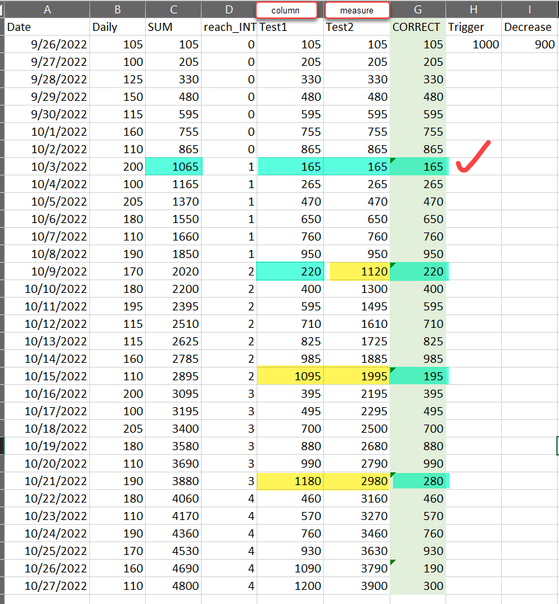
As a measure:

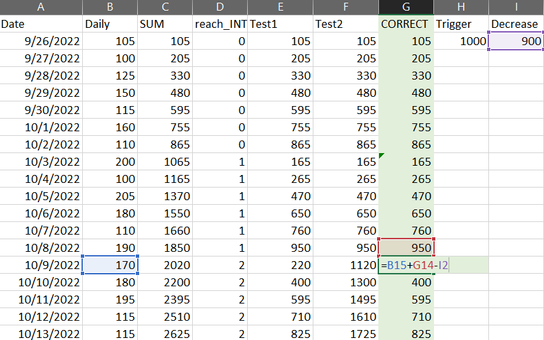
Question 1 - is there any logic I can add behind the measure to calculate off the previous days result instead of SUM?
As a calcualted column:
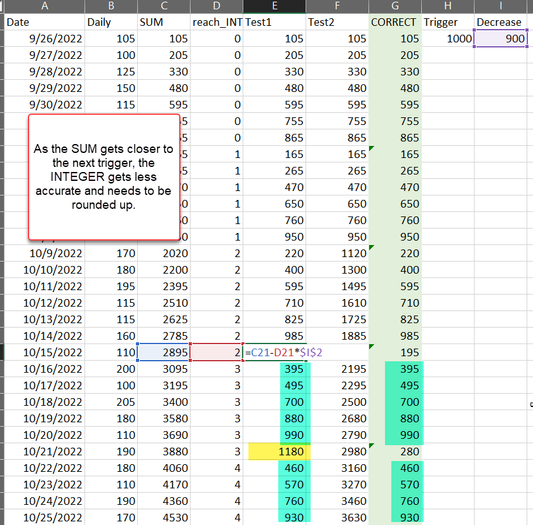

Question 2 - Is there logic behind calculating the integer and rounding it up somehow? This seems like the more comlplex solution though.
I need to take a mental break from this so here is some sample data if anyone wants to take a crack at it. Thank you!
| Date | Daily | SUM | reach_INT | Test1 (column) | Test2 (measure) | CORRECT | Trigger | Decrease |
| 9/26/2022 | 105 | 105 | 0 | 105 | 105 | 105 | 1000 | 900 |
| 9/27/2022 | 100 | 205 | 0 | 205 | 205 | 205 | ||
| 9/28/2022 | 125 | 330 | 0 | 330 | 330 | 330 | ||
| 9/29/2022 | 150 | 480 | 0 | 480 | 480 | 480 | ||
| 9/30/2022 | 115 | 595 | 0 | 595 | 595 | 595 | ||
| 10/1/2022 | 160 | 755 | 0 | 755 | 755 | 755 | ||
| 10/2/2022 | 110 | 865 | 0 | 865 | 865 | 865 | ||
| 10/3/2022 | 200 | 1065 | 1 | 165 | 165 | 165 | ||
| 10/4/2022 | 100 | 1165 | 1 | 265 | 265 | 265 | ||
| 10/5/2022 | 205 | 1370 | 1 | 470 | 470 | 470 | ||
| 10/6/2022 | 180 | 1550 | 1 | 650 | 650 | 650 | ||
| 10/7/2022 | 110 | 1660 | 1 | 760 | 760 | 760 | ||
| 10/8/2022 | 190 | 1850 | 1 | 950 | 950 | 950 | ||
| 10/9/2022 | 170 | 2020 | 2 | 220 | 1120 | 220 | ||
| 10/10/2022 | 180 | 2200 | 2 | 400 | 1300 | 400 | ||
| 10/11/2022 | 195 | 2395 | 2 | 595 | 1495 | 595 | ||
| 10/12/2022 | 115 | 2510 | 2 | 710 | 1610 | 710 | ||
| 10/13/2022 | 115 | 2625 | 2 | 825 | 1725 | 825 | ||
| 10/14/2022 | 160 | 2785 | 2 | 985 | 1885 | 985 | ||
| 10/15/2022 | 110 | 2895 | 2 | 1095 | 1995 | 195 | ||
| 10/16/2022 | 200 | 3095 | 3 | 395 | 2195 | 395 | ||
| 10/17/2022 | 100 | 3195 | 3 | 495 | 2295 | 495 | ||
| 10/18/2022 | 205 | 3400 | 3 | 700 | 2500 | 700 | ||
| 10/19/2022 | 180 | 3580 | 3 | 880 | 2680 | 880 | ||
| 10/20/2022 | 110 | 3690 | 3 | 990 | 2790 | 990 | ||
| 10/21/2022 | 190 | 3880 | 3 | 1180 | 2980 | 280 | ||
| 10/22/2022 | 180 | 4060 | 4 | 460 | 3160 | 460 | ||
| 10/23/2022 | 110 | 4170 | 4 | 570 | 3270 | 570 | ||
| 10/24/2022 | 190 | 4360 | 4 | 760 | 3460 | 760 | ||
| 10/25/2022 | 170 | 4530 | 4 | 930 | 3630 | 930 | ||
| 10/26/2022 | 160 | 4690 | 4 | 1090 | 3790 | 190 | ||
| 10/27/2022 | 110 | 4800 | 4 | 1200 | 3900 | 300 |
- Mark as New
- Bookmark
- Subscribe
- Mute
- Subscribe to RSS Feed
- Permalink
- Report Inappropriate Content
you can update the DAX like below
Column =
VAR _SUM=SUMX(FILTER('Table','Table'[date]<=EARLIER('Table'[date])),'Table'[Daily])
VAR _reach=int(_SUM/1000)
VAR _result=_SUM-_reach*900
return if (_result>1000,_result-900,_result)
Did I answer your question? Mark my post as a solution!
Proud to be a Super User!
- Mark as New
- Bookmark
- Subscribe
- Mute
- Subscribe to RSS Feed
- Permalink
- Report Inappropriate Content
Works beautifully. Thank you both!
- Mark as New
- Bookmark
- Subscribe
- Mute
- Subscribe to RSS Feed
- Permalink
- Report Inappropriate Content
you are welcome
Did I answer your question? Mark my post as a solution!
Proud to be a Super User!

- Mark as New
- Bookmark
- Subscribe
- Mute
- Subscribe to RSS Feed
- Permalink
- Report Inappropriate Content
Hi @kpickle
Yes. Let's say you are calcuting the RT like this (a measure, this is better than a static calculated column)
= CALCULATE(SUM([Actual]), FILTER(ALLSELECTED('Calendar'[Date]),ISONORAFTER('Calendar'[Date], MAX(Actual[Date]), DESC)))
You can modify that to check the value of the running total (storing it in a Variable called _RT) and carry out whatever modification you want based on the value of _RT e.g.
= VAR _RT = CALCULATE(SUM([Actual]), FILTER(ALLSELECTED('Calendar'[Date]),ISONORAFTER('Calendar'[Date], MAX(Actual[Date]), DESC)))

RETURN

IF(_RT > 1000, _RT - 1000, _RT)
Regards
Phil
Did I answer your question? Then please mark my post as the solution.
If I helped you, click on the Thumbs Up to give Kudos.
Blog :: YouTube Channel :: Connect on Linkedin
Proud to be a Super User!

Helpful resources

Power BI Monthly Update - April 2026
Check out the April 2026 Power BI update to learn about new features.

Data Days 2026 coming soon!
Sign up to receive a private message when registration opens and key events begin.

New to Fabric Survey
If you have recently started exploring Fabric, we'd love to hear how it's going. Your feedback can help with product improvements.

Power BI DataViz World Championships - June 2026
A new Power BI DataViz World Championship is coming this June! Don't miss out on submitting your entry.

| User | Count |
|---|---|
| 36 | |
| 33 | |
| 31 | |
| 24 | |
| 18 |


| User | Count |
|---|---|
| 70 | |
| 50 | |
| 33 | |
| 24 | |
| 24 |


