Get Fabric certified for FREE!
Don't miss your chance to take the Fabric Data Engineer (DP-700) exam on us!
Learn more- Power BI forums
- Get Help with Power BI
- Desktop
- Service
- Report Server
- Power Query
- Mobile Apps
- Developer
- DAX Commands and Tips
- Custom Visuals Development Discussion
- Health and Life Sciences
- Power BI Spanish forums
- Translated Spanish Desktop
- Training and Consulting
- Instructor Led Training
- Dashboard in a Day for Women, by Women
- Galleries
- Data Stories Gallery
- Themes Gallery
- Contests Gallery
- QuickViz Gallery
- Quick Measures Gallery
- Visual Calculations Gallery
- Notebook Gallery
- Translytical Task Flow Gallery
- TMDL Gallery
- R Script Showcase
- Webinars and Video Gallery
- Ideas
- Custom Visuals Ideas (read-only)
- Issues
- Issues
- Events
- Upcoming Events
We've captured the moments from FabCon & SQLCon that everyone is talking about, and we are bringing them to the community, live and on-demand. Starts on April 14th. Register now
- Power BI forums
- Forums
- Get Help with Power BI
- Desktop
- Re: Running Total - Incorrect Results
- Subscribe to RSS Feed
- Mark Topic as New
- Mark Topic as Read
- Float this Topic for Current User
- Bookmark
- Subscribe
- Printer Friendly Page

- Mark as New
- Bookmark
- Subscribe
- Mute
- Subscribe to RSS Feed
- Permalink
- Report Inappropriate Content
Running Total - Incorrect Results
I have searched the forum for possible solution to below scenario, could not find any leads.
Following is the data snapshot:
| Date | Sales Person | Geography | Sales |
| 1/1/2017 | A | X | 10 |
| 1/1/2017 | A | Y | 10 |
| 1/1/2017 | A | Z | 10 |
| 1/1/2017 | B | X | 10 |
| 1/1/2017 | B | Y | 10 |
| 1/1/2017 | B | Z | 10 |
| 1/1/2017 | C | X | 10 |
| 1/1/2017 | C | Y | 10 |
| 1/1/2017 | C | Z | 10 |
| 1/2/2017 | A | X | 10 |
| 1/2/2017 | A | Y | 10 |
| 1/2/2017 | A | Z | 10 |
| 1/2/2017 | B | X | 10 |
| 1/2/2017 | B | Y | 10 |
| 1/2/2017 | B | Z | 10 |
| 1/2/2017 | C | X | 10 |
| 1/2/2017 | C | Y | 10 |
| 1/2/2017 | C | Z | 10 |
| 1/3/2017 | A | X | 10 |
| 1/3/2017 | A | Y | 10 |
| 1/3/2017 | A | Z | 10 |
| 1/3/2017 | B | X | 10 |
| 1/3/2017 | B | Y | 10 |
| 1/3/2017 | B | Z | 10 |
| 1/3/2017 | C | X | 10 |
| 1/3/2017 | C | Y | 10 |
| 1/3/2017 | C | Z | 10 |
| 1/4/2017 | A | X | 10 |
| 1/4/2017 | B | X | 10 |
| 1/4/2017 | C | X | 10 |
| 1/4/2017 | A | Y | 10 |
| 1/4/2017 | B | Y | 10 |
| 1/4/2017 | C | Y | 10 |
| 1/4/2017 | A | Z | 10 |
| 1/4/2017 | B | Z | 10 |
Notice how C Sales person for Z geography is missing for 1/4/2017.
This is the calculation for calculating MTD value:
MTD = CALCULATE(SUM(Sheet1[Sales]), ALLEXCEPT(Sheet1, Sheet1[Sales Person], Sheet1[Geography]), Sheet1[Date] <= EARLIER(Sheet1[Date]), DATESMTD('Date'[Date]))
This is the output generated:
| Date | Sales | MTD |
| 1/1/2017 | 90 | 90 |
| 1/2/2017 | 90 | 180 |
| 1/3/2017 | 90 | 270 |
| 1/4/2017 | 80 | 320 |
As you see the result expected for 1/4/2017, is 270+80=350. But what is happening here is that since C, Z combination is missing for 1/4/2017, the previous sum of this combination is missed and the result is 320.
How will I get the expected result? Thanks in advance.
Solved! Go to Solution.


- Mark as New
- Bookmark
- Subscribe
- Mute
- Subscribe to RSS Feed
- Permalink
- Report Inappropriate Content
The problem is that you want a calculated column and my answer was to a measure =(
I'm sure that other friends in community can help you. I'm sign out until tomorrow.
Good Luck
Lima - Peru


- Mark as New
- Bookmark
- Subscribe
- Mute
- Subscribe to RSS Feed
- Permalink
- Report Inappropriate Content
It's 320 cause you are using calculated column. Behind the scenes, it iterates row by row and cumulatives sum values, but there are 8 rows in April when it should be 9 rows as another months. My recommendation is using calculated measure.
- Mark as New
- Bookmark
- Subscribe
- Mute
- Subscribe to RSS Feed
- Permalink
- Report Inappropriate Content
It's 320 cause you are using calculated column. Behind the scenes, it iterates row by row and cumulatives sum values, but there are 8 rows in April when it should be 9 rows as another months. My recommendation is using calculated measure.
- Mark as New
- Bookmark
- Subscribe
- Mute
- Subscribe to RSS Feed
- Permalink
- Report Inappropriate Content
Thanks @tringuyenminh92. The following formula gives the correct and expected result for a measure:
TOTALMTD(Sum(Sheet1[Sales]), Sheet1[Date])
- Mark as New
- Bookmark
- Subscribe
- Mute
- Subscribe to RSS Feed
- Permalink
- Report Inappropriate Content
- Mark as New
- Bookmark
- Subscribe
- Mute
- Subscribe to RSS Feed
- Permalink
- Report Inappropriate Content
Thanks Victor for quick reply. Tried it, it doesnt even work as expected:
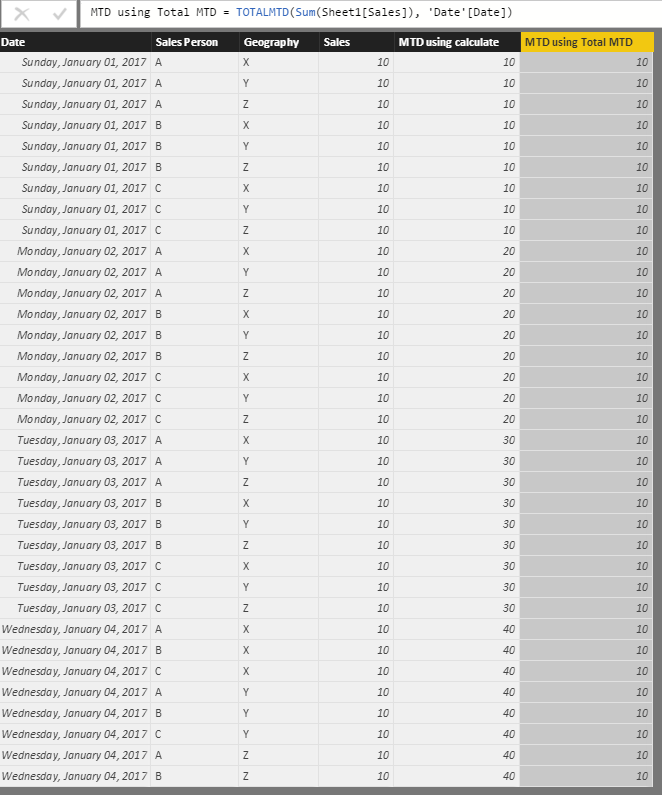
- Mark as New
- Bookmark
- Subscribe
- Mute
- Subscribe to RSS Feed
- Permalink
- Report Inappropriate Content
The TOTALMTD works now, but it is working same as the other calculation, this is the TOTALMTD formula:
MTD using Total MTD = TOTALMTD(Sum(Sheet1[Sales]), 'Date'[Date], ALLEXCEPT(Sheet1, Sheet1[Sales Person], Sheet1[Geography]))

But we still have the missing previous total for combination mentioned in OP.
- Mark as New
- Bookmark
- Subscribe
- Mute
- Subscribe to RSS Feed
- Permalink
- Report Inappropriate Content
The problem is that you want a calculated column and my answer was to a measure =(
I'm sure that other friends in community can help you. I'm sign out until tomorrow.
Good Luck
Lima - Peru

Helpful resources

New to Fabric Survey
If you have recently started exploring Fabric, we'd love to hear how it's going. Your feedback can help with product improvements.

Power BI DataViz World Championships - June 2026
A new Power BI DataViz World Championship is coming this June! Don't miss out on submitting your entry.

Join our Fabric User Panel
Share feedback directly with Fabric product managers, participate in targeted research studies and influence the Fabric roadmap.

Power BI Community Update - March 2026
Check out the March 2026 Power BI update to learn about new features.

| User | Count |
|---|---|
| 52 | |
| 38 | |
| 37 | |
| 19 | |
| 18 |


| User | Count |
|---|---|
| 67 | |
| 67 | |
| 34 | |
| 32 | |
| 29 |


