FabCon is coming to Atlanta
Join us at FabCon Atlanta from March 16 - 20, 2026, for the ultimate Fabric, Power BI, AI and SQL community-led event. Save $200 with code FABCOMM.
Register now!- Power BI forums
- Get Help with Power BI
- Desktop
- Service
- Report Server
- Power Query
- Mobile Apps
- Developer
- DAX Commands and Tips
- Custom Visuals Development Discussion
- Health and Life Sciences
- Power BI Spanish forums
- Translated Spanish Desktop
- Training and Consulting
- Instructor Led Training
- Dashboard in a Day for Women, by Women
- Galleries
- Data Stories Gallery
- Themes Gallery
- Contests Gallery
- QuickViz Gallery
- Quick Measures Gallery
- Visual Calculations Gallery
- Notebook Gallery
- Translytical Task Flow Gallery
- TMDL Gallery
- R Script Showcase
- Webinars and Video Gallery
- Ideas
- Custom Visuals Ideas (read-only)
- Issues
- Issues
- Events
- Upcoming Events
The Power BI Data Visualization World Championships is back! Get ahead of the game and start preparing now! Learn more
- Power BI forums
- Forums
- Get Help with Power BI
- Desktop
- Rolling total of calculated measure
- Subscribe to RSS Feed
- Mark Topic as New
- Mark Topic as Read
- Float this Topic for Current User
- Bookmark
- Subscribe
- Printer Friendly Page

- Mark as New
- Bookmark
- Subscribe
- Mute
- Subscribe to RSS Feed
- Permalink
- Report Inappropriate Content
Rolling total of calculated measure
Hello,
I am trying to calculate measure Rolling Total like on screenshot below. Measures Sent and Returns are coming from one table, and the Delivery number is an attribute from related table which is connected by relationship.
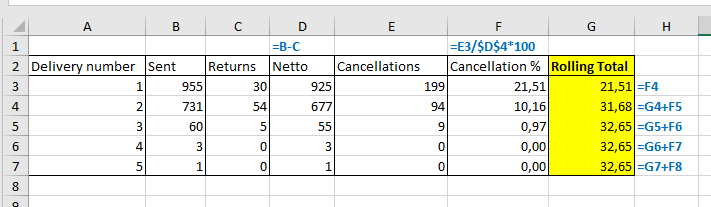
Cancellation is calculated measure and we are using formulas like below:
Cancellations :=
VAR NextPack =
MAX ( 'Order'[DeliveryNumber] ) + 1
VAR NextOrders =
CALCULATE (
SUM ( 'Fact Rolling'[Sent] ) - SUM ( 'Fact Rolling'[Returned] ),
'Order'[DeliveryNumber] = NextPack
)
VAR CurrentOrders =
IF (
NextPack = 1,
CALCULATE (
SUM ( 'Fact Subscriptions'[NewSubscriptions] ),
'Order'[DeliveryNumber] = 0
),
SUM ( 'Fact Rolling'[Sent] ) - SUM ( 'Fact Rolling'[Returned] )
- SUM ( 'Fact Rolling'[ActiveSubscriptions] )
)
RETURN
IF (
ISBLANK ( MAX ( 'Order'[DeliveryNumber] ) ),
BLANK (),
CurrentOrders - NextOrders
)
----------
Cancellation % (DropOff):=
VAR Netto =
IF (
MAX ( 'Order'[DeliveryNumber] ) = 0,
CALCULATE (
SUM ( 'Fact Subscriptions'[NewSubscriptions] ),
'Order'[DeliveryNumber] = 0
),
[Netto]
)
RETURN
DIVIDE ( [Cancellations (Rolling Total)], Netto )
As it should be calculated dynamically we are trying calculate Rolling Total like below
DropOff (DropOff):=
CALCULATE(
IF (
ISBLANK ( MAX ( 'Order'[DeliveryNumber] ) ),
BLANK (),
[Cancellation % (Rolling Total)]
), FILTER(ALL('Order'[DeliveryNumber]), 'Order'[DeliveryNumber] <= MAX('Order'[DeliveryNumber])))
But calculation still not returns data like in presented table. We are receiving data like below
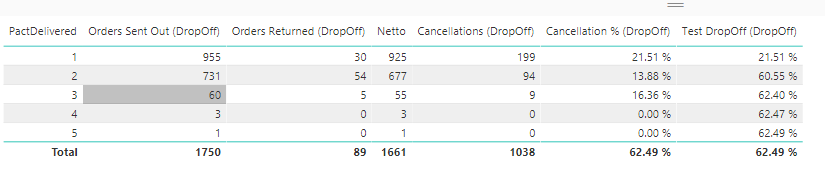
We assuming we have problem with below part, but have no idea how to calculate it in other way.
VAR NextPack =
MAX ( 'Order'[DeliveryNumber] ) + 1
Calculation for cancellation base on below formula:
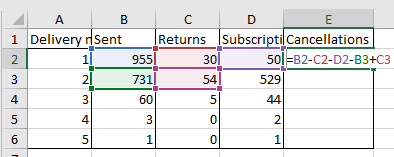
Solved! Go to Solution.


- Mark as New
- Bookmark
- Subscribe
- Mute
- Subscribe to RSS Feed
- Permalink
- Report Inappropriate Content
Hi @kt_powerbiuser,
From your measures, I found that we cannot calculate the Rolling total before should be caused by the context.
You could modify your formula refer to the measure below.
Rolling Total =
CALCULATE (
    SUMX (
        ADDCOLUMNS (
            SUMMARIZE ( 'Fact DropOff', 'Order'[PactDelivered] ),
            "Value", [Cancellation % (DropOff)]
        ),
        [Value]
    ),
    FILTER (
        ALL ( 'Order'[PactDelivered] ),
        'Order'[PactDelivered] <= MAX ( 'Order'[PactDelivered] )
    )
)
Then you should get the right Roliing total.
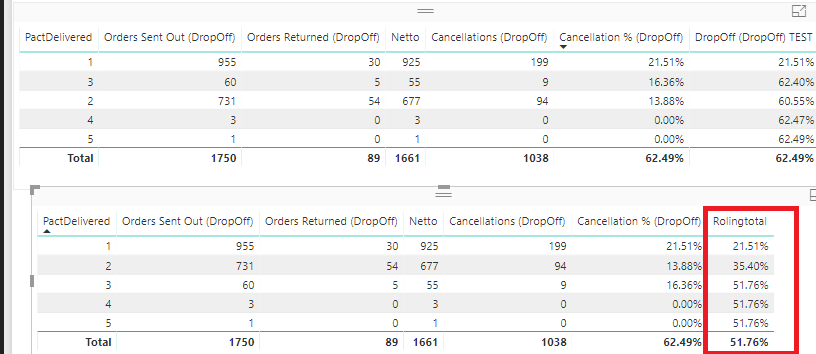
Hope this can help you!
Best Regards,
Cherry
If this post helps, then please consider Accept it as the solution to help the other members find it more quickly.
- Mark as New
- Bookmark
- Subscribe
- Mute
- Subscribe to RSS Feed
- Permalink
- Report Inappropriate Content
Hi @kt_powerbiuser,
Although you have posted the details information, I still need more details such as your another table Fact Subscriptions.
If it is conventient, could you share a dummy pbix file which can reproduce the scenario, so that we can help further investigate on it? You can upload it to OneDrive or Dropbox and post the link here. Do mask sensitive data before uploading.)
Best Regards,
Cherry
If this post helps, then please consider Accept it as the solution to help the other members find it more quickly.
- Mark as New
- Bookmark
- Subscribe
- Mute
- Subscribe to RSS Feed
- Permalink
- Report Inappropriate Content
Hello @v-piga-msft,
Thank you for your reply. I put here crucial part of my model https://drive.google.com/open?id=1achCPQpKEv1w5iXnJiaMLAIKD92k8f60.
I will be very gratefull for some tips.
Regards,
kt
- Mark as New
- Bookmark
- Subscribe
- Mute
- Subscribe to RSS Feed
- Permalink
- Report Inappropriate Content
Hi @kt_powerbiuser,
From your measures, I found that we cannot calculate the Rolling total before should be caused by the context.
You could modify your formula refer to the measure below.
Rolling Total =
CALCULATE (
    SUMX (
        ADDCOLUMNS (
            SUMMARIZE ( 'Fact DropOff', 'Order'[PactDelivered] ),
            "Value", [Cancellation % (DropOff)]
        ),
        [Value]
    ),
    FILTER (
        ALL ( 'Order'[PactDelivered] ),
        'Order'[PactDelivered] <= MAX ( 'Order'[PactDelivered] )
    )
)
Then you should get the right Roliing total.
Hope this can help you!
Best Regards,
Cherry
If this post helps, then please consider Accept it as the solution to help the other members find it more quickly.
- Mark as New
- Bookmark
- Subscribe
- Mute
- Subscribe to RSS Feed
- Permalink
- Report Inappropriate Content
- Mark as New
- Bookmark
- Subscribe
- Mute
- Subscribe to RSS Feed
- Permalink
- Report Inappropriate Content
Hello,
I am trying to calculate measure DroppOff like on screenshot below. Measures Orders sent ot and Returns are coming from one table, and the PactDelivered is an attribute from related table which is connected by relationship.
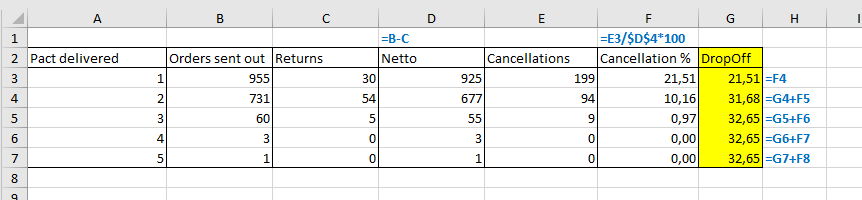
Cancellation is calculated measure and we are using formulas like below:
Cancellations (DropOff):=
VAR NextPack =
MAX ( 'Order'[PactDelivered] ) + 1
VAR NextOrders =
CALCULATE (
SUM ( 'Fact DropOff'[OrdersSentOut] ) - SUM ( 'Fact DropOff'[OrdersReturned] ),
'Order'[PactDelivered] = NextPack
)
VAR CurrentOrders =
IF (
NextPack = 1,
CALCULATE (
SUM ( 'Fact Subscriptions'[NewSubscriptions] ),
'Order'[PactDelivered] = 0
),
SUM ( 'Fact DropOff'[OrdersSentOut] ) - SUM ( 'Fact DropOff'[OrdersReturned] )
- SUM ( 'Fact DropOff'[ActiveSubscriptions] )
)
RETURN
IF (
ISBLANK ( MAX ( 'Order'[PactDelivered] ) ),
BLANK (),
CurrentOrders - NextOrders
)
----------
Cancellation % (DropOff):=
VAR Netto =
IF (
MAX ( 'Order'[PactDelivered] ) = 0,
CALCULATE (
SUM ( 'Fact Subscriptions'[NewSubscriptions] ),
'Order'[PactDelivered] = 0
),
[Netto]
)
RETURN
DIVIDE ( [Cancellations (DropOff)], Netto )
As it should be calculated dynamically we are trying calculate DropOff like below
DropOff (DropOff):=
CALCULATE(
IF (
ISBLANK ( MAX ( 'Order'[PactDelivered] ) ),
BLANK (),
[Cancellation % (DropOff)]
), FILTER(ALL('Order'[PactDelivered]), 'Order'[PactDelivered] <= max('Order'[PactDelivered])))
But calculation still not returns data like in presented table. We are receiving data like below
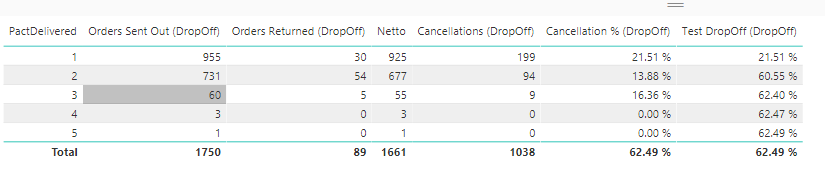
We assuming we have problem with part
VAR NextPack =
MAX ( 'Order'[PactDelivered] ) + 1
But have no idea how to calculate it in other way.
EDIT:
Calculation for cancellation base on below formula:


Helpful resources

Power BI Dataviz World Championships
The Power BI Data Visualization World Championships is back! Get ahead of the game and start preparing now!

Power BI Monthly Update - November 2025
Check out the November 2025 Power BI update to learn about new features.

FabCon Atlanta 2026
Join us at FabCon Atlanta, March 16-20, for the ultimate Fabric, Power BI, AI and SQL community-led event. Save $200 with code FABCOMM.

| User | Count |
|---|---|
| 59 | |
| 46 | |
| 42 | |
| 23 | |
| 18 |


| User | Count |
|---|---|
| 190 | |
| 122 | |
| 96 | |
| 66 | |
| 47 |


