Get Fabric or SQL Certified for Free.
Get certified for free when you join Fabric Data Days 2026 and dive into Fabric, Power BI, SQL, AI, and other essential data skills.
Join now- Power BI forums
- Get Help with Power BI
- Desktop
- Service
- Report Server
- Power Query
- Mobile Apps
- Developer
- DAX Commands and Tips
- Custom Visuals Development Discussion
- Health and Life Sciences
- Power BI Spanish forums
- Translated Spanish Desktop
- Training and Consulting
- Instructor Led Training
- Dashboard in a Day for Women, by Women
- Galleries
- Data Stories Gallery
- Themes Gallery
- Contests Gallery
- QuickViz Gallery
- Quick Measures Gallery
- Visual Calculations Gallery
- Notebook Gallery
- Translytical Task Flow Gallery
- TMDL Gallery
- R Script Showcase
- Webinars and Video Gallery
- Ideas
- Custom Visuals Ideas (read-only)
- Issues
- Issues
- Events
- Upcoming Events
Try your skills in the Power BI Dataviz World Championship! Round one ends June 26. Join now
- Power BI forums
- Forums
- Get Help with Power BI
- Desktop
- Re: Previous Value Using DAX
- Subscribe to RSS Feed
- Mark Topic as New
- Mark Topic as Read
- Float this Topic for Current User
- Bookmark
- Subscribe
- Printer Friendly Page

- Mark as New
- Bookmark
- Subscribe
- Mute
- Subscribe to RSS Feed
- Permalink
- Report Inappropriate Content
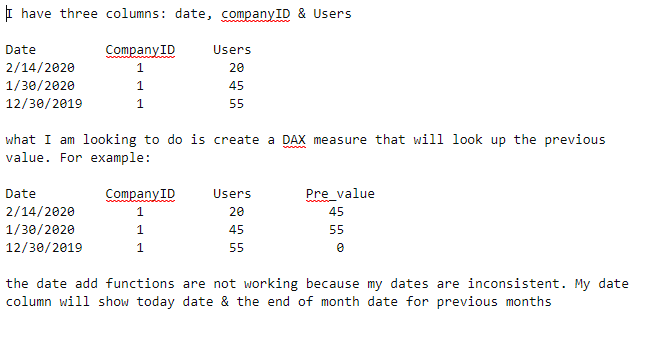


- Mark as New
- Bookmark
- Subscribe
- Mute
- Subscribe to RSS Feed
- Permalink
- Report Inappropriate Content
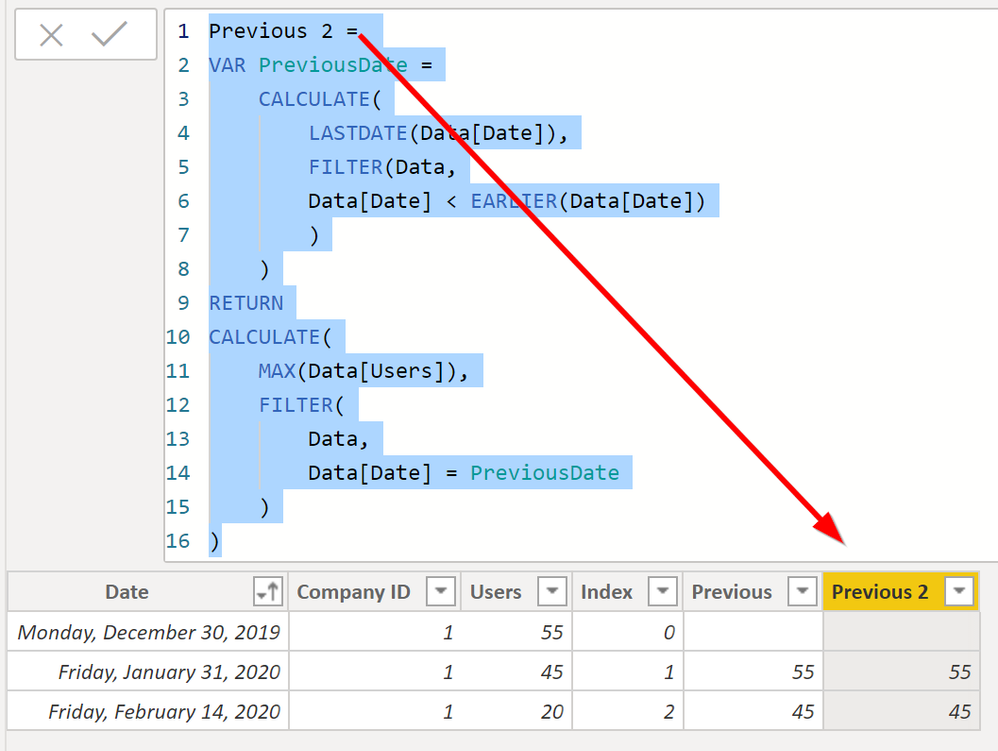
EDIT: Better way with no index, but I'm leaving my previous reply there. The Index method would allow you to move up/down by any number of rows you wish. Below will only move up to the previous date, but doesn't require an index to do this.
Use this calculated column (final edit - got rid of EARLIER altogether - Variables are better - didn't upload new image, so you can see the earlier EARLIER formula):
Previous 2 =
VAR CurrentDate = Data[Date]
VAR PreviousDate =
    CALCULATE(
        LASTDATE(Data[Date]),
        FILTER(Data,
        Data[Date] < CurrentDate
        )
    )
RETURN
CALCULATE(
    MAX(Data[Users]),
    FILTER(
        Data,
        Data[Date] = PreviousDate
    )
)
Index method:
If you can create an Index column in Power Query this will help.
- In Power Query, sort your date column ascending
- On the Add Columns tab, click on Add Index Column. Doesn't matter if it starts with 0 or 1.
- Close and load the table.
Then Add this custom column in the table:
Previous =
CALCULATE(
    MAX(Data[Users]),
    FILTER(
        Data,
        Data[Index] = EARLIER(Data[Index],1) -1
    )
)
You'll have this:

Did I answer your question? Mark my post as a solution!
Did my answers help arrive at a solution? Give it a kudos by clicking the Thumbs Up!
DAX is for Analysis. Power Query is for Data Modeling
Proud to be a Super User!
MCSA: BI Reporting

- Mark as New
- Bookmark
- Subscribe
- Mute
- Subscribe to RSS Feed
- Permalink
- Report Inappropriate Content
Hi @Anonymous ,
First, add a [index] column in Edit Queries;
Second, create the measure:
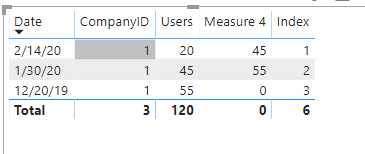
Measure 4 =
VAR x =
CALCULATE(
    MIN(Sheet2[Users]),
    FILTER(
        ALLSELECTED(Sheet2),
        Sheet2[Date] < MAX(Sheet2[Date]) && Sheet2[Index] = MAX(Sheet2[Index]) + 1
    )
)
RETURN
IF(
    x = BLANK(),
    0,
    x
)
Best regards,
Lionel Chen
If this post helps, then please consider Accept it as the solution to help the other members find it more quickly.

- Mark as New
- Bookmark
- Subscribe
- Mute
- Subscribe to RSS Feed
- Permalink
- Report Inappropriate Content
This work for me, thank you sir
- Mark as New
- Bookmark
- Subscribe
- Mute
- Subscribe to RSS Feed
- Permalink
- Report Inappropriate Content
Hi @Anonymous ,
First, add a [index] column in Edit Queries;
Second, create the measure:
Measure 4 =
VAR x =
CALCULATE(
    MIN(Sheet2[Users]),
    FILTER(
        ALLSELECTED(Sheet2),
        Sheet2[Date] < MAX(Sheet2[Date]) && Sheet2[Index] = MAX(Sheet2[Index]) + 1
    )
)
RETURN
IF(
    x = BLANK(),
    0,
    x
)
Best regards,
Lionel Chen
If this post helps, then please consider Accept it as the solution to help the other members find it more quickly.
- Mark as New
- Bookmark
- Subscribe
- Mute
- Subscribe to RSS Feed
- Permalink
- Report Inappropriate Content
EDIT: Better way with no index, but I'm leaving my previous reply there. The Index method would allow you to move up/down by any number of rows you wish. Below will only move up to the previous date, but doesn't require an index to do this.
Use this calculated column (final edit - got rid of EARLIER altogether - Variables are better - didn't upload new image, so you can see the earlier EARLIER formula):
Previous 2 =
VAR CurrentDate = Data[Date]
VAR PreviousDate =
    CALCULATE(
        LASTDATE(Data[Date]),
        FILTER(Data,
        Data[Date] < CurrentDate
        )
    )
RETURN
CALCULATE(
    MAX(Data[Users]),
    FILTER(
        Data,
        Data[Date] = PreviousDate
    )
)
Index method:
If you can create an Index column in Power Query this will help.
- In Power Query, sort your date column ascending
- On the Add Columns tab, click on Add Index Column. Doesn't matter if it starts with 0 or 1.
- Close and load the table.
Then Add this custom column in the table:
Previous =
CALCULATE(
    MAX(Data[Users]),
    FILTER(
        Data,
        Data[Index] = EARLIER(Data[Index],1) -1
    )
)
You'll have this:
Did I answer your question? Mark my post as a solution!
Did my answers help arrive at a solution? Give it a kudos by clicking the Thumbs Up!
DAX is for Analysis. Power Query is for Data Modeling
Proud to be a Super User!
MCSA: BI Reporting
- Mark as New
- Bookmark
- Subscribe
- Mute
- Subscribe to RSS Feed
- Permalink
- Report Inappropriate Content
This was SO helpful, thank you!
Helpful resources

Fabric Data Days 2026
Don't miss out on Data Days, June 15 through August 7. Learn Fabric, Power BI, SQL, AI and more.

Power BI DataViz World Championships - June 2026
A new Power BI DataViz World Championship is coming this June! Don't miss out on submitting your entry.

| User | Count |
|---|---|
| 23 | |
| 20 | |
| 19 | |
| 19 | |
| 10 |


| User | Count |
|---|---|
| 54 | |
| 53 | |
| 41 | |
| 37 | |
| 32 |


