Get certified for free when you join Fabric Data Days 2026 and dive into Fabric, Power BI, SQL, AI, and other essential data skills.
Join nowJuly 7 - July 17 | Round 2 of the Power BI Dataviz World Championships. Don't miss your chance! Learn more
Hi guys,
I'm trying to improve my dax queries, but it still takes about 7000ms to load a table.
I have these 4 measures, will it be possible to improve performance using other functions? If so can you help me?
Slowness is only in the Final measure (Val Li Final LY).
Val Li: 240ms
Val Li LY: 180ms
Val Li Has LY: 500ms
Val Li Final LY: 7000ms
Solved! Go to Solution.
Hi @fcarvalho ,
You need to improve Val Li LY first:
VAR SelectedMin = MINX(VALUES('table2'[StartInicio]),'table2'[StartInicio]))
VAR SelectedMax = MAXX(VALUES('table2'[EndFim]),'table2'[EndFim]))
For measure Val Li Has LY,you could first create 2 columns as below:
Column = 'Table'[Level 1]&'Table'[Level 2]&'Table'[Level 3]&'Table'[Level 4]&'Table'[Level 5]&'Table'[Level 6]&'Table'[Level 7]&'Table'[Level 8]&'Table'[Level 9]
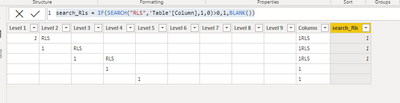
search_Rls = IF(SEARCH("RLS",'Table'[Column],1,0)>0,1,BLANK())
And you will see:
Then modify your measure as below:
Val Li Has LY =
CALCULATE( [Val Li LY],
FILTER(RLSF,
RLSF[search_Rls]=1),
,TREATAS( VALUES( Calendario[Date] ), table[Data] )
,TREATAS( VALUES( table2[key] ), table[key] )
,CROSSFILTER( table[key2], table2[key2], None )
)
Best Regards,
Kelly
Did I answer your question? Mark my post as a solution!
Hi @v-kelly-msft ,
I had come to the conclusion that with Values () or Summarize () it would be better to use Addcolumns (), so I added Addcolumns to my sumx, values and put a Filter in the last measure. Now I have 400ms , it improved the performance!
I will follow your advice too, thank you very much
Hi @fcarvalho ,
You need to improve Val Li LY first:
VAR SelectedMin = MINX(VALUES('table2'[StartInicio]),'table2'[StartInicio]))
VAR SelectedMax = MAXX(VALUES('table2'[EndFim]),'table2'[EndFim]))
For measure Val Li Has LY,you could first create 2 columns as below:
Column = 'Table'[Level 1]&'Table'[Level 2]&'Table'[Level 3]&'Table'[Level 4]&'Table'[Level 5]&'Table'[Level 6]&'Table'[Level 7]&'Table'[Level 8]&'Table'[Level 9]
search_Rls = IF(SEARCH("RLS",'Table'[Column],1,0)>0,1,BLANK())
And you will see:
Then modify your measure as below:
Val Li Has LY =
CALCULATE( [Val Li LY],
FILTER(RLSF,
RLSF[search_Rls]=1),
,TREATAS( VALUES( Calendario[Date] ), table[Data] )
,TREATAS( VALUES( table2[key] ), table[key] )
,CROSSFILTER( table[key2], table2[key2], None )
)
Best Regards,
Kelly
Did I answer your question? Mark my post as a solution!
Join us in Barcelona for FabCon and SQLCon, the Fabric, Power BI, SQL, and AI community event. Save €200 with code FABCMTY200.
Join Fabric Data Days 2026: 60 days of free live/on-demand sessions, challenges, study groups, and certification opportunities.
| User | Count |
|---|---|
| 22 | |
| 20 | |
| 14 | |
| 13 | |
| 13 |
| User | Count |
|---|---|
| 63 | |
| 41 | |
| 40 | |
| 39 | |
| 38 |