Join us at FabCon Atlanta from March 16 - 20, 2026, for the ultimate Fabric, Power BI, AI and SQL community-led event. Save $200 with code FABCOMM.
Register now!Vote for your favorite vizzies from the Power BI Dataviz World Championship submissions. Vote now!
Hi,
I have searched the other answers, but I'm still stuck/ don't see the big picture.
I know HOW to pivot, merge, append - but don't know WHEN/IF.
I have answers to survey questions from companies as well as answers from reports published by the companies itself - each once a year.
The answers have attributes (e.g. hierarchy-level) as well as the companies (size, type, reportA: xy, reportB: xy).
The companies will be sliced by name, singular-filters (type A or B) and multiple-filters ("is family-friendly" yes or no AND maybe (checkbox) "is great" yes or no)
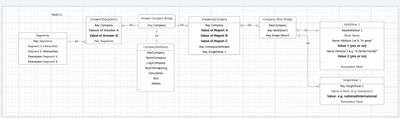
Here's a Lucidchart of this picture: https://lucid.app/lucidchart/71e6ae51-a9bf-43dc-899c-e6f79be9a1a2/view?page=0_0&invitationId=inv_2d0...
I struggle with which table to pivot - and thus create long, narrow tables, with multiple company-keys - and which to leave or make short & broad, with a single company-key.
Do I need one fact table or two?
Do I create one dim table for each of the slicers, or one for each type of slicer: single-value-slicers (On/Off, Yes/no) and one for multi-value-slicers ("Family-friendly yes/no" and maybe! (Checkbox) "Great" yes/no")?
Size is about 40 companies, 350 questions.
Could you advise me how to model it "better"/which tables to make long&narrow and which to make short&broad
Hi @Anonymous ,
For performance reasons it is better that you reduce BD relationships.It is recommend that you activate bi-directional filtering in a measure definition by using the CROSSFILTER DAX function instead. Maybe you can consider using the bridge table as a slicer.
Best Regards,
Liang
If this post helps, then please consider Accept it as the solution to help the other members find it more quickly.
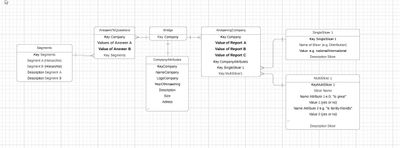
Edit: here's a new picture:
sd = single direction, bd = multi direction
I realized the Slicers would be a problem.
In which table do I have to pack the attributes for a company-slicer?
Hi,
I have searched the other answers, but I'm still stuck/ don't see the big picture.
I know HOW to pivot, merge, append - but don't know WHEN/IF.
I have answers to survey questions from companies as well as answers from reports published by the companies itself - each once a year.
The answers have attributes (e.g. hierarchy-level) as well as the companies (size, type, reportA: xy, reportB: xy).
The companies will be sliced by name, singular-filters (type A or B) and multiple-filters ("is family-friendly" yes or no AND maybe (checkbox) "is great" yes or no)
Here's a Lucidchart of this picture: https://lucid.app/lucidchart/71e6ae51-a9bf-43dc-899c-e6f79be9a1a2/view?page=0_0&invitationId=inv_2d0...
I struggle with which table to pivot - and thus create long, narrow tables, with multiple company-keys - and which to leave or make short & broad, with a single company-key.
Do I need one fact table or two?
Do I create one dim table for each of the slicers, or one for each type of slicer: single-value-slicers (On/Off, Yes/no) and one for multi-value-slicers ("Family-friendly yes/no" and maybe! (Checkbox) "Great" yes/no")?
Size is about 40 companies, 350 questions.
Could you advise me how to model it "better"/which tables to make long&narrow and which to make short&broad
Vote for your favorite vizzies from the Power BI World Championship submissions!
If you love stickers, then you will definitely want to check out our Community Sticker Challenge!
Check out the January 2026 Power BI update to learn about new features.
| User | Count |
|---|---|
| 56 | |
| 53 | |
| 40 | |
| 17 | |
| 16 |
| User | Count |
|---|---|
| 122 | |
| 108 | |
| 44 | |
| 32 | |
| 26 |