Get Fabric or SQL Certified for Free.
Get certified for free when you join Fabric Data Days 2026 and dive into Fabric, Power BI, SQL, AI, and other essential data skills.
Join now- Power BI forums
- Get Help with Power BI
- Desktop
- Service
- Report Server
- Power Query
- Mobile Apps
- Developer
- DAX Commands and Tips
- Custom Visuals Development Discussion
- Health and Life Sciences
- Power BI Spanish forums
- Translated Spanish Desktop
- Training and Consulting
- Instructor Led Training
- Dashboard in a Day for Women, by Women
- Galleries
- Data Stories Gallery
- Themes Gallery
- Contests Gallery
- QuickViz Gallery
- Quick Measures Gallery
- Visual Calculations Gallery
- Notebook Gallery
- Translytical Task Flow Gallery
- TMDL Gallery
- R Script Showcase
- Webinars and Video Gallery
- Ideas
- Custom Visuals Ideas (read-only)
- Issues
- Issues
- Events
- Upcoming Events
July 7 - July 17 | Round 2 of the Power BI Dataviz World Championships. Don't miss your chance! Learn more
- Power BI forums
- Forums
- Get Help with Power BI
- Desktop
- Multivariable Matrix with User Input
- Subscribe to RSS Feed
- Mark Topic as New
- Mark Topic as Read
- Float this Topic for Current User
- Bookmark
- Subscribe
- Printer Friendly Page

- Mark as New
- Bookmark
- Subscribe
- Mute
- Subscribe to RSS Feed
- Permalink
- Report Inappropriate Content
Multivariable Matrix with User Input
See pictures below to help with explanation.
Summary: I am receiveing a string of data with missing data points. I need to calculate the missing data points as well as react to user input. The user input could affect the calculation and/or the data shown. I've hit a dead end with both calculated columns (how can I capture user activity and use it in the calculated column formula?) as well as mutiple measure to represent the months (how do I get the beginning balance from the prior month/column?).
Below is an example of the data I receive as well as a few examples showing ways the user wants the result displayed. Any ideas?

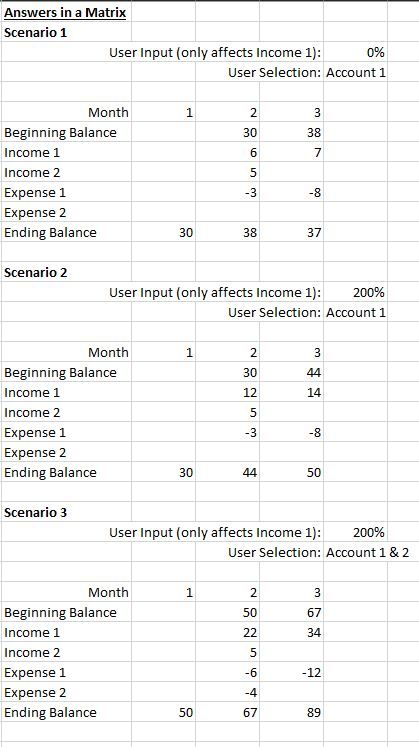
Solved! Go to Solution.


- Mark as New
- Bookmark
- Subscribe
- Mute
- Subscribe to RSS Feed
- Permalink
- Report Inappropriate Content
- Mark as New
- Bookmark
- Subscribe
- Mute
- Subscribe to RSS Feed
- Permalink
- Report Inappropriate Content
Hi, @Anonymous
you could try to use a measure and a parameter for user input:
AmountMeasure =
VAR beginingbalance =
    CALCULATE (
        SUM ( accounts[amount] );
        FILTER (
            ALLEXCEPT ( accounts; accounts[account] );
            accounts[month]
                <= MIN ( [month] ) - 1
                && accounts[item] <> "income 1"
        )
    )
        + CALCULATE (
            SUM ( accounts[amount] );
            FILTER (
                ALLEXCEPT ( accounts; accounts[account] );
                accounts[month]
                    <= MIN ( [month] ) - 1
                    && accounts[item] = "income 1"
            )
        ) * [User input Value income 1]
VAR endingbalance =
    CALCULATE (
        SUM ( accounts[amount] );
        FILTER (
            ALL ( accounts );
            accounts[account] IN VALUES ( accounts[account] )
                && accounts[month] <= MIN ( [month] )
                && accounts[item] <> "income 1"
        )
    )
        + + CALCULATE (
            SUM ( accounts[amount] );
            FILTER (
                ALLEXCEPT ( accounts; accounts[account] );
                accounts[month] <= MIN ( [month] )
                    && accounts[item] = "income 1"
            )
        ) * [User input Value income 1]
RETURN
    SWITCH (
        TRUE ();
        MAX ( accounts[item] ) = "ending balance"; endingbalance;
        MAX ( accounts[item] ) = "begining balance"; beginingbalance;
        MAX ( accounts[item] ) = "income 1"; CALCULATE (
            SUM ( accounts[amount] );
            FILTER (
                ALLEXCEPT ( accounts; accounts[account]; accounts[month] );
                accounts[item] = "income 1"
            )
        ) * [User input Value income 1];
        SUM ( accounts[amount] )
    )
The measure in this code called [User input Value income 1] is from the parameter
- Mark as New
- Bookmark
- Subscribe
- Mute
- Subscribe to RSS Feed
- Permalink
- Report Inappropriate Content
This is great. I appreciate you working on this.
I am using the measure now and it is acting unexpectedly. I am seeing amounts for Income 1 for every month, and not just the months where there is income. Also, the beginning balance looks like it is aggregating prior month ending balances for all accounts.
- Mark as New
- Bookmark
- Subscribe
- Mute
- Subscribe to RSS Feed
- Permalink
- Report Inappropriate Content
I have tested it for the sample data you provided in the first post, perhaps you could provide a larger sample set? And preferably not provide data as screenshots, as I then have to manually input the values
- Mark as New
- Bookmark
- Subscribe
- Mute
- Subscribe to RSS Feed
- Permalink
- Report Inappropriate Content
Yes, you are correct. The measure works for the sample data above. I failed to include the year dimension in my sample data model. Here is the sample data with year included.
Account;Item;Month;Year;Amount
1;Ending Balance;10;2018;30
1;Beginning Balance;11;2018;0
1;Expense 1;11;2018;-3
1;Income 1;11;2018;6
1;Income 2;11;2018;5
1;Ending Balance;11;2018;0
1;Beginning Balance;12;2018;0
1;Income 1;12;2018;7
1;Expense 1;12;2018;-8
1;Ending Balance;12;2018;0
1;Beginning Balance;1;2019;0
1;Expense 1;1;2019;-3
1;Income 2;1;2019;10
1;Income 3;1;2019;8
1;Ending Balance;1;2019;0
1;Income 2;12;2019;10
2;Ending Balance;10;2018;20
2;Beginning Balance;11;2018;0
2;Expense 1;11;2018;-3
2;Expense 2;11;2018;-4
2;Income 1;11;2018;5
2;Ending Balance;11;2018;0
2;Beginning Balance;12;2018;0
2;Expense 1;12;2018;-4
2;Income 1;12;2018;10
2;Ending Balance;12;2018;0
2;Beginning Balance;1;2019;0
2;Expense 3;1;2019;-3
2;Income 3;1;2019;15
2;Ending Balance;1;2019;0
2;Expense 3;11;2019;-3
3;Ending Balance;10;2018;30
3;Beginning Balance;11;2018;0
3;Expense 1;11;2018;-3
3;Expense 2;11;2018;-4
3;Income 1;11;2018;5
3;Ending Balance;11;2018;0
3;Beginning Balance;12;2018;0
3;Expense 1;12;2018;-3
3;Income 1;12;2018;10
3;Income 2;12;2018;5
3;Ending Balance;12;2018;0
3;Beginning Balance;1;2019;0
3;Expense 3;1;2019;-5
3;Income 1;1;2019;6
3;Ending Balance;1;2019;0
3;Expense 3;11;2019;-4
3;Income 3;12;2019;8
- Mark as New
- Bookmark
- Subscribe
- Mute
- Subscribe to RSS Feed
- Permalink
- Report Inappropriate Content
- Mark as New
- Bookmark
- Subscribe
- Mute
- Subscribe to RSS Feed
- Permalink
- Report Inappropriate Content
This works exactly as I needed. Huge help! Thanks again.
Helpful resources

FabCon & SQLCon – Barcelona 2026
Join us in Barcelona for FabCon and SQLCon, the Fabric, Power BI, SQL, and AI community event. Save €200 with code FABCMTY200.

Data Days 2026
Join Data Days 2026: 60 days of free live/on-demand sessions, challenges, study groups, and certification opportunities.

Power BI DataViz World Championships - June 2026
A new Power BI DataViz World Championship is coming this June! Don't miss out on submitting your entry.

| User | Count |
|---|---|
| 26 | |
| 23 | |
| 19 | |
| 18 | |
| 15 |


| User | Count |
|---|---|
| 46 | |
| 46 | |
| 43 | |
| 36 | |
| 31 |


