Join us at FabCon Atlanta from March 16 - 20, 2026, for the ultimate Fabric, Power BI, AI and SQL community-led event. Save $200 with code FABCOMM.
Register now!Vote for your favorite vizzies from the Power BI Dataviz World Championship submissions. Vote now!
Hi all
I have gone through several threads trying to find what I want but I did not get a solution for my case (sorry if the solution has already been given to someone else).
I have a table like the below.
Product Inital Date End Date Value
AAAAA 01/01/2022 31/01/2022 60
AAAAA 01/02/2022 28/02/2022 50
AAAAA 01/03/2022 31/03/2022 70
Also, I have a Dates table whose relations with the Initial Date and End Date columns of this Table are inactive (otherwise I mess other stuff).
I want to create a matrix which shows the values for any given date. Like the one below.
Product 15/01/2022 31/01/2022 08/02/2022
AAAAAA 60 60 50
Thanks for your assistance
Solved! Go to Solution.
@jtemes , try a measure like this with date table
calculate(sumx(filter(Table, Table[End Date] <= Max('Date'[Date])), Table[Value]), crossfilter(Table, Date, none))
@jtemes , try a measure like this with date table
calculate(sumx(filter(Table, Table[End Date] <= Max('Date'[Date])), Table[Value]), crossfilter(Table, Date, none))
The issue is that the table has more columns with other data and, if I do that, these data would be inaccurate.
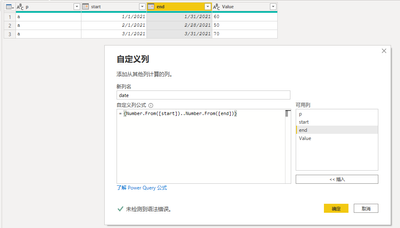
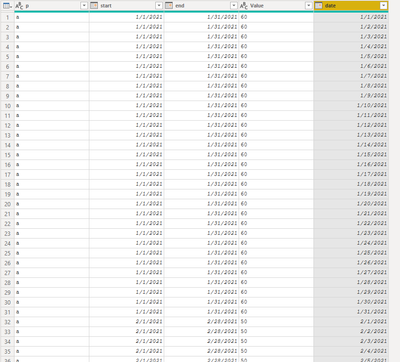
in power query add colum {Number.From(Inital Date) ..Number.From(End Date)} and expand
Vote for your favorite vizzies from the Power BI World Championship submissions!
If you love stickers, then you will definitely want to check out our Community Sticker Challenge!
Check out the January 2026 Power BI update to learn about new features.
| User | Count |
|---|---|
| 63 | |
| 51 | |
| 41 | |
| 20 | |
| 16 |
| User | Count |
|---|---|
| 122 | |
| 107 | |
| 47 | |
| 30 | |
| 24 |