Join us at FabCon Atlanta from March 16 - 20, 2026, for the ultimate Fabric, Power BI, AI and SQL community-led event. Save $200 with code FABCOMM.
Register now!Vote for your favorite vizzies from the Power BI Dataviz World Championship submissions. Vote now!
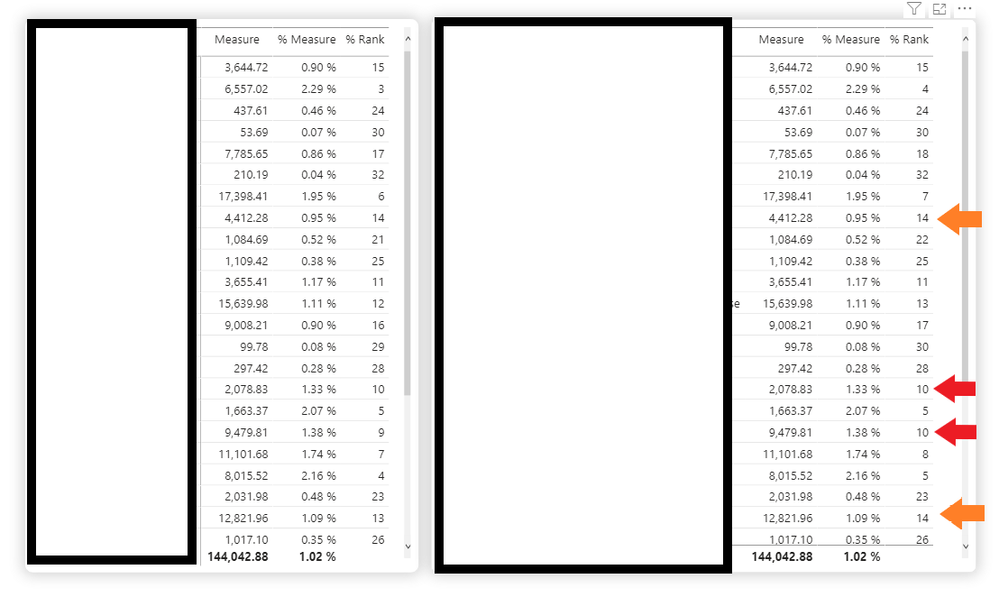
My rank measure works well when only introducing the ranked items, but when I introduce a category for each item (in this example, it's a geographic region) the rank measure returns false ties and skips unused rank numbers. See screenshot below, where the table on the left omits the geograhic location, and the table on the right includes it.
Generically, the rank and ranked measure look like this:
% RANK =
RANKX (
ALLSELECTED ( 'Dimension'[Item] ),
CALCULATE ( [% Measure], ALLEXCEPT ( 'Dimension', 'Dimension'[Item] ) )
)
% Measure =
DIVIDE (
SUM ( 'FACT_1'[COLUMN_1] ),
SUM ( 'FACT_2'[COLUMN_2] ),
BLANK()
)
Am I missing something to control for the additional category added to the visual? My understanding is that this should only come into play if I wanted to rank within each category, but this rank measure is independent of the category.
NOTE: I'm trying to replicate within a dummy dataset to share but have not been successful yet.
Solved! Go to Solution.
Resolved this with the updated measure:
% RANK =
RANKX (
ALL ( 'Dimension' ),
CALCULATE ( [% Measure], ALLEXCEPT ( 'Dimension', 'Dimension'[Item], 'Dimension'[Category]) )
)
Resolved this with the updated measure:
% RANK =
RANKX (
ALL ( 'Dimension' ),
CALCULATE ( [% Measure], ALLEXCEPT ( 'Dimension', 'Dimension'[Item], 'Dimension'[Category]) )
)
Vote for your favorite vizzies from the Power BI World Championship submissions!
If you love stickers, then you will definitely want to check out our Community Sticker Challenge!
Check out the January 2026 Power BI update to learn about new features.
| User | Count |
|---|---|
| 64 | |
| 53 | |
| 42 | |
| 20 | |
| 17 |
| User | Count |
|---|---|
| 121 | |
| 103 | |
| 46 | |
| 30 | |
| 24 |