Don't miss your chance to take the Fabric Data Engineer (DP-700) exam on us!
Learn moreThe FabCon + SQLCon recap series starts April 14th at 8am Pacific. If you’re tracking where AI is going inside Fabric, this first session is a can't miss. Register now
Dear All,
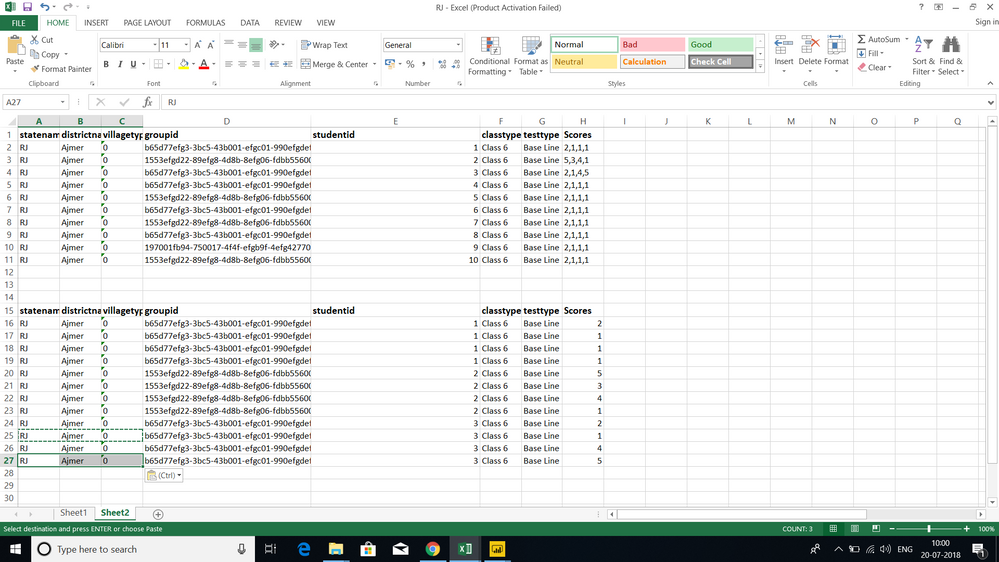
I am struggling with a data-set. For each child the scores are in a cell separated by comma. I want first separate them and then put them in single row. The way it is shows below the data set. I have done that manually! Can some body help me? The above is the data set, and below is what I want.
Thank You,
Solved! Go to Solution.
In Power Query you should be able to use Split Column by Delimiter on your Scores column (Transform tab in the Text column area) and then you can upivot the resulting columns.
let
Source = Table.FromRows(Json.Document(Binary.Decompress(Binary.FromText("i45Wcs5JLC42U9JRckosTvXJzEsFMk11jHQMQVApNhYA", BinaryEncoding.Base64), Compression.Deflate)), let _t = ((type text) meta [Serialized.Text = true]) in type table [classtype = _t, #"type" = _t, scores = _t]),
#"Split Column by Delimiter" = Table.SplitColumn(Source, "scores", Splitter.SplitTextByDelimiter(",", QuoteStyle.Csv), {"scores.1", "scores.2", "scores.3", "scores.4", "scores.5"}),
#"Changed Type" = Table.TransformColumnTypes(#"Split Column by Delimiter",{{"classtype", type text}, {"type", type text}, {"scores.1", Int64.Type}, {"scores.2", Int64.Type}, {"scores.3", Int64.Type}, {"scores.4", Int64.Type}, {"scores.5", Int64.Type}}),
#"Unpivoted Other Columns" = Table.UnpivotOtherColumns(#"Changed Type", {"classtype", "type"}, "Attribute", "Value"),
#"Removed Columns" = Table.RemoveColumns(#"Unpivoted Other Columns",{"Attribute"})
in
#"Removed Columns"
In Power Query you should be able to use Split Column by Delimiter on your Scores column (Transform tab in the Text column area) and then you can upivot the resulting columns.
let
Source = Table.FromRows(Json.Document(Binary.Decompress(Binary.FromText("i45Wcs5JLC42U9JRckosTvXJzEsFMk11jHQMQVApNhYA", BinaryEncoding.Base64), Compression.Deflate)), let _t = ((type text) meta [Serialized.Text = true]) in type table [classtype = _t, #"type" = _t, scores = _t]),
#"Split Column by Delimiter" = Table.SplitColumn(Source, "scores", Splitter.SplitTextByDelimiter(",", QuoteStyle.Csv), {"scores.1", "scores.2", "scores.3", "scores.4", "scores.5"}),
#"Changed Type" = Table.TransformColumnTypes(#"Split Column by Delimiter",{{"classtype", type text}, {"type", type text}, {"scores.1", Int64.Type}, {"scores.2", Int64.Type}, {"scores.3", Int64.Type}, {"scores.4", Int64.Type}, {"scores.5", Int64.Type}}),
#"Unpivoted Other Columns" = Table.UnpivotOtherColumns(#"Changed Type", {"classtype", "type"}, "Attribute", "Value"),
#"Removed Columns" = Table.RemoveColumns(#"Unpivoted Other Columns",{"Attribute"})
in
#"Removed Columns"
If you have recently started exploring Fabric, we'd love to hear how it's going. Your feedback can help with product improvements.
A new Power BI DataViz World Championship is coming this June! Don't miss out on submitting your entry.
Share feedback directly with Fabric product managers, participate in targeted research studies and influence the Fabric roadmap.
| User | Count |
|---|---|
| 52 | |
| 44 | |
| 44 | |
| 20 | |
| 19 |
| User | Count |
|---|---|
| 71 | |
| 70 | |
| 34 | |
| 33 | |
| 31 |