Hi folks. I'm experimenting with using queries to filter other queries so that I don't have to use the code of some queries multiple times. However, I'm having trouble coding the columns in M.
So far, I'm looking at 3 tables:
Table A lists the assignments of trainers to trainees. Some genius decided that they would include two different types of identificaion for the trainers and drivers, respsecitively; i.e. in the same record, trainers are identified in one field using info X, and trainees in the next using info Y.
Table B is a Type 2 person dimension with data about people. This table includes info X and Y for all people.
Tables C has other event data about people. People in here are only identifiable with info X.

Tables B and C are massive tables, and I want to cut down on them by only pulling data pertaining to the people listed in Table A.
First, I'm pulling Table A, which is a simple enough query.
Then I added Table B, but, then added two Left Outer Joins to check if the person record is one of those included in Table A, checking the trainer and trainee fields, respsectively:
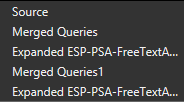
Now I need to add a columns that says, "if both of these fields are null, then do not include this record."
This is how I'm attempting to accomplish this:
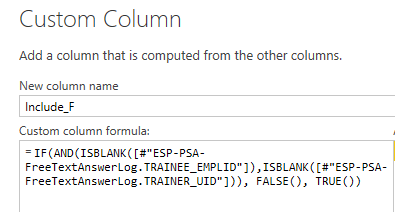
In simpler terms:
Include_F = Table.AddColumn(#"Expanded LastQueryStep"
, "Include_F"
, each IF(AND(ISBLANK([#"TableA.TRAINEE"])
     , ISBLANK([#"TableA.TRAINER"]))
  , FALSE()
  , TRUE()))
But I get the error: "Expression.Error: The name 'IF' wasn't recognized. Make sure it's spelled correctly."
If I can't use an if statement, want can I use?
Next, I will have to check Table C if those people are included in the filtered Table B.
Thanks!
Yes, I know I could just join all of these tables together in a single query, but I don't want to have a MASSIVE data set that will be impossible to read.
I also could also just use the queries in tables A and B multiple times, but I want to avoid versioning issues and to minimize maintenance,


