Join us in Barcelona for FabCon and SQLCon, September 28 - October 1, 2026.
This is best Fabric, Power BI, SQL and AI community event. How do we know? The last event sold out! Save €200 with code FABCMTY200.
Register now- Power BI forums
- Get Help with Power BI
- Desktop
- Service
- Report Server
- Power Query
- Mobile Apps
- Developer
- DAX Commands and Tips
- Custom Visuals Development Discussion
- Health and Life Sciences
- Power BI Spanish forums
- Translated Spanish Desktop
- Training and Consulting
- Instructor Led Training
- Dashboard in a Day for Women, by Women
- Galleries
- Data Stories Gallery
- Themes Gallery
- Contests Gallery
- QuickViz Gallery
- Quick Measures Gallery
- Visual Calculations Gallery
- Notebook Gallery
- Translytical Task Flow Gallery
- TMDL Gallery
- R Script Showcase
- Webinars and Video Gallery
- Ideas
- Custom Visuals Ideas (read-only)
- Issues
- Issues
- Events
- Upcoming Events
A new Data Days event is coming soon! This time we’re going bigger than ever. Fabric, Power BI, SQL, AI and more. Don't miss out.
- Power BI forums
- Forums
- Get Help with Power BI
- Desktop
- Re: Frequency Count
- Subscribe to RSS Feed
- Mark Topic as New
- Mark Topic as Read
- Float this Topic for Current User
- Bookmark
- Subscribe
- Printer Friendly Page


- Mark as New
- Bookmark
- Subscribe
- Mute
- Subscribe to RSS Feed
- Permalink
- Report Inappropriate Content
Frequency Count
I have a two tables are data and report. In data table contain Date, Item and Vendor.
Report table contain item only. (Item stored as text format. Item column data type is mixed – Sometimes number only or number and text together)
In-between two tables the item column are common.
I would like to get the most frequency vendor according to the item based on the data ranges (From April 2020 to April 2021)
Data:
DATE | ITEM | Vendor |
22/04/2020 | 125 | A1 |
22/04/2020 | 125 | AE |
22/04/2020 | 125 | AE |
22/04/2020 | 125 | AE |
22/04/2020 | 125 | AE |
22/04/2020 | 125 | AE |
22/04/2020 | 125 | AE |
22/04/2020 | 125 | AE |
22/04/2020 | 125 | AR |
24/04/2020 | 4568 | H1 |
24/04/2020 | 4568 | H1 |
24/04/2020 | 4568 | H1 |
24/04/2020 | 4568 | H1 |
24/04/2020 | 4568 | H1 |
24/04/2020 | 4568 | H1 |
24/04/2020 | 4568 | H3 |
24/04/2020 | 4568 | H3 |
24/04/2020 | 4568 | H3 |
24/04/2020 | 4568 | H3 |
Report:
ITEM | Vendor FREQUENCY |
125 | AE |
4568 | H1 |
In Excel I am applying the following array formula =IF($F4="","",IFERROR(INDEX(C:C,AGGREGATE(14,6,ROW($A$3:$A$67)/(MAX(FREQUENCY(IF($A$3:$A$67>=$E$2,IF($A$3:$A$67<=$E$3,IF($B$3:$B$67=$F4,IF($C$3:$C$67<>"",MATCH($B$3:$B$67&$C$3:$C$67,$B$3:$B$67&$C$3:$C$67,0))))),ROW($B$3:$B$67)-2))=FREQUENCY(IF($A$3:$A$67>=$E$2,IF($A$3:$A$67<=$E$3,IF($B$3:$B$67=$F4,IF($C$3:$C$67<>"",MATCH($B$3:$B$67&$C$3:$C$67,$B$3:$B$67&$C$3:$C$67,0))))),ROW($B$3:$B$67)-2)),1)),""))
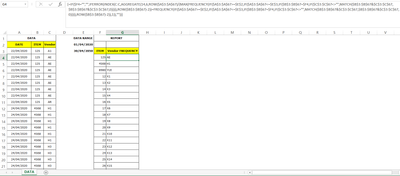
I would like to get the same result in Power BI. I am looking for New calculated column option.
Any advise please.
Excel File:
Here is the excel file for your refence https://www.dropbox.com/scl/fi/c4e55usqn9ej36bum5acp/FREQUENCY-COUNT-31-05.21.xlsx?dl=0&rlkey=i5ntr3...
PBI File,
https://www.dropbox.com/s/a8f66j5w80xyr5h/FREQUENCY%20ND%20COUNT.pbix?dl=0
Solved! Go to Solution.


- Mark as New
- Bookmark
- Subscribe
- Mute
- Subscribe to RSS Feed
- Permalink
- Report Inappropriate Content
@Saxon10
I created a measure, you can add the ITEM column from Report and the measure. Check the attached file. You can use the slicer to filter for any date period.
Freq =
MAXX(
    TOPN(
        1 ,
        ADDCOLUMNS(VALUES(DATA[Vendor]),"Count", CALCULATE(COUNT(DATA[Vendor]))),[Count]
    ),
    [Vendor]
)
⭕ Subscribe and learn Power BI from these videos
⚪ Website ⚪ LinkedIn ⚪ PBI User Group
- Mark as New
- Bookmark
- Subscribe
- Mute
- Subscribe to RSS Feed
- Permalink
- Report Inappropriate Content
@Saxon10
Please find below the formula for the calculated Column that will return only for available vendors for April 2020 to April 2021.
Freq Column =
CALCULATE(
    MAXX(
        TOPN(
            1 ,
            ADDCOLUMNS(VALUES(DATA[Vendor]),"Count", CALCULATE(COUNT(DATA[Vendor]))),[Count]
        ),
        [Vendor]
    ),
    FILTER(all(DATA[DATE]), DATA[DATE] >= DATE(2020,4,1) && DATA[DATE] <= DATE(2021,4,30) )
)
⭕ Subscribe and learn Power BI from these videos
⚪ Website ⚪ LinkedIn ⚪ PBI User Group
- Mark as New
- Bookmark
- Subscribe
- Mute
- Subscribe to RSS Feed
- Permalink
- Report Inappropriate Content
@Saxon10
I created a measure, you can add the ITEM column from Report and the measure. Check the attached file. You can use the slicer to filter for any date period.
Freq =
MAXX(
    TOPN(
        1 ,
        ADDCOLUMNS(VALUES(DATA[Vendor]),"Count", CALCULATE(COUNT(DATA[Vendor]))),[Count]
    ),
    [Vendor]
)
⭕ Subscribe and learn Power BI from these videos
⚪ Website ⚪ LinkedIn ⚪ PBI User Group
- Mark as New
- Bookmark
- Subscribe
- Mute
- Subscribe to RSS Feed
- Permalink
- Report Inappropriate Content
Your measure solutions working well.
is that possibile can I get the new calulate column option inculding date range?
can you please advise.
- Mark as New
- Bookmark
- Subscribe
- Mute
- Subscribe to RSS Feed
- Permalink
- Report Inappropriate Content
@Saxon10
Please find below the formula for the calculated Column that will return only for available vendors for April 2020 to April 2021.
Freq Column =
CALCULATE(
    MAXX(
        TOPN(
            1 ,
            ADDCOLUMNS(VALUES(DATA[Vendor]),"Count", CALCULATE(COUNT(DATA[Vendor]))),[Count]
        ),
        [Vendor]
    ),
    FILTER(all(DATA[DATE]), DATA[DATE] >= DATE(2020,4,1) && DATA[DATE] <= DATE(2021,4,30) )
)
⭕ Subscribe and learn Power BI from these videos
⚪ Website ⚪ LinkedIn ⚪ PBI User Group
- Mark as New
- Bookmark
- Subscribe
- Mute
- Subscribe to RSS Feed
- Permalink
- Report Inappropriate Content
Thanks for your reply and help.
Your solution working well.
- Mark as New
- Bookmark
- Subscribe
- Mute
- Subscribe to RSS Feed
- Permalink
- Report Inappropriate Content
Thanks for your reply.
Is there any chance can I get the New calculate column instead of measure because based on the result column (Frequency).

Helpful resources

Power BI Monthly Update - May 2026
Check out the May 2026 Power BI update to learn about new features.

Data Days 2026 coming soon!
Sign up to receive a private message when registration opens and key events begin.

New to Fabric Survey
If you have recently started exploring Fabric, we'd love to hear how it's going. Your feedback can help with product improvements.

Power BI DataViz World Championships - June 2026
A new Power BI DataViz World Championship is coming this June! Don't miss out on submitting your entry.

| User | Count |
|---|---|
| 31 | |
| 26 | |
| 23 | |
| 22 | |
| 15 |


| User | Count |
|---|---|
| 62 | |
| 47 | |
| 28 | |
| 24 | |
| 21 |


