Get Fabric or SQL Certified for Free.
Get certified for free when you join Fabric Data Days 2026 and dive into Fabric, Power BI, SQL, AI, and other essential data skills.
Join now- Power BI forums
- Get Help with Power BI
- Desktop
- Service
- Report Server
- Power Query
- Mobile Apps
- Developer
- DAX Commands and Tips
- Custom Visuals Development Discussion
- Health and Life Sciences
- Power BI Spanish forums
- Translated Spanish Desktop
- Training and Consulting
- Instructor Led Training
- Dashboard in a Day for Women, by Women
- Galleries
- Data Stories Gallery
- Themes Gallery
- Contests Gallery
- QuickViz Gallery
- Quick Measures Gallery
- Visual Calculations Gallery
- Notebook Gallery
- Translytical Task Flow Gallery
- TMDL Gallery
- R Script Showcase
- Webinars and Video Gallery
- Ideas
- Custom Visuals Ideas (read-only)
- Issues
- Issues
- Events
- Upcoming Events
July 7 - July 17 | Round 2 of the Power BI Dataviz World Championships. Don't miss your chance! Learn more
- Power BI forums
- Forums
- Get Help with Power BI
- Desktop
- Re: Find the difference between dates excluding We...
- Subscribe to RSS Feed
- Mark Topic as New
- Mark Topic as Read
- Float this Topic for Current User
- Bookmark
- Subscribe
- Printer Friendly Page


- Mark as New
- Bookmark
- Subscribe
- Mute
- Subscribe to RSS Feed
- Permalink
- Report Inappropriate Content
Find the difference between dates excluding Weekends
Hi,
I have to calculate the difference between two dates but excluding the weekends (Holiday's may in in future) i.e, Sat & Sun for now.
I checked many threads here all the solutions are with seperate Date table and I don't have any seperate date table 😞

Solved! Go to Solution.


- Mark as New
- Bookmark
- Subscribe
- Mute
- Subscribe to RSS Feed
- Permalink
- Report Inappropriate Content
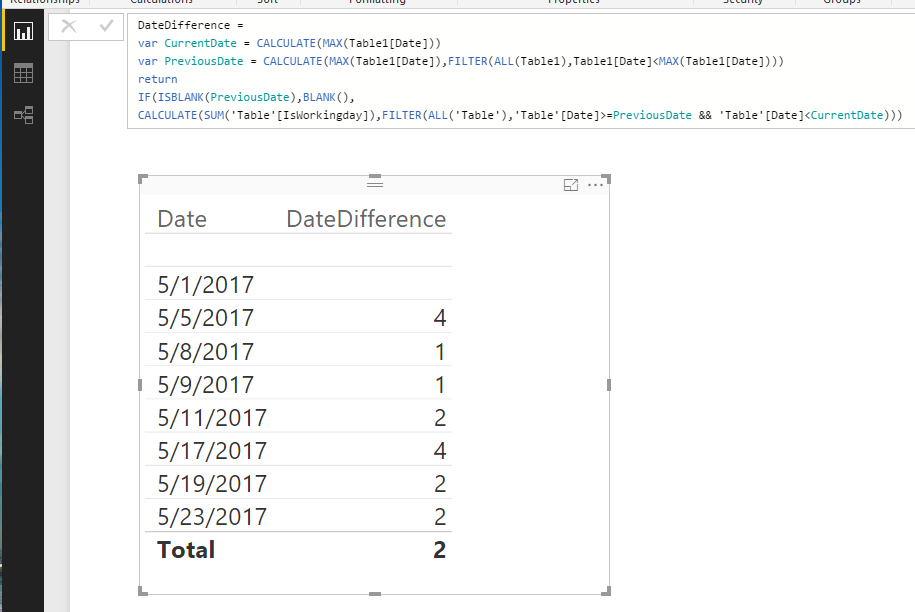
I have tested it on my local environment, we can add a calculated column to check if the date is working, and then sum up this calculated column.
Weekday = WEEKDAY('Table'[Date])
IsWorkingday = IF('Table'[Weekday]>6||'Table'[Weekday]<2,0,1)
DateDifference =
var CurrentDate = CALCULATE(MAX(Table1[Date]))
var PreviousDate = CALCULATE(MAX(Table1[Date]),FILTER(ALL(Table1),Table1[Date]<MAX(Table1[Date])))
return
IF(ISBLANK(PreviousDate),BLANK(),
CALCULATE(SUM('Table'[IsWorkingday]),FILTER(ALL('Table'),'Table'[Date]>=PreviousDate && 'Table'[Date]<CurrentDate)))
Regards,
Charlie Liao


- Mark as New
- Bookmark
- Subscribe
- Mute
- Subscribe to RSS Feed
- Permalink
- Report Inappropriate Content
Not much to go on here, but could you create a calculated column and use WEEKDAY() to get the day of the week. Let's say Sunday is 1 and Saturday is 7.
Then you could create a measure like the following:
Measure = ([First Date] - [Second Date])*1. - CALCULATE(COUNT([Column]),FILTER(Table,([WeekDay] = 1 || [WeekDay = 7) && [Date] > [First Date] && [Date] < [Second Date]))
Something along those lines.
Follow on LinkedIn
@ me in replies or I'll lose your thread!!!
Instead of a Kudo, please vote for this idea
Become an expert!: Enterprise DNA
External Tools: MSHGQM
YouTube Channel!: Microsoft Hates Greg
Latest book!: DAX For Humans
DAX is easy, CALCULATE makes DAX hard...
- Mark as New
- Bookmark
- Subscribe
- Mute
- Subscribe to RSS Feed
- Permalink
- Report Inappropriate Content
@Greg_Deckler Thank you for your response.
For making it more simple I created a date table, and also created DayInweek as Saturday as 6 & Sunday as 7 and wrote something like you suggested:
I am creating a calculated column here.
Total Time = 1.0*(Operations_Data[LAST DELIVERED EVENT] - Operations_Data[FIRST IN TRANSIT EVENT]) - CALCULATE(COUNT('Calendar'[IfWorkDay]),FILTER('Calendar','Calendar'[IfWorkDay] = 6 || 'Calendar'[IfWorkDay] = 7 ))But, I am not getting the proper result. Please suggest
- Mark as New
- Bookmark
- Subscribe
- Mute
- Subscribe to RSS Feed
- Permalink
- Report Inappropriate Content
I have tested it on my local environment, we can add a calculated column to check if the date is working, and then sum up this calculated column.
Weekday = WEEKDAY('Table'[Date])
IsWorkingday = IF('Table'[Weekday]>6||'Table'[Weekday]<2,0,1)
DateDifference =
var CurrentDate = CALCULATE(MAX(Table1[Date]))
var PreviousDate = CALCULATE(MAX(Table1[Date]),FILTER(ALL(Table1),Table1[Date]<MAX(Table1[Date])))
return
IF(ISBLANK(PreviousDate),BLANK(),
CALCULATE(SUM('Table'[IsWorkingday]),FILTER(ALL('Table'),'Table'[Date]>=PreviousDate && 'Table'[Date]<CurrentDate)))
Regards,
Charlie Liao
- Mark as New
- Bookmark
- Subscribe
- Mute
- Subscribe to RSS Feed
- Permalink
- Report Inappropriate Content
Thank you so much.
That works great. But I have one more question to ask may be you could answer:
I have 4 columns in my table:
First column
Second Column
Third Column
Fourth Column
I calculte the date diffeerence between First and Fourth but sometimes, First column has null values so insted of first I have to choose Second Column value and same with Third and Fourth (If Fourth is null, I have to choose Third Column value).
How could I proceed in the same example as you suggested above.
- Mark as New
- Bookmark
- Subscribe
- Mute
- Subscribe to RSS Feed
- Permalink
- Report Inappropriate Content
You could use a IsBlank to check the column, such as
=IF(IsBlank(Table[Colum1]),Table[Column2],Table[Column1])
Regards,
Charlie Liao
- Mark as New
- Bookmark
- Subscribe
- Mute
- Subscribe to RSS Feed
- Permalink
- Report Inappropriate Content
You could create two new columns, Five and Six with formulas like:
Five = IF(ISBLANK([One]),[Two],[One])

Six = IF(ISBLANK([Four]),[Three],[Four])
Then just base everything off of columns Five and Six.
Follow on LinkedIn
@ me in replies or I'll lose your thread!!!
Instead of a Kudo, please vote for this idea
Become an expert!: Enterprise DNA
External Tools: MSHGQM
YouTube Channel!: Microsoft Hates Greg
Latest book!: DAX For Humans
DAX is easy, CALCULATE makes DAX hard...

Helpful resources

FabCon & SQLCon – Barcelona 2026
Join us in Barcelona for FabCon and SQLCon, the Fabric, Power BI, SQL, and AI community event. Save €200 with code FABCMTY200.

Data Days 2026
Join Fabric Data Days 2026: 60 days of free live/on-demand sessions, challenges, study groups, and certification opportunities.

Power BI DataViz World Championships - June 2026
A new Power BI DataViz World Championship is coming this June! Don't miss out on submitting your entry.

| User | Count |
|---|---|
| 22 | |
| 20 | |
| 14 | |
| 13 | |
| 13 |


| User | Count |
|---|---|
| 62 | |
| 40 | |
| 39 | |
| 39 | |
| 38 |


