This is best Fabric, Power BI, SQL and AI community event. How do we know? The last event sold out! Save €200 with code FABCMTY200.
Register nowA new Data Days event is coming soon! This time we’re going bigger than ever. Fabric, Power BI, SQL, AI and more. Don't miss out.
Hi All,
The data that I have has all the surverys that were done to all the stores.
I want to consider only the latest visit to a store for that month. If the store was not visited on that month, then consider the last visited data irrespective of the month. Something like below
Store Number July Aug
1001 12-06 25-07
1002 22-06 22-06
In the above example, since Store 1002 was not visited in Aug, it should show me the last visit date. I'm using the below example, this shows blank instead of 22-06
Solved! Go to Solution.
Hi Bhavya,
Since you have a Date table, it could be a simple measure like below. Please download the demo from the attachment.
Measure = CALCULATE ( MAX ( FACT_DETAILS_KPIS[Visit Date] ), FILTER ( ALL ( DIM_DATE ), DIM_DATE[Date] <= MAX ( DIM_DATE[Date] ) ) )
Best Regards,
Dale
Hi Bhavya,
Since you have a Date table, it could be a simple measure like below. Please download the demo from the attachment.
Measure = CALCULATE ( MAX ( FACT_DETAILS_KPIS[Visit Date] ), FILTER ( ALL ( DIM_DATE ), DIM_DATE[Date] <= MAX ( DIM_DATE[Date] ) ) )
Best Regards,
Dale
This is one step closer to what I needed but I can't replicate the results. It's only showing the latest record I have.
I'm trying to display the latest ACTIVE amounts per location per month (but latest record not summed up), I think finding the latest dates per month is close to that goal.
Here is my file:
Hi Dale,
Thank You so much. This is very helpful.
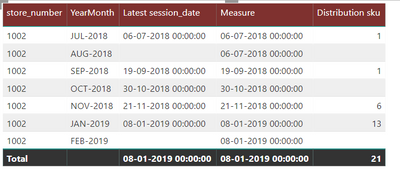
I also need to apply this in my KPI calculation. I need to find difference between distribution Sku every month vs July. If Distribution sku for a particular month doesn't exist( like Aug in the below example), then we need to consider the last distribution sku(in this case- July) and then find the difference.
Any help will be much appreciated.
Thank You,
Bhavya
Hi @Anonymous,
It seems the old question. Can you share a dummy sample that is similar to your real data? The main idea is to find the last date and then sum up the sku value where the date equals the last date.
Best Regards,
Did I answer your question correctly? Mark my answer as a solution!
Proud to be a Datanaut!
Check out the May 2026 Power BI update to learn about new features.
Sign up to receive a private message when registration opens and key events begin.
If you have recently started exploring Fabric, we'd love to hear how it's going. Your feedback can help with product improvements.
| User | Count |
|---|---|
| 31 | |
| 26 | |
| 23 | |
| 22 | |
| 13 |
| User | Count |
|---|---|
| 62 | |
| 47 | |
| 28 | |
| 23 | |
| 19 |