FabCon is coming to Atlanta
Join us at FabCon Atlanta from March 16 - 20, 2026, for the ultimate Fabric, Power BI, AI and SQL community-led event. Save $200 with code FABCOMM.
Register now!- Power BI forums
- Get Help with Power BI
- Desktop
- Service
- Report Server
- Power Query
- Mobile Apps
- Developer
- DAX Commands and Tips
- Custom Visuals Development Discussion
- Health and Life Sciences
- Power BI Spanish forums
- Translated Spanish Desktop
- Training and Consulting
- Instructor Led Training
- Dashboard in a Day for Women, by Women
- Galleries
- Data Stories Gallery
- Themes Gallery
- Contests Gallery
- QuickViz Gallery
- Quick Measures Gallery
- Visual Calculations Gallery
- Notebook Gallery
- Translytical Task Flow Gallery
- TMDL Gallery
- R Script Showcase
- Webinars and Video Gallery
- Ideas
- Custom Visuals Ideas (read-only)
- Issues
- Issues
- Events
- Upcoming Events
The Power BI Data Visualization World Championships is back! Get ahead of the game and start preparing now! Learn more
- Power BI forums
- Forums
- Get Help with Power BI
- Desktop
- Re: Distinct sum based on two columns
- Subscribe to RSS Feed
- Mark Topic as New
- Mark Topic as Read
- Float this Topic for Current User
- Bookmark
- Subscribe
- Printer Friendly Page


- Mark as New
- Bookmark
- Subscribe
- Mute
- Subscribe to RSS Feed
- Permalink
- Report Inappropriate Content
Distinct sum based on two columns
Hi Community,
Tried to count how many products the employee worked, sounds easy at the beggining but I cant count the second column.
Tried usuing
| Desire results | ||||
| Product | Shift1 | Shift2 | Name | ProductsWorked |
| a | Wade | Brian | Wade | 2 |
| b | Dave | Roberto | Dave | 3 |
| c | Seth | Ramon | Seth | 4 |
| d | Brian | Brian | 3 | |
| e | Roberto | Riley | Roberto | 2 |
| f | Ramon | Gilbert | Ramon | 3 |
| g | Jorge | Gilbert | Jorge | 1 |
| h | Dan | Gilbert | 5 | |
| i | Brian | Wade | Riley | 1 |
| j | Roberto | Dave | Dan | 1 |
| k | Ramon | Seth | ||
| l | Ramon | Brian | ||
| m | Dave | |||
| n | Gilbert | Ramon | ||
| o | Gilbert | Seth | ||
| p | Gilbert | Seth |
Solved! Go to Solution.
- Mark as New
- Bookmark
- Subscribe
- Mute
- Subscribe to RSS Feed
- Permalink
- Report Inappropriate Content
Hi @Aucesar
You can refer to the following measure
1.Create a table to diaplay the user
2.Then create a measure
ProductionBatchWorked = var a=SUMMARIZE(ALLSELECTED('Table'),[ProductionBatch],[Shift1])
var b=SUMMARIZE(ALLSELECTED('Table'),[ProductionBatch],[Shift2])
var c=SUMMARIZE(UNION(a,b),'Table'[Shift1],"Distinct",DISTINCTCOUNTNOBLANK('Table'[ProductionBatch]))
return MAXX(FILTER(c,[Shift1] in VALUES('Table 2'[Shift2])),[Distinct])
Output
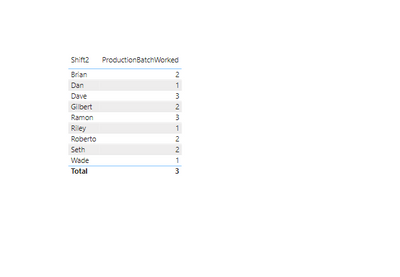
Best Regards!
Yolo Zhu
If this post helps, then please consider Accept it as the solution to help the other members find it more quickly.


- Mark as New
- Bookmark
- Subscribe
- Mute
- Subscribe to RSS Feed
- Permalink
- Report Inappropriate Content
Based on your description, I created data to reproduce your scenario. The pbix file is attached in the end.
my solution in DAX
https://1drv.ms/u/s!AiUZ0Ws7G26Rigc-Q_c7tkx3fX-1?e=vdm3x6
If this post helps, then please consider accepting it as the solution to help other members find it faster, and give a big thumbs up.
- Mark as New
- Bookmark
- Subscribe
- Mute
- Subscribe to RSS Feed
- Permalink
- Report Inappropriate Content
Hi @Ahmedx / @Dhairya thanks so far, as the users are never happy, how to accomplish this new column?
Thanks
| Desire results | ||||||
| ProductionBatch | Product | Shift1 | Shift2 | Name | ProductsWorked | ProductionBatchWorked |
| XX01 | a | Wade | Brian | Wade | 2 | 1 |
| XX01 | b | Dave | Roberto | Dave | 3 | 3 |
| XX01 | c | Seth | Ramon | Seth | 4 | 3 |
| XX01 | d | Brian | Wade | Brian | 3 | 2 |
| XX02 | e | Roberto | Riley | Roberto | 2 | 2 |
| XX02 | f | Ramon | Gilbert | Ramon | 3 | 3 |
| XX02 | g | Jorge | Gilbert | Jorge | 1 | 1 |
| XX02 | h | Dan | Gilbert | 5 | 3 | |
| XX02 | i | Brian | Ramon | Riley | 1 | 1 |
| XX02 | j | Roberto | Dave | Dan | 1 | 1 |
| XX02 | k | Ramon | Brian | |||
| XX03 | l | Ramon | Seth | |||
| XX03 | m | Dave | ||||
| XX03 | n | Gilbert | Ramon | |||
| XX03 | o | Gilbert | Seth | |||
| XX03 | p | Gilbert | Seth |
- Mark as New
- Bookmark
- Subscribe
- Mute
- Subscribe to RSS Feed
- Permalink
- Report Inappropriate Content
Hi @Aucesar
You can refer to the following measure
1.Create a table to diaplay the user
2.Then create a measure
ProductionBatchWorked = var a=SUMMARIZE(ALLSELECTED('Table'),[ProductionBatch],[Shift1])
var b=SUMMARIZE(ALLSELECTED('Table'),[ProductionBatch],[Shift2])
var c=SUMMARIZE(UNION(a,b),'Table'[Shift1],"Distinct",DISTINCTCOUNTNOBLANK('Table'[ProductionBatch]))
return MAXX(FILTER(c,[Shift1] in VALUES('Table 2'[Shift2])),[Distinct])
Output
Best Regards!
Yolo Zhu
If this post helps, then please consider Accept it as the solution to help the other members find it more quickly.
- Mark as New
- Bookmark
- Subscribe
- Mute
- Subscribe to RSS Feed
- Permalink
- Report Inappropriate Content


- Mark as New
- Bookmark
- Subscribe
- Mute
- Subscribe to RSS Feed
- Permalink
- Report Inappropriate Content
Hey @Aucesar
If the provided solution helps you then please give it a kudo and mark my solution as accepted so that other can find it quickly on facing similar issue. Thank You!
- Mark as New
- Bookmark
- Subscribe
- Mute
- Subscribe to RSS Feed
- Permalink
- Report Inappropriate Content
Hey @Aucesar
You have to transform your data first please follow the below steps
Input:
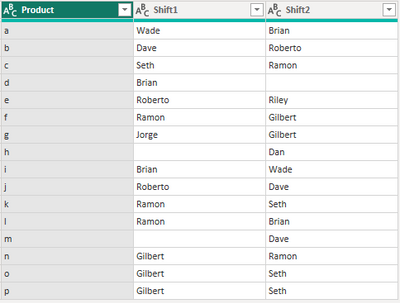
Step1: Open Power Query Editor and unpivot Shift1 and Shift2 columns, and click on close and apply
Output:
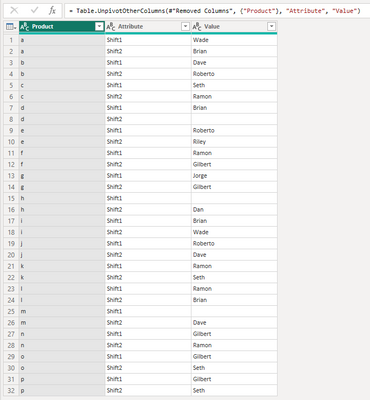
Step2: Now create following measure
S1 =
CALCULATE(
    COUNTX(TableA,TableA[Product]),
    ALLEXCEPT(TableA,TableA[Value])
)
Step3: Plot your expected columns you will get the following output
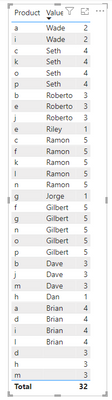
If this helps you then please mark my solution as accepted so that others can find it quickly while facing similar issue. Thank You!

Helpful resources

Power BI Dataviz World Championships
The Power BI Data Visualization World Championships is back! Get ahead of the game and start preparing now!

Power BI Monthly Update - December 2025
Check out the December 2025 Power BI Holiday Recap!

FabCon Atlanta 2026
Join us at FabCon Atlanta, March 16-20, for the ultimate Fabric, Power BI, AI and SQL community-led event. Save $200 with code FABCOMM.

| User | Count |
|---|---|
| 38 | |
| 37 | |
| 34 | |
| 31 | |
| 27 |


| User | Count |
|---|---|
| 136 | |
| 99 | |
| 73 | |
| 66 | |
| 65 |


