Join us at FabCon Atlanta from March 16 - 20, 2026, for the ultimate Fabric, Power BI, AI and SQL community-led event. Save $200 with code FABCOMM.
Register now!The Power BI Data Visualization World Championships is back! It's time to submit your entry. Live now!
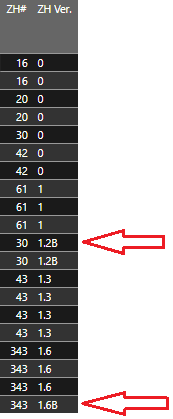
I have 2 columns: ZH# + ZH Versions. ZH# is the item number. ZH Version is the version iteration of the ZH#.
PROBLEM TO SOLVE = How can I get a distinct count of all the ZH# + take into consideration a different ZH Version?
- I currently can successfuly get the distinct count of ZH# but I cannot figure out how to add another filter to my DAX that will take into consideration if there is a different ZH Version used with the same ZH# (please see screenshot below).
Current Output = 7 -> This result is from distinct count of the ZH#
Desired Output = 9 -> This desired output will count all of the distinct ZH# + any other ZH Versions (please see screenshots below...the red arrows will highlight the 2 missing items that should be counted)
Current DAX:
ZH#DistinctCount = DISTINCTCOUNT(ZH[ZH#])
ZHReplacementCount =
I know my current ZHReplacementCount DAX does not take into account the ZH Versions, but I am not sure on how to incorporate it?
Any assistance will be greatly appreciated!
Solved! Go to Solution.
I don't get the logic exactly
ZH#DistinctCount = DISTINCTCOUNT(ZH[ZH#])
returns 7, which is including ZH# 30 which has version 1.3B, which is also the only version for ZH# 30
so it seems to me that output should be 8 not 9, correct?
if you want to count multiple verisons within same ZH# I would probably do something like this
Measure = COUNTROWS ( SUMMARIZE ( ZH, ZH[ZH#], ZH[ZH Ver.] ) )
Hi @Anonymous
You can do that count taking the version into account like this:
NewMeasure = COUNTROWS ( SUMMARIZECOLUMNS ( ZH[ZH#], ZH[ZH Ver.] ) )
If you're going to use this in the SUMX, I guess (you're omitting crucial info on the structure of your tables and existing relationships) you'd need something like this:
ZHReplacementCount_V2 = SUMX ( VALUES ( Programs_Machine[MACHINE_L_NUMBER] ), [NewMeasure] )
Your explanation is quite good but you should include the details of the tables involved and their relationships. Plus please always show your sample data in text-tabular format in addition to (or instead of) the screen captures. That allows people trying to help to readily copy the data and run a quick test (which I haven't been able to do)
Thank you for your support. I will make sure to add additional details about table relationships and show some sample data in text-tablular format in the future.
Apologies for any inconvenience.
I don't get the logic exactly
ZH#DistinctCount = DISTINCTCOUNT(ZH[ZH#])
returns 7, which is including ZH# 30 which has version 1.3B, which is also the only version for ZH# 30
so it seems to me that output should be 8 not 9, correct?
if you want to count multiple verisons within same ZH# I would probably do something like this
Measure = COUNTROWS ( SUMMARIZE ( ZH, ZH[ZH#], ZH[ZH Ver.] ) )
Thank you for your response! Your DAX measure to count multiple versions of ZH# worked! I added your suggestion to my current DAX and it worked:
| User | Count |
|---|---|
| 56 | |
| 40 | |
| 38 | |
| 21 | |
| 21 |
| User | Count |
|---|---|
| 140 | |
| 102 | |
| 64 | |
| 36 | |
| 35 |