Get Fabric or SQL Certified for Free.
Get certified for free when you join Fabric Data Days 2026 and dive into Fabric, Power BI, SQL, AI, and other essential data skills.
Join now- Power BI forums
- Get Help with Power BI
- Desktop
- Service
- Report Server
- Power Query
- Mobile Apps
- Developer
- DAX Commands and Tips
- Custom Visuals Development Discussion
- Health and Life Sciences
- Power BI Spanish forums
- Translated Spanish Desktop
- Training and Consulting
- Instructor Led Training
- Dashboard in a Day for Women, by Women
- Galleries
- Data Stories Gallery
- Themes Gallery
- Contests Gallery
- QuickViz Gallery
- Quick Measures Gallery
- Visual Calculations Gallery
- Notebook Gallery
- Translytical Task Flow Gallery
- TMDL Gallery
- R Script Showcase
- Webinars and Video Gallery
- Ideas
- Custom Visuals Ideas (read-only)
- Issues
- Issues
- Events
- Upcoming Events
July 7 - July 17 | Round 2 of the Power BI Dataviz World Championships. Don't miss your chance! Learn more
- Subscribe to RSS Feed
- Mark Topic as New
- Mark Topic as Read
- Float this Topic for Current User
- Bookmark
- Subscribe
- Printer Friendly Page


- Mark as New
- Bookmark
- Subscribe
- Mute
- Subscribe to RSS Feed
- Permalink
- Report Inappropriate Content
Dax
Measure1 = Calculate(
SUM(movement[pcena]);
FILTER(movement; movement[date] >= NOW()-30 && movement[date] <= NOW()))
Measure2 = Calculate(
SUM(movement[pcena2]);
FILTER(movement; movement[date] >= NOW()-30 && movement[date] <= NOW()))
Measure3=IF([Measure1]<>0,[Measure1]/[Measure2],0).
Can you tell me, where is the mistake in syntax in Measure3.
measure 1 = CALCULATE(SUM(movement[date]); movement[date]>NOW()-30; movement[date] <= NOW()).
Can you tell me ,what the difference bettweenn Measure1 a measure 1 is?
Problem 2
I have two tables with relation in query.
A->B
Table A includes column Office and revenue.
Table B includes column Office and parameter.
I want to create report Office Revenue/parameter . How will I create it in DAX.
I need this solve fast as I can.
Solved! Go to Solution.


- Mark as New
- Bookmark
- Subscribe
- Mute
- Subscribe to RSS Feed
- Permalink
- Report Inappropriate Content
@pstanek This should work for a Calculated Column in Table A
Column = TableA[Pcena] * RELATED ( TableB[Parameter_n] )
- Mark as New
- Bookmark
- Subscribe
- Mute
- Subscribe to RSS Feed
- Permalink
- Report Inappropriate Content
@pstanek Besides that . at the end of Measure3 there's nothing wrong with that formula
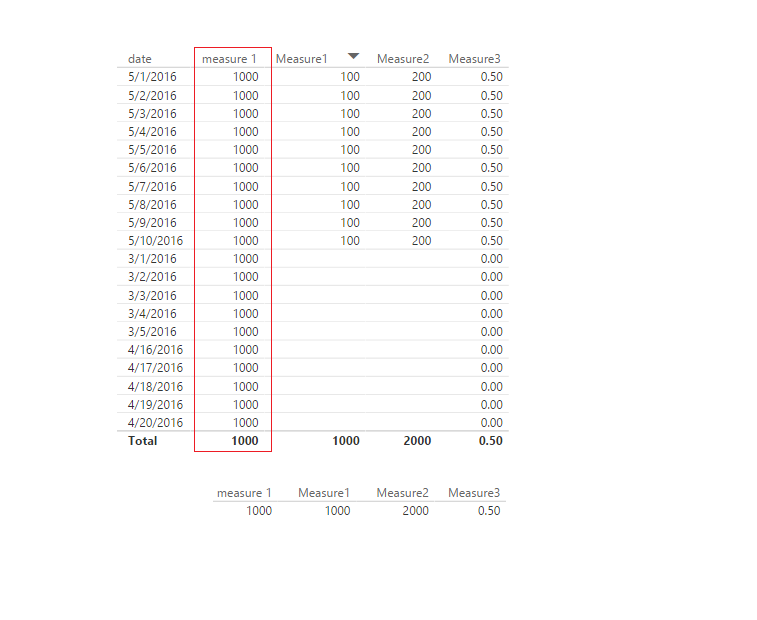
The difference between Measure1 and measure 1 - is the evaluation context - best way to explain/show is with a picture
Measure1 is the way to go even tough you get the same overall result in the bottom Total Row
Go to the Relationship View => select Column Office in either table => drag and point to column Office in the other table
The relationship will be established
Hope this helps. Le me know...
- Mark as New
- Bookmark
- Subscribe
- Mute
- Subscribe to RSS Feed
- Permalink
- Report Inappropriate Content
Can you tell new, which one is faster? Measure1 , or measure1
I have data, where Measure 1 is too slow. Results are not often calculated. I can even tell, I am at BI mercy, If results appear, or not.
- Mark as New
- Bookmark
- Subscribe
- Mute
- Subscribe to RSS Feed
- Permalink
- Report Inappropriate Content
Measure 3 didn´t t work. Sometimes It writes something about function filter, that I can not be used in fuctions If and similar functions
I have already established relationship, but i don´t know How to create column in Table A .
Table a
Office1 goods1 Pcena1
Office1 goods2 Pcena2
Office2 goods1 Pcena3
Table B
Office_n parameter_n
Column should have values
Pcena*VLooklup(office_ n)
It means
Office1 goods1 Pcena1 Pcena1*VLooklup(office_ 1)
Office1 goods2 Pcena2 Pcena2*VLooklup(office_ 1)
Office2 goods1 Pcena3 Pcena3*VLooklup(office_ 2)
Vlookup will find parameterin Table B
- Mark as New
- Bookmark
- Subscribe
- Mute
- Subscribe to RSS Feed
- Permalink
- Report Inappropriate Content
@pstanek This should work for a Calculated Column in Table A
Column = TableA[Pcena] * RELATED ( TableB[Parameter_n] )
- Mark as New
- Bookmark
- Subscribe
- Mute
- Subscribe to RSS Feed
- Permalink
- Report Inappropriate Content
Thanks, I was stepping around.
Do you know some really good Dax library or books for Power Bi. I mean, I would like to see not only codes, but with easy examples.
Tables, what we want to calculate., results
I always find code, tables - not described in detail where I can not say what It means. Result is that, I know function related, but I can not use it effectively.
- Mark as New
- Bookmark
- Subscribe
- Mute
- Subscribe to RSS Feed
- Permalink
- Report Inappropriate Content
These are great DAX sites/resources: (and their authors have also published books)
http://www.sqlbi.com/books/the-definitive-guide-to-dax/companion/
http://www.powerpivotpro.com/the-book/
http://exceleratorbi.com.au/learn-to-write-dax/

Helpful resources

FabCon & SQLCon – Barcelona 2026
Join us in Barcelona for FabCon and SQLCon, the Fabric, Power BI, SQL, and AI community event. Save €200 with code FABCMTY200.

Data Days 2026
Join Data Days 2026: 60 days of free live/on-demand sessions, challenges, study groups, and certification opportunities.

Power BI DataViz World Championships - June 2026
A new Power BI DataViz World Championship is coming this June! Don't miss out on submitting your entry.

| User | Count |
|---|---|
| 27 | |
| 23 | |
| 18 | |
| 18 | |
| 15 |


| User | Count |
|---|---|
| 54 | |
| 44 | |
| 42 | |
| 39 | |
| 36 |


