cancel
Showing results for 
Search instead for 
Did you mean: 

The Power BI Data Visualization World Championships is back! Get ahead of the game and start preparing now! Learn more

Reply
N_R_000
Helper I
Helper I

DAX Calculation: Average Cumulative Spend by 'Days Since'

I have a dataset of [Members] and [Orders] and I need to find the 'Average Spend Per Member', but the bit I'm struggling with is I need that same measure broken down so it can be used in a 'Cumulative Average Spend Since Membership Started'. 


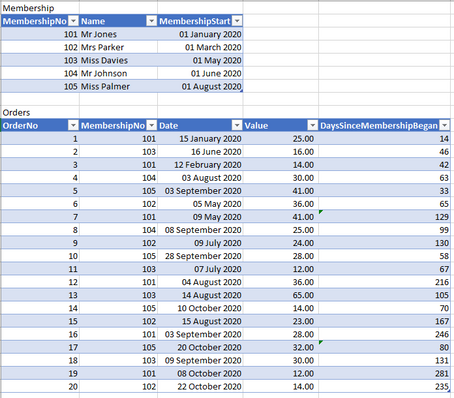
Here's a mock-up of my dataset: 

N_R_000_0-1620136432788.png


The DAX I'm using for the 'Average Spend Per Member' measure is:

AVERAGEX (
SUMMARIZE (
Orders,
Orders[MembershipNo],
"MembershipAverage",
[Total Order Amount]
),
MembershipAverage
)
 
Let's say that shows me the average spend per Membership is £200 (example only). What I'd like to know is; what's the average spend 30 days after membership begins, or 60 days, or 90 days etc. So I'd like a line graph with 'Days Since Membership began' on the X axis, and 'Average Cumulative Spend' on the Y axis, producing a rising trend eventually reaching £200. I just can't get the DAX right to do it, any ideas?  


1 ACCEPTED SOLUTION
v-xiaotang
Community Support
Community Support

Hi @

Because not clear about how your data model and table structure look like, so I create a sample.

You can take steps bellow for reference.

-

1. create a column


DaysSinceMembershipBegan column =
VAR _start =
    RELATED ( Membership[MembershipStart] )
RETURN
    DATEDIFF ( _start, ( Orders[Date] ), DAY )


2. create the measure:

if you want to divide by actual number,
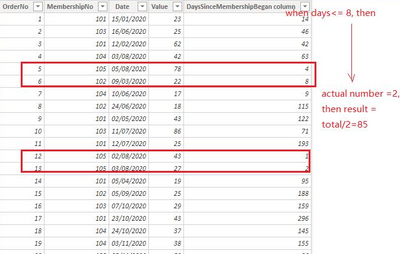
v-xiaotang_3-1620294762974.png

then create the measure:


_average =
VAR filter_table =
    FILTER (
        ALL ( Orders ),
        Orders[DaysSinceMembershipBegan column]
            <= SELECTEDVALUE ( Orders[DaysSinceMembershipBegan column] )
    )
VAR total =
    CALCULATE ( SUM ( Orders[Value] ), filter_table )
VAR membercount =
    CALCULATE ( DISTINCTCOUNT ( Orders[MembershipNo] ), filter_table )
VAR _div =
    DIVIDE ( total, membercount )
RETURN
    _div


Result:
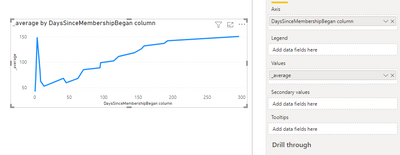
v-xiaotang_1-1620294716237.png


OR

if you want to divide by total number in membership table, create this measure


_average1 =
VAR filter_table =
    FILTER (
        ALL ( Orders ),
        Orders[DaysSinceMembershipBegan column]
            <= SELECTEDVALUE ( Orders[DaysSinceMembershipBegan column] )
    )
VAR total =
    CALCULATE ( SUM ( Orders[Value] ), filter_table )
VAR membercount =
    COUNTROWS ( Membership )
VAR _div =
    DIVIDE ( total, membercount )
RETURN
    _div


result:

v-xiaotang_2-1620294716241.png

 Hope this helps.


Best Regards,

Community Support Team _ Tang

If this post helps, please consider Accept it as the solution to help the other members find it more quickly.

View solution in original post

2 REPLIES 2
v-xiaotang
Community Support
Community Support

Hi @

Because not clear about how your data model and table structure look like, so I create a sample.

You can take steps bellow for reference.

-

1. create a column


DaysSinceMembershipBegan column =
VAR _start =
    RELATED ( Membership[MembershipStart] )
RETURN
    DATEDIFF ( _start, ( Orders[Date] ), DAY )


2. create the measure:

if you want to divide by actual number,

v-xiaotang_3-1620294762974.png

then create the measure:


_average =
VAR filter_table =
    FILTER (
        ALL ( Orders ),
        Orders[DaysSinceMembershipBegan column]
            <= SELECTEDVALUE ( Orders[DaysSinceMembershipBegan column] )
    )
VAR total =
    CALCULATE ( SUM ( Orders[Value] ), filter_table )
VAR membercount =
    CALCULATE ( DISTINCTCOUNT ( Orders[MembershipNo] ), filter_table )
VAR _div =
    DIVIDE ( total, membercount )
RETURN
    _div


Result:

v-xiaotang_1-1620294716237.png


OR

if you want to divide by total number in membership table, create this measure


_average1 =
VAR filter_table =
    FILTER (
        ALL ( Orders ),
        Orders[DaysSinceMembershipBegan column]
            <= SELECTEDVALUE ( Orders[DaysSinceMembershipBegan column] )
    )
VAR total =
    CALCULATE ( SUM ( Orders[Value] ), filter_table )
VAR membercount =
    COUNTROWS ( Membership )
VAR _div =
    DIVIDE ( total, membercount )
RETURN
    _div


result:

v-xiaotang_2-1620294716241.png

 Hope this helps.


Best Regards,

Community Support Team _ Tang

If this post helps, please consider Accept it as the solution to help the other members find it more quickly.
amitchandak
Super User
Super User

@N_R_000 , try a measure like

calculate(
AVERAGEX (
Values (Orders[MembershipNo])
[Total Order Amount]
),filter(allselected(Orders) , Orders[Date] <=max(Orders[Date]))
)

Share with Power BI Enthusiasts: Full Power BI Video (20 Hours) YouTube
Microsoft Fabric Series 60+ Videos YouTube
Microsoft Fabric Hindi End to End YouTube

Helpful resources

Announcements
Power BI DataViz World Championships

Power BI Dataviz World Championships

The Power BI Data Visualization World Championships is back! Get ahead of the game and start preparing now!

December 2025 Power BI Update Carousel

Power BI Monthly Update - December 2025

Check out the December 2025 Power BI Holiday Recap!

FabCon Atlanta 2026 carousel

FabCon Atlanta 2026

Join us at FabCon Atlanta, March 16-20, for the ultimate Fabric, Power BI, AI and SQL community-led event. Save $200 with code FABCOMM.