Join us at FabCon Atlanta from March 16 - 20, 2026, for the ultimate Fabric, Power BI, AI and SQL community-led event. Save $200 with code FABCOMM.
Register now!View all the Fabric Data Days sessions on demand. View schedule
Hi,
I have a requirement to create a summary table based on three other tables.
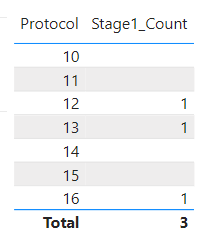
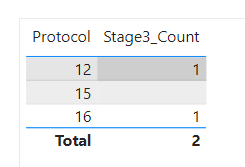
Please find sample data below
Table1:
Table2:
Table3:
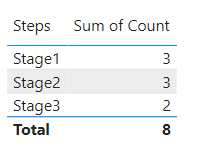
Expected Outut:
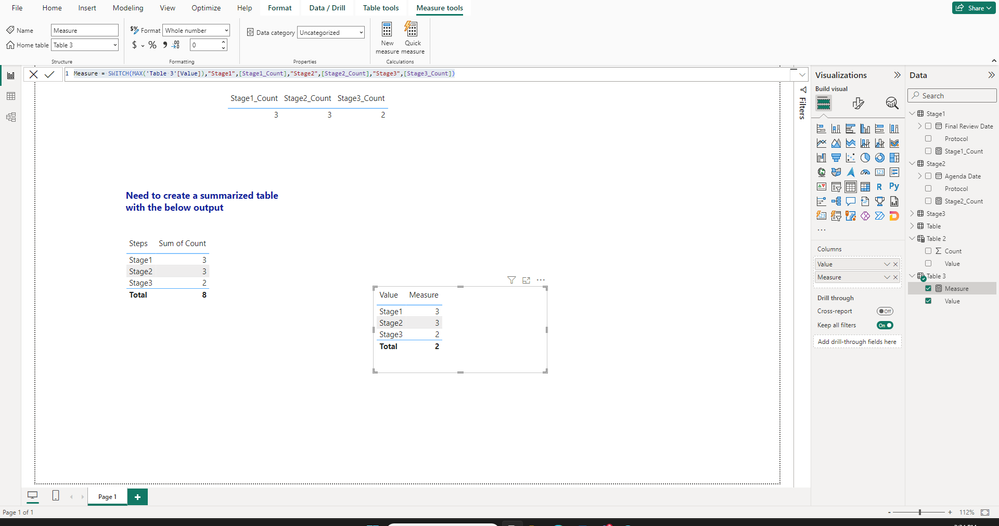
Create a summary table with the counts from each table as below:
I have also attached a sample pbix file here.
Could somone please help with the solution in DAX.
Thank you.
Solved! Go to Solution.
Hi @POSPOS ,
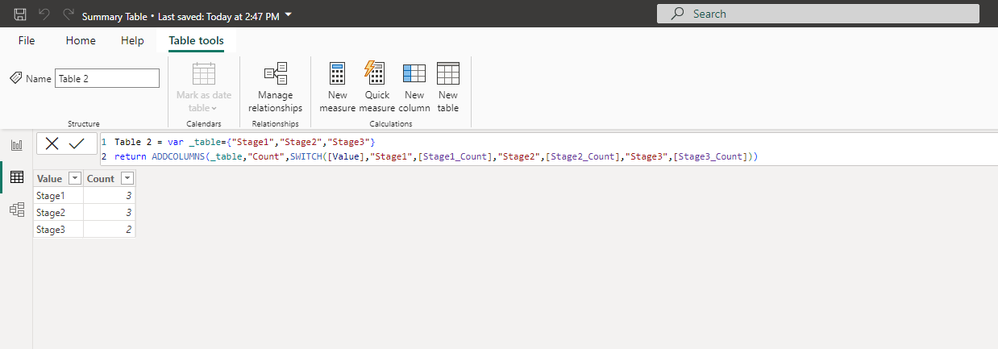
The calculated table is static, here's the formula:
Table 2 = var _table={"Stage1","Stage2","Stage3"}
return ADDCOLUMNS(_table,"Count",SWITCH([Value],"Stage1",[Stage1_Count],"Stage2",[Stage2_Count],"Stage3",[Stage3_Count]))
If you want the dynamic counting result, you should create a table with three stages. And put a measure into the table visual. Because measures are dynamic.
Here're the steps.
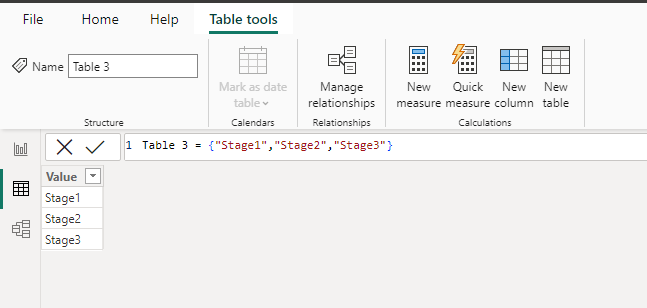
1.Table with three stages. You can also create it by entering data.
2.Create a measure.
Measure = SWITCH(MAX('Table 3'[Value]),"Stage1",[Stage1_Count],"Stage2",[Stage2_Count],"Stage3",[Stage3_Count])
3.Here's the result.
Best Regards,
Stephen Tao
If this post helps, then please consider Accept it as the solution to help the other members find it more quickly.
Hi @POSPOS ,
The calculated table is static, here's the formula:
Table 2 = var _table={"Stage1","Stage2","Stage3"}
return ADDCOLUMNS(_table,"Count",SWITCH([Value],"Stage1",[Stage1_Count],"Stage2",[Stage2_Count],"Stage3",[Stage3_Count]))
If you want the dynamic counting result, you should create a table with three stages. And put a measure into the table visual. Because measures are dynamic.
Here're the steps.
1.Table with three stages. You can also create it by entering data.
2.Create a measure.
Measure = SWITCH(MAX('Table 3'[Value]),"Stage1",[Stage1_Count],"Stage2",[Stage2_Count],"Stage3",[Stage3_Count])
3.Here's the result.
Best Regards,
Stephen Tao
If this post helps, then please consider Accept it as the solution to help the other members find it more quickly.
Hi @POSPOS
I have a solution that may or may not work for your exact use case.
First I create a blank table with two columns, "Steps" and "Sum of Count". No rows. I called this table "Solution Table".
Then I create a DAX Table as below:
Solution =
UNION('Solution Table',
ROW(
"Steps", "Stage1"
,"Sum of Count", Stage1[Stage1_Count]
),
ROW(
"Steps", "Stage2"
,"Sum of Count", Stage2[Stage2_Count]
),
ROW(
"Steps", "Stage3"
,"Sum of Count", Stage3[Stage3_Count]
)
)
And the result of this "Solution" will match the result your expected outcome. However, if you start intrducing filters in your report that affect the 3 original measures in the 3 Stage tables, then the summary table will not update automatically. I am afraid I do not have a solution where the summary table would be affected by slicers or filters dynamically.
I hope this helps!
Proud to be a Super User! | |
@dk_dk - Thank you for the response. But we do have other visuals/slicers in the report and the users would expect the visuals to be interactive.
Eg: Selecting a protocol in the slicer and the "Solution" table should be filtered out to see in which step that protocol is in.
Trying to find out if we have any solution to have the visual interactive.
Check out the November 2025 Power BI update to learn about new features.
Advance your Data & AI career with 50 days of live learning, contests, hands-on challenges, study groups & certifications and more!