cancel
Showing results for 
Search instead for 
Did you mean: 

Did you hear? There's a new SQL AI Developer certification (DP-800). Start preparing now and be one of the first to get certified. Register now

Reply
Anonymous
Not applicable

Count new users based on usage logging

How can I create two column charts based on usage logging that shows the growth of users? I have the username and timestamp (among other metrics).


I want one chart to show the number of users that's never been seen before (new users), and one that shows the accumulated user count (all unique users).


Date, username

2019-01-01, user1

2019-01-01, user1

2019-01-24, user2  -- Two new users in Jan

2019-02-11, user1

2019-02-17, user3

2019-02-11, user2 -- Three unique, but only one new user i Feb

2019-03-05, user4 -- One new user i Mar

and so on...


Chart1, new users per month:
  |
  |   |   |
-----------------

  j   f   m...


Chart2, total unique users:

          |

      |   |

  |   |   |
  |   |   |
-----------------

  j   f   m...


Thanks!

1 ACCEPTED SOLUTION
v-lili6-msft
Community Support
Community Support

hi @Anonymous 

You could try this way as below:

Step1:

Add a YearMonth column for date column

Step2:

Use these two formula to create two measure for your requirement:

new users = CALCULATE(DISTINCTCOUNT('Table'[username]),FILTER('Table','Table'[Date]=CALCULATE(MIN('Table'[Date]),ALLEXCEPT('Table','Table'[username]))))
all unique users = CALCULATE(DISTINCTCOUNT('Table'[username]),FILTER(ALL('Table'),'Table'[Date]<=MAX('Table'[Date])))

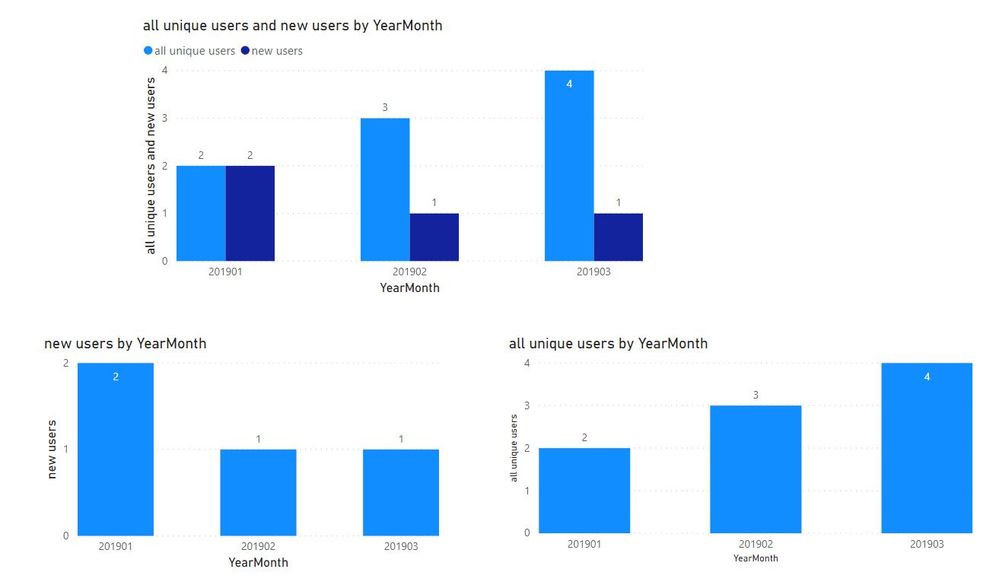
Result:

4.JPG

and here is sample pbix file, please try it.


Regards,

Lin

Community Support Team _ Lin
If this post helps, then please consider Accept it as the solution to help the other members find it more quickly.

View solution in original post

2 REPLIES 2
v-lili6-msft
Community Support
Community Support

hi @Anonymous 

You could try this way as below:

Step1:

Add a YearMonth column for date column

Step2:

Use these two formula to create two measure for your requirement:

new users = CALCULATE(DISTINCTCOUNT('Table'[username]),FILTER('Table','Table'[Date]=CALCULATE(MIN('Table'[Date]),ALLEXCEPT('Table','Table'[username]))))
all unique users = CALCULATE(DISTINCTCOUNT('Table'[username]),FILTER(ALL('Table'),'Table'[Date]<=MAX('Table'[Date])))

Result:

4.JPG

and here is sample pbix file, please try it.


Regards,

Lin

Community Support Team _ Lin
If this post helps, then please consider Accept it as the solution to help the other members find it more quickly.
Anonymous
Not applicable

Thank you so much! Works perfectly.

But your measure formulas needed to be adjusted to use semicolons instead of commas to get it to work. Maybe it's some internationalization setting, but it threw me off for a minute (the attached file helped a lot!).

Helpful resources

Announcements
April Power BI Update Carousel

Power BI Monthly Update - April 2026

Check out the April 2026 Power BI update to learn about new features.

Fabric SQL PBI Data Days

Data Days 2026 coming soon!

Sign up to receive a private message when registration opens and key events begin.

New to Fabric survey Carousel

New to Fabric Survey

If you have recently started exploring Fabric, we'd love to hear how it's going. Your feedback can help with product improvements.

Power BI DataViz World Championships carousel

Power BI DataViz World Championships - June 2026

A new Power BI DataViz World Championship is coming this June! Don't miss out on submitting your entry.