Don't miss your chance to take the Fabric Data Engineer (DP-700) exam on us!
Learn moreWe've captured the moments from FabCon & SQLCon that everyone is talking about, and we are bringing them to the community, live and on-demand. Starts on April 14th. Register now
Hi Experts
Struggling on how i could convert the following measure into a calculated column in my table..
__freq = VAR ComplaintsByFiscalMo = ADDCOLUMNS(VALUES(PMS_FINANCIAL_PDS[Month Start]),"CountComplaints", CALCULATE(COUNTROWS(PMS_COMPLAINT))) VAR __table = GROUPBY(ComplaintsByFiscalMo,[CountComplaints],"__ties",COUNTX(CURRENTGROUP(),[Month Start])) VAR __table1 = ADDCOLUMNS(__table,"__ties1",[__ties] - 1) VAR __table2 = ADDCOLUMNS(__table1,"__freq",IF([__ties1]=0,0,[__ties1]*([__ties1]+1)*(2*[__ties1]+7))) RETURN SUMX(__table2,[__freq])
Solved! Go to Solution.
Hi Route217,
My sample is like below
| Month Start | value |
| 1 | 1 |
| 1 | 2 |
| 1 | 3 |
| 2 | 2 |
| 2 | 1 |
| 3 | 2 |
| 3 | 1 |
| 3 | 1 |
| 5 | 1 |
| 5 | 2 |
| 5 | 2 |
| 6 | 1 |
| 4 | 2 |
| 4 | 1 |
Then you could create calculated column like below
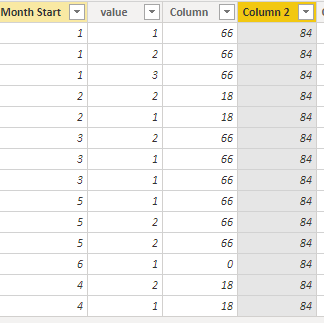
Column = var temp= CALCULATE(COUNT(PMS_COMPLAINT[month start]), ALLEXCEPT(PMS_COMPLAINT,PMS_COMPLAINT[Month Start]))-1 var mul= temp*(temp+1)*(2*temp+7) return mul Column 2 = SUMX(SUMMARIZE(PMS_COMPLAINT,PMS_COMPLAINT[Column],"avg",AVERAGE(PMS_COMPLAINT[Column])),[avg])
then you will get the result like below
Best Regards,
Zoe Zhi
If this post helps, then please consider Accept it as the solution to help the other members find it more quickly.
Hi Route217,
My sample is like below
| Month Start | value |
| 1 | 1 |
| 1 | 2 |
| 1 | 3 |
| 2 | 2 |
| 2 | 1 |
| 3 | 2 |
| 3 | 1 |
| 3 | 1 |
| 5 | 1 |
| 5 | 2 |
| 5 | 2 |
| 6 | 1 |
| 4 | 2 |
| 4 | 1 |
Then you could create calculated column like below
Column = var temp= CALCULATE(COUNT(PMS_COMPLAINT[month start]), ALLEXCEPT(PMS_COMPLAINT,PMS_COMPLAINT[Month Start]))-1 var mul= temp*(temp+1)*(2*temp+7) return mul Column 2 = SUMX(SUMMARIZE(PMS_COMPLAINT,PMS_COMPLAINT[Column],"avg",AVERAGE(PMS_COMPLAINT[Column])),[avg])
then you will get the result like below
Best Regards,
Zoe Zhi
If this post helps, then please consider Accept it as the solution to help the other members find it more quickly.
If you have recently started exploring Fabric, we'd love to hear how it's going. Your feedback can help with product improvements.
A new Power BI DataViz World Championship is coming this June! Don't miss out on submitting your entry.
Share feedback directly with Fabric product managers, participate in targeted research studies and influence the Fabric roadmap.
| User | Count |
|---|---|
| 56 | |
| 40 | |
| 35 | |
| 19 | |
| 18 |
| User | Count |
|---|---|
| 70 | |
| 69 | |
| 38 | |
| 35 | |
| 23 |