Join us at FabCon Atlanta from March 16 - 20, 2026, for the ultimate Fabric, Power BI, AI and SQL community-led event. Save $200 with code FABCOMM.
Register now!The Power BI Data Visualization World Championships is back! It's time to submit your entry. Live now!
Hi everyone,
I am looking for a solution to dynamically reference to columns in another table based on values in a column of the current table. Similar as it done with '@Columnname' in Excel.
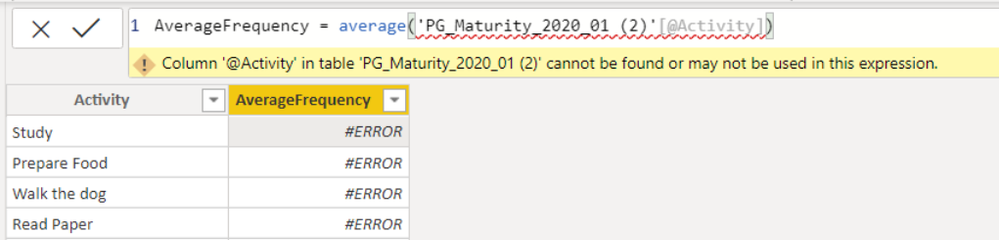
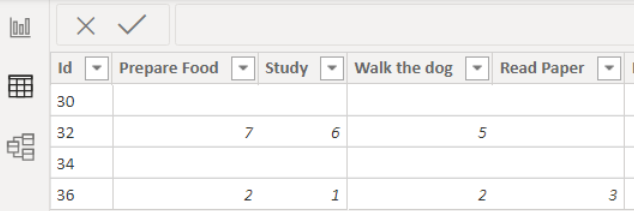
A seen in the screenshots, I would like to replace the '@Activity' with an expression that references the columns in Table 2 based on the cell value of the column Activity in Table 1 so that the respective averages are calculated.
Thanks in advance!
Jonas
New table that should hold averages calculated from table PG_Maturity_2020_01 (2)
Table: PG_Maturity_2020_01 (2)
Solved! Go to Solution.
@Anonymous you have to create a dynamic measure
My Measure =
SWITCH ( SELECTEDVALUE ( Table[Activity] ),
"Value1", AVERAGE ( Table2[Column1] ),
"Vale2", AVERGE ( Table2[Column2] ),
"Vale3", AVERGE ( Table2[Column3] )
)
replace table and column name as per your model.
I would ❤ Kudos if my solution helped. 👉 If you can spend time posting the question, you can also make efforts to give Kudos whoever helped to solve your problem. It is a token of appreciation!
Subscribe to the @PowerBIHowTo YT channel for an upcoming video on List and Record functions in Power Query!!
Learn Power BI and Fabric - subscribe to our YT channel - Click here: @PowerBIHowTo
If my solution proved useful, I'd be delighted to receive Kudos. When you put effort into asking a question, it's equally thoughtful to acknowledge and give Kudos to the individual who helped you solve the problem. It's a small gesture that shows appreciation and encouragement! ❤
Did I answer your question? Mark my post as a solution. Proud to be a Super User! Appreciate your Kudos 🙂
Feel free to email me with any of your BI needs.
Hi @Anonymous
go to the Power Query editor, pick ID column in PG_Maturity_2020_01 table, right-click, Unpivot Other Columns
then in report mode create relationships by [Activity] and PG_Maturity_2020_01[Attribute] values
then create a measure
AverageFrequency = AVERAGE('PG_Maturity_2020_01 (2)'[Value])
@Anonymous you have to create a dynamic measure
My Measure =
SWITCH ( SELECTEDVALUE ( Table[Activity] ),
"Value1", AVERAGE ( Table2[Column1] ),
"Vale2", AVERGE ( Table2[Column2] ),
"Vale3", AVERGE ( Table2[Column3] )
)
replace table and column name as per your model.
I would ❤ Kudos if my solution helped. 👉 If you can spend time posting the question, you can also make efforts to give Kudos whoever helped to solve your problem. It is a token of appreciation!
Subscribe to the @PowerBIHowTo YT channel for an upcoming video on List and Record functions in Power Query!!
Learn Power BI and Fabric - subscribe to our YT channel - Click here: @PowerBIHowTo
If my solution proved useful, I'd be delighted to receive Kudos. When you put effort into asking a question, it's equally thoughtful to acknowledge and give Kudos to the individual who helped you solve the problem. It's a small gesture that shows appreciation and encouragement! ❤
Did I answer your question? Mark my post as a solution. Proud to be a Super User! Appreciate your Kudos 🙂
Feel free to email me with any of your BI needs.
The Power BI Data Visualization World Championships is back! It's time to submit your entry.
Check out the January 2026 Power BI update to learn about new features.
| User | Count |
|---|---|
| 61 | |
| 48 | |
| 35 | |
| 25 | |
| 23 |
| User | Count |
|---|---|
| 134 | |
| 110 | |
| 59 | |
| 39 | |
| 32 |