Share feedback directly with Fabric product managers, participate in targeted research studies and influence the Fabric roadmap.
Sign up nowGet Fabric certified for FREE! Don't miss your chance! Learn more
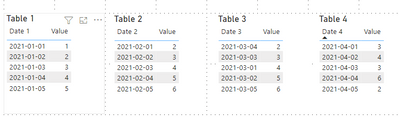
I have 7 tables , each tables has various rows and columns. One column is Dates ( in each table ).
I want to create a calendar using DAX that picks up the MAX from these tables columns.
The min value is picked up from another table.
any suggestion ?
Solved! Go to Solution.
Hi @Anonymous
Please correct me if I wrongly understood your issue .
You need to return the Max date from these multiple tables and then return the MIX date from these multiple tables .Then use the two dates to create a new Calendar date table .
Create a table with the following formula .
Calendar Date =
var _MIN=MINX({MIN('Table 1'[Date 1]),MIN('Table 2'[Date 2]),MIN('Table 3'[Date 3]),MIN('Table 4'[Date 4])},[Value])
var _MAX=MAXX({MAX('Table 1'[Date 1]),MAX('Table 2'[Date 2]),MAX('Table 3'[Date 3]),MAX('Table 4'[Date 4])},[Value])
return CALENDAR(_MIN,_MAX)
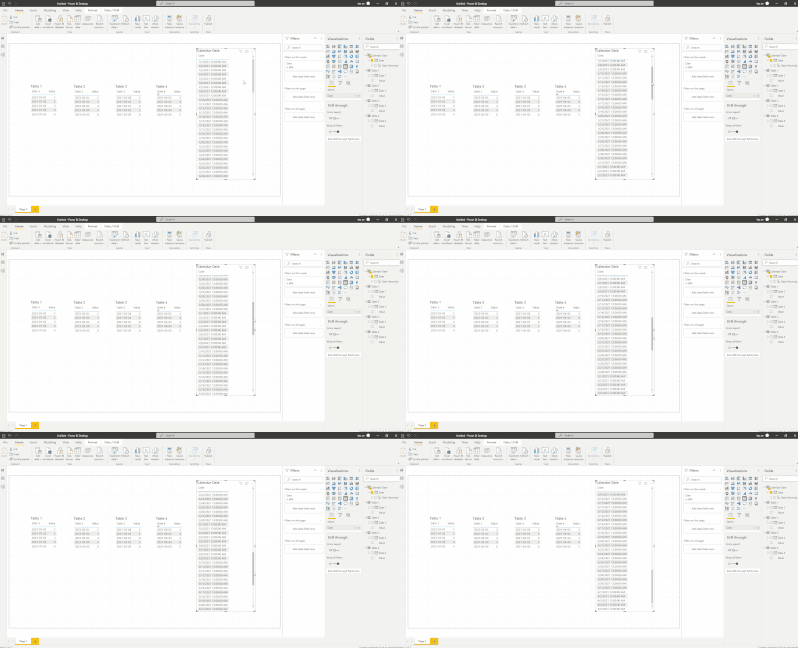
And the final result is as shown(Max date is 2021-04-05 and Min date is 2021-01-01) :
[value] is used to return some values in the previous {}, Take the above formula as an example: {MIN('Table 1'[Date 1]),MIN('Table 2'[Date 2]),MIN('Table 3'[Date 3]),MIN('Table 4'[Date 4])},[Value] , here [value] is used to return the min date in the four tables, and the final result is 2021-01-01,2021-02-01,2021-03-01,2021-04-01 . Is this explanation clear ?
I have attached my pbix file ,you can refer to it .
Best Regards
Community Support Team _ Ailsa Tao
If this post helps, then please consider Accept it as the solution to help the other members find it more quickly.
Hi @Anonymous
Please correct me if I wrongly understood your issue .
You need to return the Max date from these multiple tables and then return the MIX date from these multiple tables .Then use the two dates to create a new Calendar date table .
Create a table with the following formula .
Calendar Date =
var _MIN=MINX({MIN('Table 1'[Date 1]),MIN('Table 2'[Date 2]),MIN('Table 3'[Date 3]),MIN('Table 4'[Date 4])},[Value])
var _MAX=MAXX({MAX('Table 1'[Date 1]),MAX('Table 2'[Date 2]),MAX('Table 3'[Date 3]),MAX('Table 4'[Date 4])},[Value])
return CALENDAR(_MIN,_MAX)
And the final result is as shown(Max date is 2021-04-05 and Min date is 2021-01-01) :
[value] is used to return some values in the previous {}, Take the above formula as an example: {MIN('Table 1'[Date 1]),MIN('Table 2'[Date 2]),MIN('Table 3'[Date 3]),MIN('Table 4'[Date 4])},[Value] , here [value] is used to return the min date in the four tables, and the final result is 2021-01-01,2021-02-01,2021-03-01,2021-04-01 . Is this explanation clear ?
I have attached my pbix file ,you can refer to it .
Best Regards
Community Support Team _ Ailsa Tao
If this post helps, then please consider Accept it as the solution to help the other members find it more quickly.
what does [value] refer to ?
You can try an expression like this to do that.
Calendar =
VAR vMinDate =
MIN ( Table1[Date1] )
VAR vMaxDate =
MAXX (
{ MAX ( Table2[Date2] ), MAX ( Table3[Date3] ), MAX ( Table4[Date4] ) },
//add more as needed
[Value]
)
RETURN
CALENDAR ( vMinDate, vMaxDate )
Pat
To learn more about Power BI, follow me on Twitter or subscribe on YouTube.
If you love stickers, then you will definitely want to check out our Community Sticker Challenge!
Check out the January 2026 Power BI update to learn about new features.
| User | Count |
|---|---|
| 64 | |
| 63 | |
| 49 | |
| 21 | |
| 18 |
| User | Count |
|---|---|
| 121 | |
| 118 | |
| 38 | |
| 36 | |
| 29 |